What Number to Words does, and when you need it
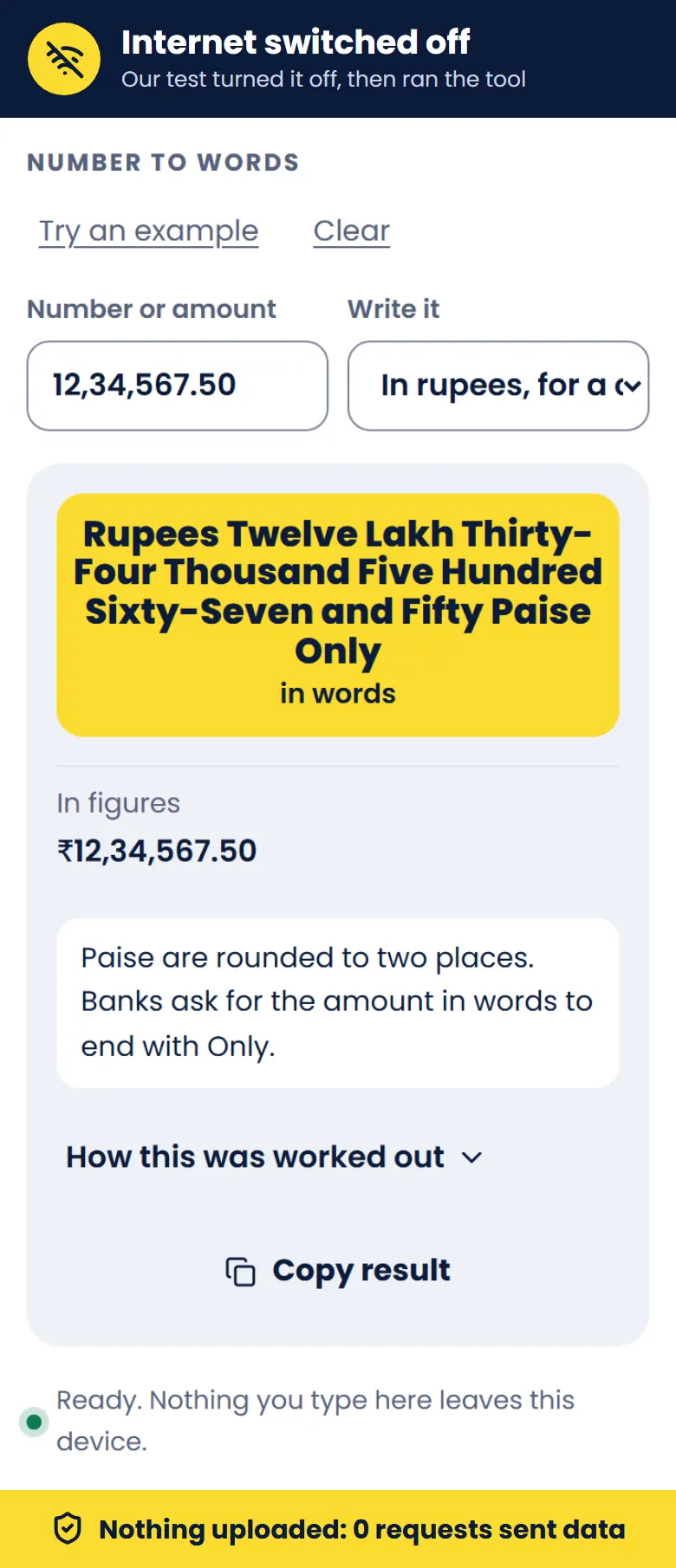
Type a number or an amount and this page writes it in words, three ways: in rupees for a cheque, such as “Rupees Twelve Lakh Thirty-Four Thousand Five Hundred Sixty-Seven and Fifty Paise Only” for ₹12,34,567.50; in the Indian system of lakh and crore; or in the international system of million and billion. It also writes the figures back with the commas in the right places, so you can copy both.
It all happens in your browser: nothing you type is uploaded or kept, which matters when the number is a salary, a cheque or an account balance.
When it helps:
- Writing a cheque, a demand draft or a deposit slip, where the amount must be in words as well as figures.
- Invoices, receipts and agreements that state the amount in words.
- Reading a long number, such as 1,50,00,000, with confidence: one crore fifty lakh.
- Turning crore into million, or the other way, for a report or a news story.
- Homework, where children learn to read and write large numbers both ways.
Step by step
- Type the number or amount, such as 12,34,567.50. Commas the Indian or the international way are read, and so are Hindi, Bengali and other scripts' digits.
- Choose how to write it: in rupees, for a cheque; Indian, with lakh and crore; or international, with million and billion.
- Read the words in large type, with the figures under them, written the same way.
- Use Copy result to copy the words, ready to paste into an invoice, a letter or a form.
Try an example fills in 12,34,567.50 in rupees, and Clear empties the box.
What the page does, exactly
These are the page's rules in full, and the same rules are checked by our tests.
| Part | The rule | Example |
|---|---|---|
| What you can type | Digits, also those of Hindi and other scripts, a dot for decimals, and commas the Indian or the international way | 12,34,567.50 and 1234567.50 are the same |
| How large | From 0 to 99,99,99,99,99,999, which is 99,999,999,999,999 the international way: 14 digits before the point | A larger number gets a message under its box |
| In rupees | Rounded to the paisa, half a paisa up; the rupees in the Indian system, then “and” with the paise, then “Only” | ₹1,234.56 is Rupees One Thousand Two Hundred Thirty-Four and Fifty-Six Paise Only |
| Indian | The last three digits as hundreds, then two at a time as thousand, lakh and crore, with crore repeated above it | 1,11,111 is One Lakh Eleven Thousand One Hundred Eleven |
| International | Three digits at a time: thousand, million, billion, trillion | 5,00,000 is Five Hundred Thousand |
| Decimals | In the Indian and international ways, the digits after the point are read one by one after “Point” | 45.05 is Forty-Five Point Zero Five |
| The words | Each word with a capital letter, a hyphen between tens and ones, and no “and” inside the number | Twenty-One, Five Hundred Sixty-Seven |
| In figures | From the digits you typed, never through the computer's binary numbers, so all 14 digits stay right | 99,99,99,99,99,999 stays 99,99,99,99,99,999 |
Real results from our tests
We tested the Number to Words page with headless Chromium 148, the open-source browser Chrome is built on, on a Windows laptop with an Intel Core i7-1185G7 and 32 GB of memory, on 1 November 2026. Other work was running on the laptop at the same time, so times vary a little from run to run: each time below is the middle one of 3 runs.
Checked against a second program. Our own Python program, written from the rules of the two number systems and with none of the page's code, wrote 25,000 random numbers from 0 to 99,99,99,99,99,999, with and without decimals, in rupees for a cheque, in lakh and crore and in millions, and the page gave the same 50,000 values every time: the words and the figures of each. The boxes were typed as people type them, with Indian and international commas, and in Hindi, Bengali and Gujarati digits.
The answer is drawn at once. The page drew the answer to a typed number in 0.06 milliseconds (the middle of 3 runs of 200 numbers typed in a row), not counting the moment the browser takes to paint the screen.
Size and offline. On a first visit the page downloads about 0.1 MB for the tool: the page, its styles, its scripts and the fonts, with Google's ad code not counted. In our test we switched the network off after the page had loaded and pressed Try an example: the words showed 0.1 seconds later or less in each of 15 runs.
Phone-sized screen. We also ran the tests on a phone-sized screen in Chromium (390 × 844 pixels, with touch). That is not a real phone. Every button and box was 44 pixels high or more, and the page did not scroll sideways.
Try it yourself: press "Try an example" at the top of this page. It puts 12,34,567.50 in the box, in rupees, and the words are Rupees Twelve Lakh Thirty-Four Thousand Five Hundred Sixty-Seven and Fifty Paise Only. Then choose the international way: One Million Two Hundred Thirty-Four Thousand Five Hundred Sixty-Seven Point Five Zero.

The Indian system: lakh and crore
In India, numbers above a thousand are grouped in twos after the first three digits from the right. One lakh is 1,00,000, a hundred thousand, and one crore is 1,00,00,000, a hundred lakh or ten million. The commas show the names: in 12,34,567, the 12 is lakh, the 34 is thousand and the 567 is the hundreds.
- 1,000: One Thousand.
- 1,00,000: One Lakh.
- 1,01,000: One Lakh One Thousand.
- 1,00,00,000: One Crore.
- 1,50,00,000: One Crore Fifty Lakh.
The words follow the commas, so a well-placed comma makes a long number easy to say: read each group with its name, and leave out the groups that are zero. In speech, people often round: 1,50,00,000 is “one and a half crore”, and 2,50,000 “two and a half lakh”, but on paper the full words are clearer.
The international system: million and billion
The international system groups digits in threes: thousand, million, billion and trillion. 10,000,000 is Ten Million; 5,00,000 in the Indian way is 500,000, Five Hundred Thousand. Companies' annual reports, foreign invoices and many news reports use this system, so the same number often needs both forms.
Billion here means a thousand million, 1,000,000,000, as it does in English everywhere today.
Between the two systems
| Indian | International | Digits |
|---|---|---|
| 1 lakh | 100 thousand | 1,00,000 = 100,000 |
| 10 lakh | 1 million | 10,00,000 = 1,000,000 |
| 1 crore | 10 million | 1,00,00,000 = 10,000,000 |
| 100 crore | 1 billion | 1,00,00,00,000 = 1,000,000,000 |
| 1 lakh crore | 1 trillion | 10,00,00,00,00,000 = 1,000,000,000,000 |
A quick check: a million is ten lakh, so ₹5 million is ₹50 lakh, and a billion is a hundred crore. Type the number once and switch between Indian and international to see both.
Writing a cheque
Words are there because they are much harder to change than figures: one stroke turns a 1 into a 7, and a zero can be slipped in after a number, while Twenty-Five Thousand can't become Seventy-Five Thousand without the change showing.
A cheque has the amount twice: in figures in the box, and in words on the line. Write both so that nothing can be added before or after them:
- Start right after “Rupees” on the line, with no gap, so a word can't be squeezed in front.
- Write the words as this page gives them, such as Twenty-Five Thousand, and end with “Only”.
- Draw a line through the space left on the line after “Only”.
- In the box, write the figures close to the ₹ sign, such as 25,000/- or 25,000.00, so no digit can be added.
- Check that the two match. Section 18 of the Negotiable Instruments Act, 1881, covers an amount stated differently in figures and in words, and the amount in words is the one that counts; banks often return such a cheque all the same.
For paise, the words read “Rupees One Thousand Two Hundred Thirty-Four and Fifty-Six Paise Only”. Many people leave paise off cheques and pay in whole rupees, which keeps both lines short. How to write an amount in words on a cheque goes through every step, with the mistakes that get cheques returned.
Paise and rounding
In rupees, the amount is rounded to the paisa first, half a paisa up, since money has no smaller coin: 999.999 becomes ₹1,000.00, written Rupees One Thousand Only. A single digit after the point means tens of paise: 0.5 is fifty paise, not five. So ₹0.75 is Rupees Zero and Seventy-Five Paise Only, and ₹21 is Rupees Twenty-One Only, with no paise at all.
The figures under the words show the same rounded amount, with two decimal places, ₹1,000.00, so you can see exactly what the words say.
Decimals
In the Indian and international ways, the number isn't money, so the digits after the point are read one at a time, as people say them: 45.05 is Forty-Five Point Zero Five, and 3.14159 is Three Point One Four One Five Nine. The page keeps every digit you typed after the point, including a zero at the end, and doesn't round them.
For an amount of money, choose “In rupees” instead, so the paise are read as a number of paise.
Very large numbers
Above a hundred crore, the Indian system has no common new name in daily use, so crore is repeated: 1,00,000 crore is “One Lakh Crore”, the way government budgets are reported. The largest number the page takes, 99,99,99,99,99,999, is Nine Lakh Ninety-Nine Thousand Nine Hundred Ninety-Nine Crore Ninety-Nine Lakh Ninety-Nine Thousand Nine Hundred Ninety-Nine; the international way, the same number is Ninety-Nine Trillion Nine Hundred Ninety-Nine Billion and so on.
Older words such as arab and kharab for a hundred crore and a hundred arab exist, but they are rarely used today, so the page sticks to lakh and crore.
Worked examples
- ₹25,000: Rupees Twenty-Five Thousand Only.
- ₹1,00,000: Rupees One Lakh Only.
- ₹1,01,000: Rupees One Lakh One Thousand Only.
- ₹1,50,00,000: Rupees One Crore Fifty Lakh Only.
- ₹1,234.56: Rupees One Thousand Two Hundred Thirty-Four and Fifty-Six Paise Only.
- 1,11,111, the Indian way: One Lakh Eleven Thousand One Hundred Eleven.
- 10,000,000, the international way: Ten Million, which is one crore.
Style: and, hyphens and capitals
There are small differences in how people write numbers in words, and all of these are understood:
- “And”: British English often says “five hundred and sixty-seven”; the page writes “Five Hundred Sixty-Seven”, as is usual on Indian cheques, and keeps “and” for the paise.
- Hyphens: the page writes Twenty-One with a hyphen, the standard English spelling; Twenty One without one is also common on cheques.
- Capitals: every word starts with a capital letter, which makes each word stand out on a cheque. Change them to small letters after copying if a document needs that.
Common mistakes
- Skipping a group: 1,01,000 is One Lakh One Thousand, not “One Lakh Thousand”; 1,00,500 is One Lakh Five Hundred.
- Mixing the systems: “Ten Lakh Million” means nothing. Use lakh and crore together, or million and billion together.
- Plurals: after a number, formal writing says Five Lakh and Two Crore, not Lakhs and Crores, though the plural is common in speech.
- Spelling: forty has no u, ninety keeps its e, and eighteen has one t.
- Forgetting “Only” on a cheque, which leaves room for more words after the amount.
- One decimal place as paise: ₹45.5 is forty-five rupees and fifty paise, not five paise.
The place-value chart
School books in India teach the Indian place-value chart, from the right: ones, tens, hundreds, thousands, ten thousands, lakhs, ten lakhs, crores and ten crores. Each place is ten times the one before it, and the commas fall after the hundreds and then after every two places. In 4,56,78,912, the 4 is in the crores place, the 56 in the lakhs, the 78 in the thousands and the 912 in the hundreds, so it reads Four Crore Fifty-Six Lakh Seventy-Eight Thousand Nine Hundred Twelve. Type any number here to check a homework answer, and switch to the international way to see the same number in millions.
Deposit slips and demand drafts
Bank deposit slips, withdrawal forms and demand draft forms also ask for the amount in words. The same rules as a cheque apply: start right after the printed word, end with Only, and make sure the figures say the same. When you fill in a form for someone else, read the words back to them, since a missed group, such as a lakh, is easy to overlook in a long line.
To check an amount in words that someone else wrote, type the figures here and compare the two lines word by word.
Other uses
Amounts in words appear on rent agreements, salary letters, receipts and bills, where they make the number harder to change. For a bill or an invoice that needs GST, work the GST out first with the GST Calculator, then write the total in words here. To check what an amount in a document comes to after a discount, the Discount Calculator works it out. If you have only the total, our post on how to remove GST from a total amount shows how to find the GST inside it. To write a number as Roman numerals instead, such as a year as MMXXVI, use Roman Numeral Converter.
Private: your numbers stay on your device
The amounts you type never leave your device. The page runs inside your browser and has no upload step: it never sends the numbers you type anywhere, and it doesn't save them, so closing the page forgets them. The page's Content Security Policy lets it contact only this site and Google's ad service, which pays for the site; our code never gives your numbers to the ad code. You can check it yourself in your browser's network panel (F12 on a computer): writing a number in words adds no request that carries it.
Read our privacy policy and how we prove your files are never uploaded.
Tips
- Check the commas in the figures: they show at a glance whether the amount is lakh or crore.
- Copy, don't retype, the words into a document, so no word is missed.
- Always end a cheque with “Only” and a line through the space after it.
- For money, use “In rupees”, so paise are written as paise.
- Use the international way for readers abroad: a client overseas reads 1,500,000 as one and a half million, and may not know that it is fifteen lakh.
Limits
- Up to 14 digits before the point, 99,99,99,99,99,999.
- English only: the words are in English, not in Hindi or other languages.
- No negative numbers and no fractions such as one third; type them as decimals.
- Rupees only in the cheque style: no dollars or other currencies.
- Browsers. We tested only in Chromium, the engine behind Chrome and Edge, with computer and phone-sized screens. We did not test on real phones, in Safari or in Firefox, so we cannot promise how they behave.
Terms explained
- Lakh
- A hundred thousand: 1,00,000.
- Crore
- A hundred lakh, or ten million: 1,00,00,000.
- Million
- A thousand thousand, or ten lakh: 1,000,000.
- Billion
- A thousand million, or a hundred crore.
- Paisa
- A hundredth of a rupee; the plural is paise.
- Amount in words
- The amount written out on a cheque or a document, beside the figures.