What the flat to reducing rate calculator does, and when you need it
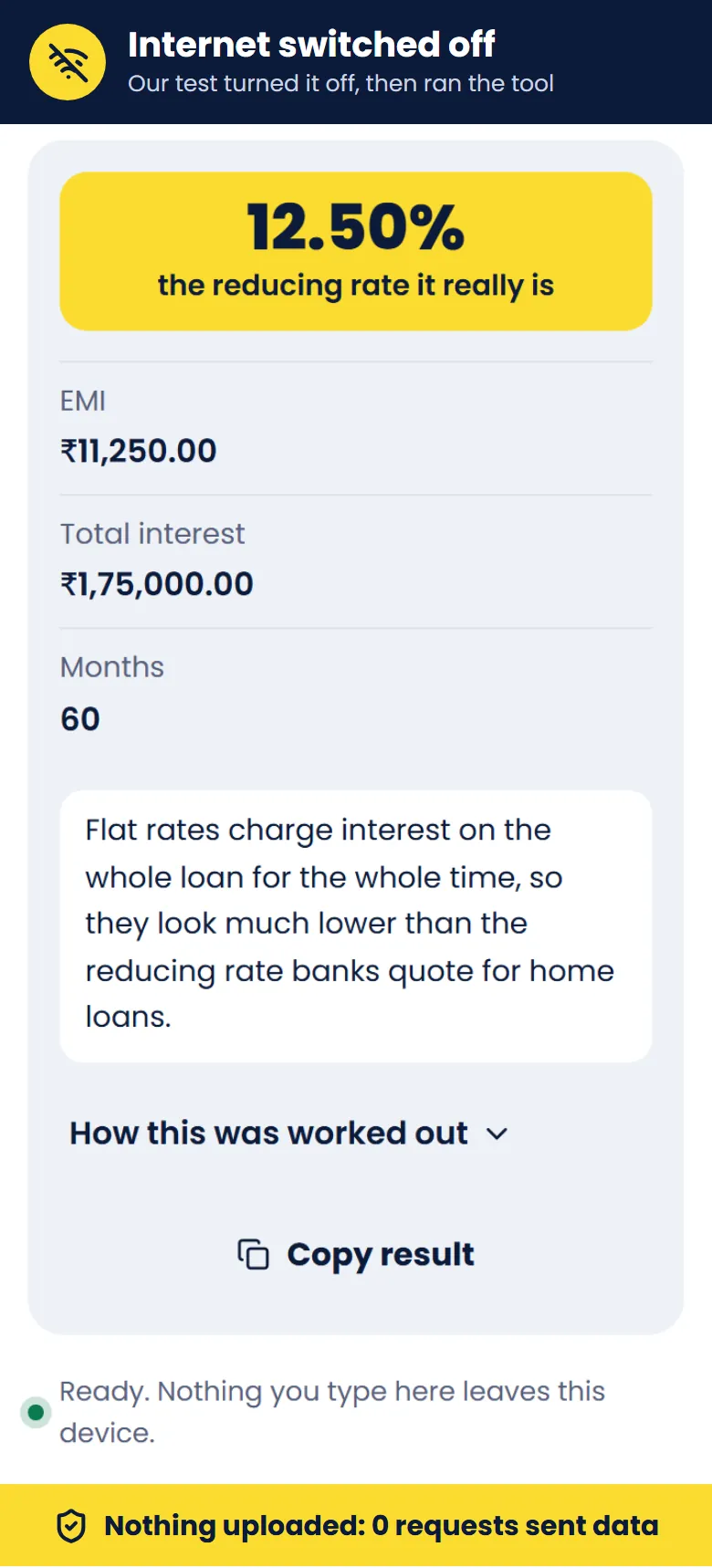
Some loans are quoted at a flat rate, which sounds low. This calculator shows the reducing-balance rate it really is, the rate that home loans and most bank loans are quoted at, so the two can be compared fairly. A loan of ₹5,00,000 at 7% flat for 5 years has an EMI of ₹11,250.00 and ₹1,75,000.00 of interest, and that is the same as a reducing rate of 12.50% a year.
Type the loan, the flat rate and the tenure, and it shows the reducing rate, the EMI, the total interest and the months, with the working. It all happens in your browser: nothing you type is uploaded or kept. To see how that EMI is worked out, read our post on how an EMI is calculated.
When it helps:
- A two-wheeler, car or consumer loan offered at a flat rate.
- Comparing a flat-rate offer with a bank's reducing-rate loan.
- Checking a dealer's or an agent's claim of a “low” rate.
- Commerce and finance studies, where flat and reducing rates are taught side by side.
Step by step
- Type the loan amount in rupees, such as 5,00,000. Commas the Indian or the international way and Hindi digits are read.
- Type the flat rate as a yearly percentage, such as 7.
- Type the tenure in years, such as 5; part of a year works too.
- Read the answer: the reducing rate in large type, then the EMI, the total interest and the months.
- Open “How this was worked out” to see the flat interest, the EMI and the rate, and use Copy result for a one-line summary.
Try an example fills in ₹5,00,000 at 7% flat for 5 years, and Clear empties the boxes.
What the page does, exactly
These are the calculator's rules in full, and the same rules are checked by our tests.
| Part | The rule | Example |
|---|---|---|
| What you can type | Digits, also those of Hindi and other scripts, a dot for decimals, and commas the Indian or the international way | 5,00,000 and 500000 are the same |
| The boxes' limits | A loan from ₹1, a flat rate from 0.01% to 50% a year, a tenure from 0.1 to 30 years | A rate of 60 gets a message under its box |
| Months | The tenure in years times 12, rounded to a whole month | 5 years is 60 months |
| Flat interest | Loan × flat rate × years ÷ 100, on the whole loan for the whole tenure | 5,00,000 × 7% × 5 = ₹1,75,000 |
| The EMI | (Loan + flat interest) ÷ months | ₹6,75,000 ÷ 60 = ₹11,250 |
| The reducing rate | The yearly rate whose EMI on the falling balance, by the usual EMI formula, is the same EMI, to the nearest hundredth of a percent | 12.50%, more exactly 12.5041% |
| Rounding | Every sum is worked out exactly, in whole numbers and fractions; the rate is found by comparing exact EMIs either side of each hundredth, so it is rounded correctly even when it lies very close to a half | ₹1,00,000 at 10% flat for 1 year is 17.97% |
What the rules don't decide: fees, insurance and other charges, which make a loan dearer than its rate; see the APR below.
Real results from our tests
We tested the Flat to Reducing Rate Calculator with headless Chromium 148, the open-source browser Chrome is built on, on a Windows laptop with an Intel Core i7-1185G7 and 32 GB of memory, on 1 November 2026. Other work was running on the laptop at the same time, so times vary a little from run to run: each time below is the middle one of 3 runs.
Checked against a second program. Python's decimal numbers, with 120 digits and none of the page's code, worked out 25,000 random loans of ₹1 to ₹5 crore, at flat rates from 0.01% to 50% and for 0.1 to 30 years, and the page's code gave the same 75,000 values every time: the reducing rate to two decimal places, and the EMI and the total interest to the paisa, of each. The boxes were typed as people type them, with Indian and international commas, in Hindi, Bengali and Gujarati digits, and with a % sign after the rate. 1,523 of the amounts sat exactly on half a paisa, and every one was rounded up, as it should be.
The answer is drawn at once. The page drew the answer to a typed amount in 0.11 milliseconds (the middle of 3 runs of 200 amounts typed in a row), not counting the moment the browser takes to paint the screen. Even a 30-year loan typed to 40 digits, the longest sum the page does, was drawn in 1.0 milliseconds.
Size and offline. On a first visit the page downloads about 0.1 MB for the tool: the page, its styles, its scripts and the fonts, with Google's ad code not counted. In our test we switched the network off after the page had loaded and pressed Try an example: the reducing rate showed 0.1 seconds later or less in each of 15 runs.
Phone-sized screen. We also ran the tests on a phone-sized screen in Chromium (390 × 844 pixels, with touch). That is not a real phone. Every button and box was 44 pixels high or more, and the page did not scroll sideways.
Try it yourself: press "Try an example" at the top of this page. It puts 5,00,000, 7 and 5 in the boxes and the reducing rate is 12.50%, with an EMI of ₹11,250.00. Then change the tenure to 2: it is 12.91%.

Flat and reducing rates, explained
With a flat rate, interest is worked out once, on the whole loan for the whole tenure, and spread evenly over the EMIs. It doesn't matter that you repay part of the loan every month: you pay interest on the full amount until the end.
With a reducing rate, also called the reducing-balance or diminishing-balance rate, interest is charged each month only on what you still owe. As the balance falls, so does the interest, and more of each EMI goes to the loan itself. Home loans, most personal loans from banks and the rates in the EMI Calculator are reducing rates.
Why a flat rate looks cheaper
On average over a loan you owe only about half of it, since the balance falls from the full amount to nothing. A flat rate charges interest on the full amount all the time, so its percentage looks roughly half the size of a reducing rate that costs the same. That is why a 7% flat rate is a 12.50% reducing rate over 5 years: the number is smaller, the cost is not. Converting the flat rate is the only fair way to compare it with other offers.
The formulas, by hand
For ₹5,00,000 at 7% flat for 5 years:
- Flat interest: 5,00,000 × 7 ÷ 100 × 5 = ₹1,75,000.
- EMI: (5,00,000 + 1,75,000) ÷ 60 = ₹11,250.
- The reducing rate: the rate r at which the usual EMI formula, P × i × (1 + i)n ÷ ((1 + i)n − 1) with i = r ÷ 1,200, gives ₹11,250 for 60 months.
There is no simple formula for the last step: the rate has to be found by trying rates until the EMI matches. The calculator does it exactly. A spreadsheet gives about the same with =RATE(60, -11250, 500000) × 12, which is 12.5041%. The quick rule of thumb, reducing ≈ flat × 2n ÷ (n + 1), with n the months, gives 13.77% here, too high, so don't rely on it.
What the tenure changes
The same 7% flat rate is a different reducing rate for each tenure:
| Tenure | Reducing rate | EMI on ₹5,00,000 | Total interest |
|---|---|---|---|
| 6 months | 11.90% | ₹86,250.00 | ₹17,500.00 |
| 1 year | 12.68% | ₹44,583.33 | ₹35,000.00 |
| 2 years | 12.91% | ₹23,750.00 | ₹70,000.00 |
| 3 years | 12.83% | ₹16,805.56 | ₹1,05,000.00 |
| 5 years | 12.50% | ₹11,250.00 | ₹1,75,000.00 |
| 10 years | 11.69% | ₹7,083.33 | ₹3,50,000.00 |
The reducing rate is highest around two years and then falls slowly, while the total interest keeps growing with every year. Whatever the tenure, a flat rate is always far above its own number once it is turned into a reducing rate. The loan amount makes no difference to the rate: ₹50,000 or ₹50 lakh at 7% flat for 5 years is 12.50% either way.
Flat rates side by side
For a 3-year loan, the reducing rate comes to about 1.7 to 1.9 times the flat rate:
- 5% flat: 9.31% reducing.
- 8% flat: 14.55% reducing.
- 10% flat: 17.92% reducing.
- 12% flat: 21.20% reducing.
- 15% flat: 25.98% reducing.
Comparing two offers
Say a dealer offers ₹5,00,000 for 5 years at 7% flat and a bank offers the same at 11% reducing. The flat offer sounds cheaper, but it is 12.50% reducing: its EMI is ₹11,250.00 and its interest ₹1,75,000.00, while the bank's EMI is ₹10,871.21 and its interest ₹1,52,272.69, from the EMI Calculator. The “7%” loan costs ₹22,727.31 more. Compare offers at the reducing rate, the EMI and the total paid, never at the headline rate alone. If an offer gives only the loan, the EMI and the number of EMIs, the Loan Interest Rate Calculator finds its reducing rate from those alone. Flat rate vs reducing rate works through more offers and the questions to ask.
Fees and the APR
The rate is not the whole cost: processing fees, insurance and other charges add to it. Under the Reserve Bank of India's circular of 15 April 2024 on the Key Facts Statement for loans and advances, every new retail and MSME term loan sanctioned from 1 October 2024 by a bank, a co-operative bank or an NBFC must come with a Key Facts Statement that includes a computation sheet of the annual percentage rate, the APR, and the loan's repayment schedule; the APR includes all the charges the lender levies. Ask for the Key Facts Statement before you sign, and compare offers by their APR, which already includes the fees that this calculator leaves out.
Where flat rates are quoted
Flat rates are most often quoted for vehicle loans at dealers, consumer durable loans for phones and appliances, some personal loans and loans from small lenders, because the smaller number is easier to advertise. They aren't wrong or hidden; they are just a different way of stating the same cost, and the EMI is what you actually pay. Whenever a rate is called “flat”, or the interest is worked out as loan × rate × years, convert it here before comparing.
Prepaying a flat-rate loan
With a reducing-rate loan, paying part of it early saves interest, because interest is charged on what remains. With a flat-rate loan, the interest is fixed when the loan starts, so how much a prepayment saves depends on the lender's terms; some reduce the interest left, others do not. Ask how a prepayment or an early closure is worked out, and what it costs, before you take the loan.
Where each EMI goes
Divided evenly, each ₹11,250 EMI of the 7% flat loan is ₹8,333.33 of the loan and ₹2,916.67 of interest, the same every month, so the interest never falls although the balance does. Seen as a reducing-rate loan at 12.5041%, the same EMIs pay about ₹5,210 of interest in the first month, when all ₹5,00,000 is owed, and only about ₹116 in the last, when almost nothing is left. That falling interest is what the reducing rate measures, and why it is the fair way to compare loans.
Worked examples
- ₹1,00,000 at 10% flat for 1 year: an EMI of ₹9,166.67, ₹10,000 of interest, 17.97% reducing.
- ₹2,00,000 at 12% flat for 2 years: ₹10,333.33 a month, ₹48,000 of interest, 21.57% reducing.
- ₹3,00,000 at 9% flat for 4 years: ₹8,500 a month, ₹1,08,000 of interest, 15.99% reducing.
- ₹10,00,000 at 8% flat for 5 years: ₹23,333.33 a month, ₹4,00,000 of interest, 14.13% reducing.
- ₹50,000 at 15% flat for 1 year: ₹4,791.67 a month, ₹7,500 of interest, 26.62% reducing.
Questions to ask before you sign
- Is the rate flat or reducing? If flat, convert it here.
- What is the APR on the Key Facts Statement, with every fee included?
- What are the processing fee and any insurance, and are they paid upfront or added to the loan?
- Are any EMIs paid in advance, at the start of the loan?
- What does it cost to prepay or close early, and is the interest reduced?
Write the answers down for each offer, and compare the EMI, the total paid and the APR side by side.
Flat interest is simple interest
A flat rate's interest is simple interest on the whole loan: P × R × T ÷ 100, the formula taught in school. The Simple Interest Calculator works it out step by step, and gives the same ₹1,75,000 for ₹5,00,000 at 7% for 5 years. The difference from a deposit is only that a loan is repaid month by month, which is exactly what the flat rate ignores.
Using the number when you negotiate
Once you know a flat offer's reducing rate, you can compare it with a bank's offer and ask the dealer to match the bank's EMI. A lender who quotes 7% flat when a bank offers 11% reducing is, in EMI terms, asking for ₹378.79 more each month on ₹5,00,000 over 5 years; saying so politely often brings a better offer.
Private: your numbers stay on your device
Your loan details never leave your device. The calculator runs inside your browser and has no upload step: it never sends the numbers you type anywhere, and it doesn't save them, so closing the page forgets them. The page's Content Security Policy lets it contact only this site and Google's ad service, which pays for the site; our code never gives your numbers to the ad code. You can check it yourself in your browser's network panel (F12 on a computer): converting a rate adds no request that carries your numbers.
Read our privacy policy and how we prove your files are never uploaded.
Tips
- Ask whether a rate is flat or reducing whenever it isn't said.
- Compare the EMI and the total paid, not just the rate.
- Ask for the Key Facts Statement and its APR before signing.
- Check prepayment terms if you may repay early.
- Read the repayment schedule that comes with the Key Facts Statement: it shows how each EMI is split between interest and the loan.
Limits
- Equal monthly EMIs only, starting a month after the loan.
- No fees, insurance or GST on charges are counted; the APR on the Key Facts Statement includes them.
- No advance EMIs: loans where the first EMIs are paid at the start cost more than shown here.
- Not advice. It works out the numbers; which loan to take is your decision.
- Browsers. We tested only in Chromium, the engine behind Chrome and Edge, with computer and phone-sized screens. We did not test on real phones, in Safari or in Firefox, so we cannot promise how they behave.
Terms explained
- Flat rate
- Interest worked out on the whole loan for the whole tenure.
- Reducing rate
- Interest charged each month on the balance still owed.
- EMI
- Equated monthly instalment: the same payment every month.
- Tenure
- How long the loan runs.
- APR
- Annual percentage rate: the yearly cost of a loan with its fees and charges included.
- Key Facts Statement
- The summary of a loan's terms, cost and APR that lenders must give before signing.
- Processing fee
- A charge for arranging the loan, often a percentage of it.