What the goal SIP calculator does, and when you need it
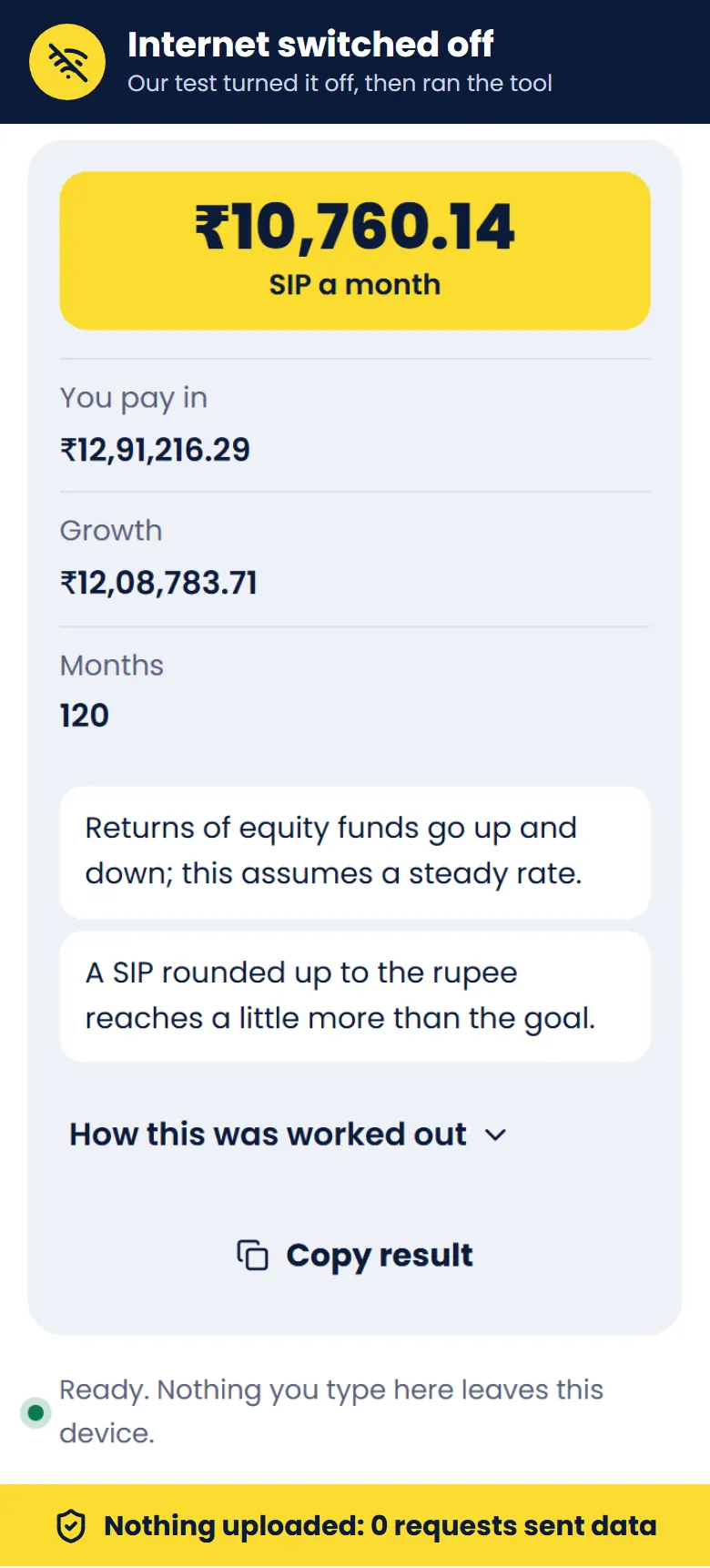
A SIP calculator answers “what will ₹5,000 a month become?”. This one answers the question people usually start with: “how much must I invest every month to reach ₹25 lakh in 10 years?” At a steady 12% a year, the answer is ₹10,760.14 a month: ₹12,91,216.29 of your own money, and ₹12,08,783.71 of growth.
Type the goal, the years until you need it and the yearly return you expect, and this calculator shows the monthly SIP, what you will pay in, the growth, and the number of months, with the working. It all happens in your browser: nothing you type is uploaded or kept.
When it helps:
- A child's education or wedding, years away, with a target amount.
- A house's down payment or a car in a few years.
- Retirement, as the long-term target behind every other goal. When the time comes to live on it, the SWP Calculator shows how long a monthly withdrawal lasts.
- Checking a plan: is the SIP you run now enough for the goal you set?
Step by step
- Type the goal amount in rupees, such as 25,00,000. Commas the Indian or the international way and Hindi digits are read.
- Type the years to the goal, such as 10. Part of a year works: 2.5 years is 30 months.
- Type the expected return as a yearly percentage, after the fund's costs, such as 12.
- Read the answer: the SIP a month in large type, then what you pay in, the growth and the months.
- Open “How this was worked out” to see what ₹1 a month grows to and how the SIP follows from it, and use Copy result for a one-line summary.
Try an example fills in ₹25,00,000 in 10 years at 12%, and Clear empties the boxes.
What the page does, exactly
These are the calculator's rules in full, and the same rules are checked by our tests.
| Part | The rule | Example |
|---|---|---|
| What you can type | Digits, also those of Hindi and other scripts, a dot for decimals, and commas the Indian or the international way | 25,00,000 and 2500000 are the same |
| The boxes' limits | A goal of at least ₹1, a time from one month to 60 years, a return from 0% to 50% a year | A return of 60 gets a message under its box |
| Months | The years times 12, rounded to a whole month | 10 years is 120 months |
| What ₹1 a month becomes | ((1 + i)n − 1) ÷ i × (1 + i), with i the yearly return ÷ 1,200, each instalment at the start of its month | At 12% for 120 months: about 232.339 |
| The SIP | The goal divided by what ₹1 a month becomes; with a return of 0, the goal divided by the months | ₹25,00,000 ÷ about 232.339 = ₹10,760.14 |
| You pay in and growth | The SIP before it is rounded to the paisa, times the months; the growth is the goal minus that | About ₹10,760.1357 × 120 = ₹12,91,216.29, and ₹12,08,783.71 of growth |
| Rounding | Every sum is worked out exactly, in whole numbers and fractions rather than the computer's binary approximations; amounts are rounded to the paisa, half a paisa up, only when they are written, in the Indian way | ₹12,08,783.71 of growth |
What the rules don't decide: the calculator assumes the same return every month and the same SIP every month. It doesn't raise the SIP each year, take off costs or tax, or allow for inflation unless you build it into the goal, as shown below.
Real results from our tests
We tested the Goal SIP Calculator with headless Chromium 148, the open-source browser Chrome is built on, on a Windows laptop with an Intel Core i7-1185G7 and 32 GB of memory, on 1 November 2026. Other work was running on the laptop at the same time, so times vary a little from run to run: each time below is the middle one of 3 runs.
Checked against a second program. Python's decimal numbers, with 120 digits and none of the page's code, worked out 25,000 random goals of ₹1 to ₹5 crore, at returns from 0% to 50% and for one month to 60 years, and the page's code gave the same 75,000 amounts every time, to the paisa: the SIP, the pay-in and the growth of each. The boxes were typed as people type them, with Indian and international commas, in Hindi, Bengali and Gujarati digits, and with a % sign after the rate.
The answer is drawn at once. The page drew the answer to a typed amount in 0.09 milliseconds (the middle of 3 runs of 200 amounts typed in a row), not counting the moment the browser takes to paint the screen. Even a 60-year goal at a return typed to 40 digits, the longest sum the page does, was drawn in 7.3 milliseconds.
Size and offline. On a first visit the page downloads about 0.1 MB for the tool: the page, its styles, its scripts and the fonts, with Google's ad code not counted. In our test we switched the network off after the page had loaded and pressed Try an example: the SIP showed 0.1 seconds later or less in each of 15 runs.
Phone-sized screen. We also ran the tests on a phone-sized screen in Chromium (390 × 844 pixels, with touch). That is not a real phone. Every button and box was 44 pixels high or more, and the page did not scroll sideways.
Try it yourself: press "Try an example" at the top of this page. It puts 25,00,000, 10 and 12 in the boxes and the SIP is ₹10,760.14 a month. Then change the years to 15: it is ₹4,954.66.

The formula, by hand
The goal SIP is the SIP formula turned around. For ₹25,00,000 in 10 years at 12%:
- The monthly rate: 12 ÷ 12 ÷ 100 = 0.01, and 10 years is 120 months.
- What ₹1 a month becomes: 1.01 multiplied by itself 120 times is about 3.30039; take away 1, divide by 0.01 and multiply by 1.01: about 232.339.
- Divide the goal by it: ₹25,00,000 ÷ 232.339 is about ₹10,760.14 a month, which the calculator works out exactly. Rounding 232.339 to 232.34 first would give ₹10,760.09, so keep three decimals or more when you check by hand.
Check it with the SIP Calculator: ₹10,760.14 a month at 12% for 10 years grows to ₹25,00,000.99, the goal and 99 paise more, because the SIP before rounding is a hair less, about ₹10,760.1357. A spreadsheet gives the same SIP with =PMT(12%/12, 120, 0, -2500000, 1).
Time does the heavy lifting
The longer the time, the less of the goal comes from your own pocket. ₹10,00,000 at 12%:
| Time | SIP a month | You pay in | Growth |
|---|---|---|---|
| 5 years | ₹12,123.22 | ₹7,27,392.93 | ₹2,72,607.07 |
| 15 years | ₹1,981.86 | ₹3,56,735.16 | ₹6,43,264.84 |
Starting 10 years earlier cuts the monthly SIP to about a sixth, and growth then does nearly two thirds of the work. A goal of ₹1 crore in 20 years at 12% needs ₹10,008.53 a month: ₹24,02,046.74 paid in, ₹75,97,953.26 of growth. How much SIP for ₹1 crore gives the figures for 10 to 30 years and other returns.
What the return changes
The return you assume changes the SIP a lot. ₹25,00,000 in 10 years:
- At 8%: ₹13,574.73 a month.
- At 10%: ₹12,103.49 a month.
- At 12%: ₹10,760.14 a month.
Planning on a careful return and doing better leaves you ahead; planning on a hopeful one and doing worse leaves you short. To see what your own past investments really earned a year, from what you paid and what they are worth now, use the CAGR Calculator. For goals within a few years, where markets have less time to recover from a fall, a lower return, or a safer investment such as a recurring deposit, is wiser.
Price the goal in future rupees
A goal priced at today's cost will fall short, because prices rise. A course that costs ₹10,00,000 today will cost about ₹23,96,558 in 15 years at 6% inflation. Work out the future cost first with the Inflation Calculator, then type that as the goal here: at 12%, the SIP for ₹23,96,558.19 in 15 years is ₹4,749.65 a month, against ₹1,981.86 for ₹10,00,000. The higher figure is the honest one.
Worked goals
- A down payment of ₹5,00,000 in 3 years, at a careful 7%: ₹12,449.26 a month, ₹4,48,173.40 paid in.
- ₹25,00,000 for a child's degree in 10 years at 12%: ₹10,760.14 a month. For a daughter under 10, a Sukanya Samriddhi account pays a rate the government sets, 8.2% a year since 1 January 2024; the Sukanya Samriddhi Calculator shows what it grows to.
- ₹1 crore in 20 years at 12%: ₹10,008.53 a month.
- ₹1,00,000 in a year with no growth, as in a savings account: ₹8,333.33 a month, simply the goal divided by 12.
If the SIP is too high
When the answer is more than you can invest, there are four levers: more years, a smaller goal, a step-up SIP that rises with your income, or a lump sum now. A step-up SIP starts lower and grows each year, so the first year's amount can be well under this calculator's figure; this calculator works out a level SIP only, and the Step-up SIP Calculator shows what a SIP that starts lower and rises each year grows to: try a lower first amount there until it reaches the goal. A lump sum invested now reduces the goal the SIP has to meet: work out what it will grow to with the Lumpsum Calculator, take that from the goal, and type the rest here.
Returns are not promised
A mutual fund's value rises and falls with the markets, so no SIP can promise a goal. The calculator assumes a steady return, which no fund gives; its answer shows what that steady return would need from you. Plan on a careful return, review the plan every year, and move money from riskier investments to safer ones as the goal gets close, so a fall in the last year doesn't undo years of saving.
Review it every year
Once a year, check the value of your investment against the plan. If you are ahead, you can keep the SIP; if behind, grow the value so far to the goal date with the Lumpsum Calculator, take it from the goal, and work out the SIP for the rest here with the years left. Small corrections each year are easier than a large one near the end.
What waiting costs
Every year you wait, the same goal needs a bigger SIP, and more of the goal comes from your own pocket. ₹1 crore at 12%:
| Start with | SIP a month | You pay in |
|---|---|---|
| 25 years to go | ₹5,269.72 | ₹15,80,915.11 |
| 20 years to go | ₹10,008.53 | ₹24,02,046.74 |
| 15 years to go | ₹19,818.62 | ₹35,67,351.60 |
| 10 years to go | ₹43,040.54 | ₹51,64,865.16 |
Each five years of waiting roughly doubles the monthly SIP. Starting at 25 years to go, you put in less than a sixth of the crore and growth does the rest; starting at 10 years to go, you put in more than half of it yourself. A small SIP started today usually beats a large one started later.
Several goals at once
Most families have more than one goal, each with its own date. Work out each one on its own, with a return that suits its time, and add the SIPs up:
- A down payment of ₹5,00,000 in 3 years, at a careful 7%: ₹12,449.26 a month.
- A degree costing ₹25,00,000 in 10 years, at 12%: ₹10,760.14 a month.
- ₹1 crore for retirement in 20 years, at 12%: ₹10,008.53 a month.
Together that is ₹33,217.93 a month. If the total is more than you can invest, look at the goals in order of date and importance: the nearest goal usually can't wait, while the furthest has the most time to catch up with a step-up later. When the down payment is made after 3 years, its SIP ends, and that money can go to the other two.
Goals only a few years away
For a goal within about three years, a fall in the markets has little time to recover, so many people use a recurring deposit or a debt fund rather than equity. A recurring deposit's rate is fixed when you open it: our RD Calculator shows what a monthly deposit grows to, with interest added every quarter as banks and the post office do. Typing the RD's rate here gives a close estimate of the deposit you need; it adds growth every month rather than every quarter, so the RD's own figure differs by a little.
Costs and tax
A fund's costs come out of its returns, so type the return you expect after costs: a fund that earns 12% with a 1% expense ratio gives you about 11%. Tax on mutual fund gains is charged when you sell, and how much depends on the kind of fund and how long you held it. The rules change with budgets, so leave some room in the goal for tax, and check the current rules on the Income Tax Department's website or with a tax adviser before you sell.
Private: your numbers stay on your device
Your goals, years and returns never leave your device. The calculator runs inside your browser and has no upload step: it never sends the numbers you type anywhere, and it doesn't save them, so closing the page forgets them. The page's Content Security Policy lets it contact only this site and Google's ad service, which pays for the site; our code never gives your numbers to the ad code. You can check it yourself in your browser's network panel (F12 on a computer): working out a SIP adds no request that carries your numbers.
Read our privacy policy and how we prove your files are never uploaded.
Tips
- Raise the goal by inflation before working out the SIP.
- Plan on a careful return, and be pleased by a better one.
- Start as early as you can: time is the cheapest way to a goal.
- One goal, one SIP: separate SIPs make each goal easy to track.
- Write each goal down with its amount, its date and the return you assumed, so the yearly review has something to check against.
- Raise the SIP with your pay: even a small rise each year makes up for a return that falls short.
Limits
- One steady return and one SIP for the whole time.
- No step-ups, lump sums, costs or tax are added for you.
- No inflation unless you build it into the goal.
- Not advice. It works out the numbers; which fund suits a goal is for you, and a registered adviser if you have one.
- Browsers. We tested only in Chromium, the engine behind Chrome and Edge, with computer and phone-sized screens. We did not test on real phones, in Safari or in Firefox, so we cannot promise how they behave.
Terms explained
- SIP
- Systematic investment plan: the same amount invested every month.
- Goal SIP
- The monthly SIP worked out from a target amount and date.
- Expected return
- The steady yearly return a plan assumes; real returns vary.
- Step-up SIP
- A SIP raised by a set amount or percentage every year.
- Inflation
- The rise in prices over time, which raises the cost of a goal.
- Corpus
- The total amount built up for a goal.
- Expense ratio
- A fund's yearly costs as a percentage of the money in it, taken out of its returns.