What the speed converter does, and when you need it
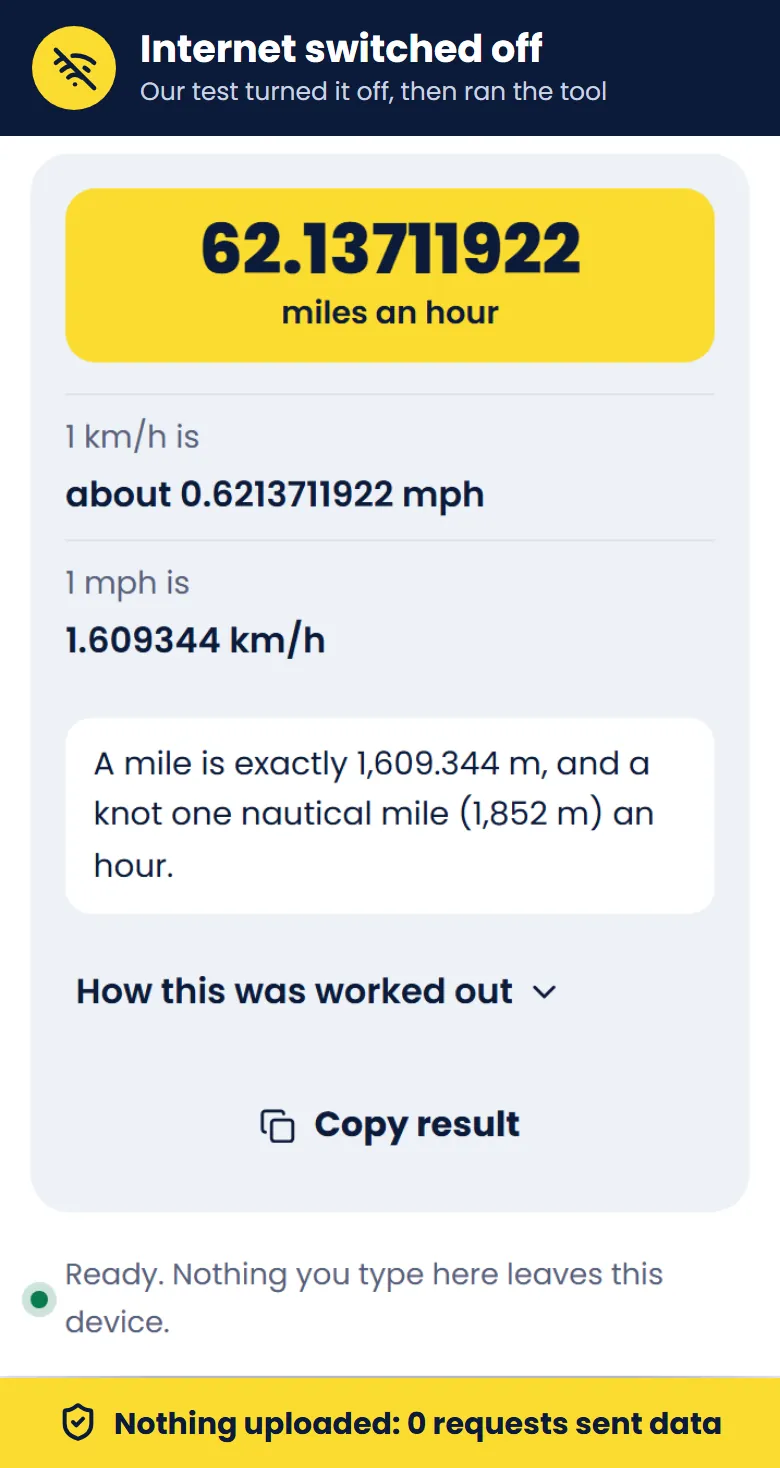
Type a speed, choose its unit and the unit you want, and this converter gives the answer at once, with both one-unit rates and the working. 100 km/h is 62.13711922 miles an hour, or 27.77777778 metres a second; 60 mph is exactly 96.56064 km/h. It converts between kilometres an hour, metres a second, miles an hour, knots and feet a second, working from each unit's exact definition.
It all happens in your browser: nothing you type is uploaded or kept.
When it helps:
- A car or a bike from abroad whose speedometer is in miles an hour.
- Sport: a bowler's or a server's speed, a runner's pace, a cyclist's average.
- Weather reports with wind in km/h, m/s or knots.
- Treadmills and cycling computers set to miles.
- Physics homework, where speeds are in metres a second.
The Length, Data Storage and Volume converters work the same way, from exact definitions.
Step by step
- Type the speed, such as 100. Commas the Indian or the international way and Hindi digits are read, and decimals are fine.
- Choose the unit it is in, such as km/h, and the unit you want, such as mph.
- Read the answer in large type, with what one of each unit is in the other.
- Open “How this was worked out” for the definitions and the sum, and use Copy result for a one-line summary.
Try an example fills in 100 km/h to mph, and Clear empties the box.
What the page does, exactly
These are the converter's rules in full, and the same rules are checked by our tests.
| Part | The rule | Example |
|---|---|---|
| What you can type | Digits, also those of Hindi and other scripts, a dot for decimals, and commas the Indian or the international way | 1,000 and 1000 are the same |
| The units | km/h, m/s, mph, knots and ft/s, each as an exact number of metres a second | 1 mph = 0.44704 m/s |
| The sum | The speed × the first unit in m/s ÷ the second unit in m/s, worked out exactly in fractions | 100 × (5 ÷ 18) ÷ 0.44704 mph |
| How it is written | To 10 significant digits, half away from zero, without trailing zeros, with lakh-style commas | 62.13711922 mph; 1,234.8 km/h |
| Exact or rounded | The working says “exactly” when nothing was rounded, and the one-unit rates say “about” when they were | 1 mph is 1.609344 km/h; 1 km/h is about 0.6213711922 mph |
Real results from our tests
We tested the Speed Converter with headless Chromium 148, the open-source browser Chrome is built on, on a Windows laptop with an Intel Core i7-1185G7 and 32 GB of memory, on 1 November 2026. Other work was running on the laptop at the same time, so times vary a little from run to run: each time below is the middle one of 3 runs.
Checked against a second program. Python's exact fractions, with none of the page's code, converted 25,000 random speeds from 10-12 to 1015, with and without decimals, between every pair of the five units, and the page's code gave the same 75,000 values every time: the answer and the two one-unit rates of each, to 10 significant digits. The boxes were typed as people type them, with Indian and international commas, and in Hindi, Bengali and Gujarati digits. One of the answers sat exactly on half of its tenth digit, and it was rounded away from zero, as it should be.
The answer is drawn at once. The page drew the answer to a typed speed in 0.39 milliseconds (the middle of 3 runs of 200 speeds typed in a row), not counting the moment the browser takes to paint the screen.
Size and offline. On a first visit the page downloads about 0.1 MB for the tool: the page, its styles, its scripts and the fonts, with Google's ad code not counted. In our test we switched the network off after the page had loaded and pressed Try an example: the answer showed 0.1 seconds later or less in each of 15 runs.
Phone-sized screen. We also ran the tests on a phone-sized screen in Chromium (390 × 844 pixels, with touch). That is not a real phone. Every button and box was 44 pixels high or more, and the page did not scroll sideways.
Try it yourself: press "Try an example" at the top of this page. It puts 100 in the box, from km/h to mph, and the answer is 62.13711922 mph. Then choose metres a second: 27.77777778.

Where the numbers come from
Every speed is a distance in a time, so each unit comes from its length and the hour or second. A kilometre an hour is 1,000 metres in 3,600 seconds, exactly 5/18 of a metre a second. The mile is exactly 1,609.344 metres, so a mile an hour is exactly 0.44704 m/s, a figure the US National Institute of Standards and Technology lists as exact. A knot is one nautical mile, exactly 1,852 metres, an hour, so 1 knot is exactly 1.852 km/h. And a foot a second is exactly 0.3048 m/s. Because all of these are exact, the converter works in exact fractions and rounds only when it writes the answer.
Converting by hand
- Km/h to m/s: divide by 3.6. 72 km/h is 20 m/s, and 100 km/h is 27.78 m/s.
- M/s to km/h: multiply by 3.6. 10 m/s is 36 km/h.
- Mph to km/h: multiply by 1.609344. 60 mph is 96.56064 km/h.
- Km/h to mph: divide by 1.609344, or multiply by about 0.6214. 100 km/h is 62.14 mph.
- Knots to km/h: multiply by 1.852. 20 knots is 37.04 km/h.
A quick check: a mile an hour is a little over one and a half km/h, and a metre a second is a little over three and a half km/h.
Driving
Speed limits in India are in km/h, and so are the speedometers of cars sold here. Cars made for Britain or the United States read in mph, often with a smaller km/h scale inside. 50 km/h is 31.07 mph, and 120 km/h is 74.56454307 mph; the other way, 40 mph is 64.37376 km/h. When driving a hired car abroad, check which unit the road signs use: Britain's are in mph. For the cost of the fuel a trip needs, the Fuel Cost Calculator works it out from the distance.
Running, walking and cycling
Runners often think in pace, minutes for each kilometre, while treadmills and cycling computers show speed. To turn a pace into a speed, divide 60 by the minutes: a 5-minute kilometre is 60 ÷ 5 = 12 km/h, which is 3.333333333 m/s. To turn a speed into a pace, divide 60 by the km/h: 10 km/h is a 6-minute kilometre. Treadmills made for America may show mph: 6 mph is about 9.66 km/h, a pace of about 6 minutes 13 seconds a kilometre. An easy walking speed is around 5 km/h.
Cricket and sport
Speed guns at cricket matches in India show km/h, while some broadcasts abroad use mph. A 145 km/h delivery is 90.09882287 mph, and a 160 km/h one is 99.41939076 mph, just short of the famous 100 mph mark. Tennis serves, football shots and badminton smashes are measured the same way; when you compare speeds from different broadcasts, convert them to the same unit first. A ball slows a little on its way, so the speed shown is usually the speed as it leaves the hand or the racket.
Wind and weather
Weather forecasts give wind speed in km/h, m/s, mph or knots, depending on the country and the service. 50 km/h is 13.88888889 m/s; a wind of 20 knots is 37.04 km/h. Cyclone warnings often give speeds in both km/h and knots. Gusts, the short bursts, are faster than the average wind speed, so a forecast may give both.
Ships and aircraft
Ships and aircraft use knots, because the nautical mile fits the way positions are measured on the globe. An aircraft cruising at 900 km/h is doing 485.9611231 knots, and one landing at 250 knots is doing exactly 463 km/h. Pilots also use airspeed and ground speed, which differ with the wind; the converter converts whichever speed you type.
In physics
Physics formulas use metres a second, the SI unit of speed. Sound travels through air at about 343 m/s at room temperature, which is 1,234.8 km/h. To use a speed in km/h in a formula, divide it by 3.6 first: a car at 72 km/h is moving at 20 m/s, and its kinetic energy uses that 20.
Speed, distance and time
Speed is distance divided by time, so time is distance divided by speed: 300 km at an average of 60 km/h takes 5 hours. Keep the units matched: a distance in kilometres needs a speed in km/h to give hours, and a distance in metres needs m/s to give seconds. For a distance in miles, convert it first with the Length Converter.
Average speed is not an average of speeds
If you drive 60 km at 60 km/h and then 60 km at 30 km/h, your average is not 45 km/h. The first part takes 1 hour and the second 2 hours, so 120 km in 3 hours is 40 km/h. Average speed is always the whole distance divided by the whole time; slow stretches count for more because you spend longer in them. A 500 km train journey that takes 8 hours averages 62.5 km/h, however fast the train goes between stops.
Speed and stopping
A car's braking distance grows with the square of its speed: at twice the speed it needs roughly four times the distance to stop, before adding the distance covered while the driver reacts. In metres a second, the numbers become clear: at 100 km/h a car covers about 27.8 metres every second, so a one-second delay in braking means almost 28 metres more.
Speedometers and GPS
Car speedometers are usually set to read a little high, so a map app's GPS speed often shows a few km/h less than the dial at the same moment. GPS measures your real speed over the ground from your position, and it can lag in tunnels or between tall buildings. Both read in whichever unit the device is set to, km/h or mph.
Writing speeds
The international symbol is km/h, though kmph is common on Indian signs and in news reports. Metres a second are m/s, miles an hour mph, and knots kn or kt. Avoid writing kph and km/hr together in one document: pick one form and keep to it.
The fastest speed there is
Light in a vacuum travels at exactly 299,792,458 metres a second: the metre itself is defined from it. In km/h that is 1,07,92,52,849 to ten significant digits, or about 1.08 thousand million km/h. Nothing with mass can reach it, which makes it a useful top end for the converter's range.
The 5/18 rule from school
Indian school books teach the conversion as a fraction: multiply km/h by 5/18 to get m/s, and m/s by 18/5 to get km/h. It is the same as dividing or multiplying by 3.6, since 18/5 is 3.6. 90 km/h × 5/18 is 25 m/s; 15 m/s × 18/5 is 54 km/h. The fraction form is handy in exams because it often cancels neatly.
Minutes and hours in speed sums
Speeds in km/h need times in hours. Turn minutes into hours by dividing by 60: 1 hour 30 minutes is 1.5 hours, so 90 km in 1 hour 30 minutes is 60 km/h, and 20 minutes is a third of an hour. Writing 1 hour 30 minutes as 1.3 hours is a common slip that makes the answer wrong.
Why ships count in knots
Sailors once measured speed by letting out a line with knots tied in it at even spacings and counting how many knots ran out in a set time, which gave the unit its name. Today a knot is defined exactly, one nautical mile an hour, but the name stayed, and so did its use at sea and in the air.
Ten significant digits
Some conversions never end: 100 km/h is 27.777… m/s, with sevens for ever. The converter writes ten significant digits, 27.77777778, rounding the last one half away from zero, and says “to 10 significant digits” in the working. When a conversion is exact, such as 60 mph to 96.56064 km/h, it is written in full and the working says “exactly”.
Quick table
| Unit | In km/h | In m/s |
|---|---|---|
| 1 m/s | 3.6 exactly | 1 |
| 1 mph | 1.609344 exactly | 0.44704 exactly |
| 1 knot | 1.852 exactly | about 0.5144 |
| 1 ft/s | 1.09728 exactly | 0.3048 exactly |
Common mistakes
- Multiplying by 3.6 the wrong way: km/h to m/s is a division by 3.6.
- Reading mph as km/h on a car from abroad, which means driving far too fast.
- Confusing the nautical mile and the ordinary mile: a knot is about 1.15 mph, not 1 mph.
- Mixing units in a time sum, such as kilometres with metres a second.
Worked examples
- 60 mph in km/h: 96.56064 km/h, exactly.
- 80 km/h in m/s: 22.22222222 m/s.
- 1 m/s in km/h: 3.6 km/h, exactly.
- 10 m/s in ft/s: 32.80839895 ft/s.
- 30 km/h in mph: 18.64113577 mph.
- 343 m/s, sound in air, in km/h: 1,234.8 km/h, exactly.
Private: your numbers stay on your device
The speeds you type never leave your device. The converter runs inside your browser and has no upload step: it never sends the numbers you type anywhere, and it doesn't save them, so closing the page forgets them. The page's Content Security Policy lets it contact only this site and Google's ad service, which pays for the site; our code never gives your numbers to the ad code. You can check it yourself in your browser's network panel (F12 on a computer): converting a speed adds no request that carries your numbers.
Read our privacy policy and how we prove your files are never uploaded.
Tips
- Remember 3.6: km/h and m/s are linked by it exactly.
- Remember 1.609344: mph to km/h, exactly.
- Check the speedometer's unit before driving a car from abroad.
- Turn pace into speed by dividing 60 by the minutes for a kilometre.
- Match the units before any speed, distance and time sum.
Limits
- Five units: no Mach number, since the speed of sound changes with the air.
- No pace: minutes a kilometre aren't in the list; divide 60 by them, as above.
- Speeds from 0 up to 1015; it doesn't take negative speeds.
- Browsers. We tested only in Chromium, the engine behind Chrome and Edge, with computer and phone-sized screens. We did not test on real phones, in Safari or in Firefox, so we cannot promise how they behave.
Terms explained
- Km/h
- Kilometres an hour, exactly 5/18 of a metre a second.
- M/s
- Metres a second, the SI unit of speed.
- Mph
- Miles an hour, exactly 1.609344 km/h.
- Knot
- One nautical mile, 1,852 metres, an hour.
- Pace
- The time taken for a set distance, such as minutes a kilometre.