What the weight converter does, and when you need it
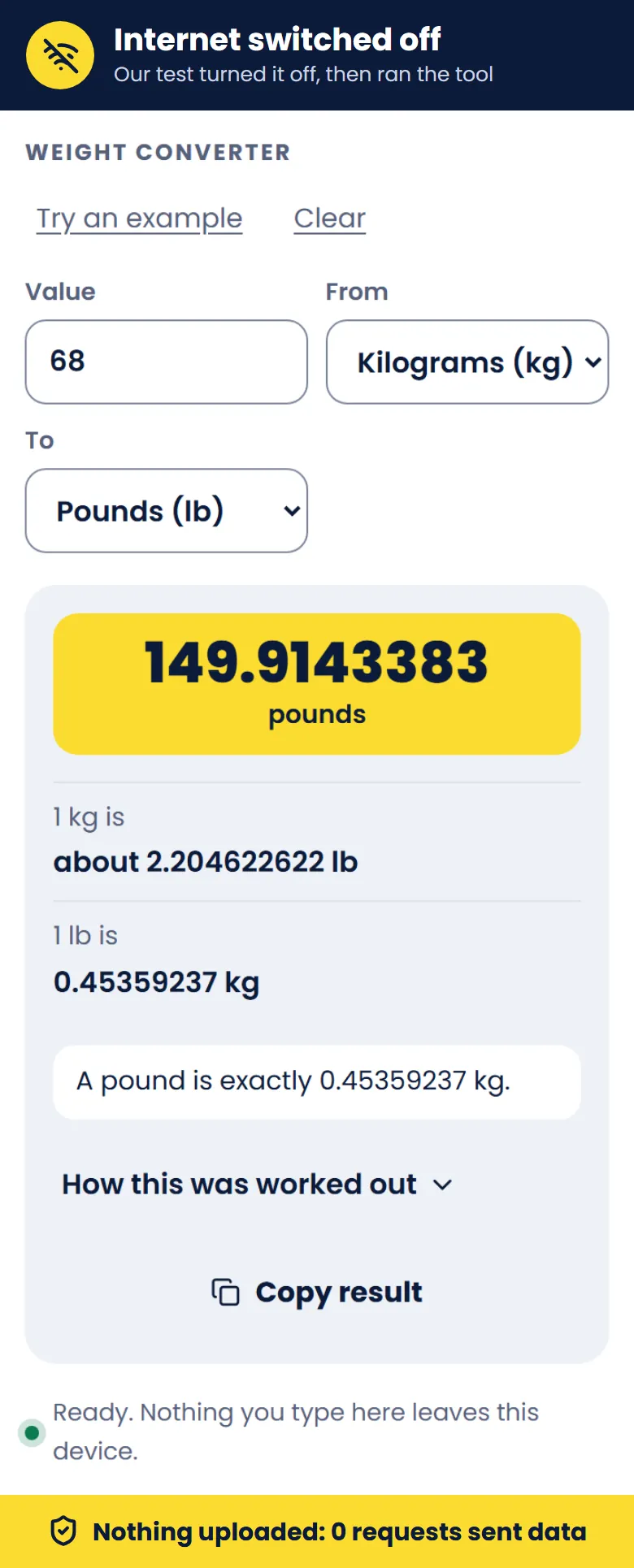
Type a weight, choose its unit and the unit you want, and this converter gives the answer at once, with both one-unit rates and the working. 68 kg is 149.9143383 pounds; 1 pound is exactly 0.45359237 kg. It converts between milligrams, grams, kilograms, tonnes, ounces, pounds and stones, working from each unit's exact definition, so the digits it shows are right.
It all happens in your browser: nothing you type is uploaded or kept.
When it helps:
- Body weight in kilograms or pounds, for a doctor, a gym or a form from abroad.
- Recipes that use ounces and pounds.
- Parcels and luggage, where limits may be in either unit.
- Shopping from abroad, where weights are often in pounds and ounces.
- Gym plans and equipment marked in pounds, when your plates are in kilograms.
- Science and school sums in grams, milligrams and kilograms.
The Length Converter, Temperature Converter and Area Converter work the same way, from exact definitions.
Step by step
- Type the weight, such as 68. Commas the Indian or the international way and Hindi digits are read, and decimals are fine.
- Choose the unit it is in, such as kilograms, and the unit you want, such as pounds.
- Read the answer in large type, with what one of each unit is in the other.
- Open “How this was worked out” for the definitions and the sum, and use Copy result for a one-line summary.
Try an example fills in 68 kg to pounds, and Clear empties the box.
What the page does, exactly
These are the converter's rules in full, and the same rules are checked by our tests.
| Part | The rule | Example |
|---|---|---|
| What you can type | Digits, also those of Hindi and other scripts, a dot for decimals, commas the Indian or the international way, and a minus sign | 1,500 and 1500 are the same |
| The units | mg, g, kg, tonnes, ounces, pounds and stones, each as an exact number of kilograms | 1 lb = 0.45359237 kg |
| The sum | The weight × the first unit in kilograms ÷ the second unit in kilograms, worked out exactly in fractions | 68 × 1 ÷ 0.45359237 lb |
| How it is written | To 10 significant digits, half away from zero, without trailing zeros, with lakh-style commas | 149.9143383 lb; 2,204.622622 lb |
| Exact or rounded | The working says “exactly” when nothing was rounded, and the one-unit rates say “about” when they were | 1 lb is 0.45359237 kg; 1 kg is about 2.204622622 lb |
Real results from our tests
We tested the Weight Converter with headless Chromium 148, the open-source browser Chrome is built on, on a Windows laptop with an Intel Core i7-1185G7 and 32 GB of memory, on 1 November 2026. Other work was running on the laptop at the same time, so times vary a little from run to run: each time below is the middle one of 3 runs.
Checked against a second program. Python's exact fractions, with none of the page's code, converted 25,000 random weights from 10-12 to 1015, with and without decimals and some below zero, between every pair of the seven units, and the page's code gave the same 75,000 values every time: the answer and the two one-unit rates of each, to 10 significant digits. The boxes were typed as people type them, with Indian and international commas, and in Hindi, Bengali and Gujarati digits. 291 of the answers sat exactly on half of their tenth digit, and every one was rounded away from zero, as it should be.
The answer is drawn at once. The page drew the answer to a typed weight in 0.42 milliseconds (the middle of 3 runs of 200 weights typed in a row), not counting the moment the browser takes to paint the screen.
Size and offline. On a first visit the page downloads about 0.1 MB for the tool: the page, its styles, its scripts and the fonts, with Google's ad code not counted. In our test we switched the network off after the page had loaded and pressed Try an example: the answer showed 0.1 seconds later or less in each of 15 runs.
Phone-sized screen. We also ran the tests on a phone-sized screen in Chromium (390 × 844 pixels, with touch). That is not a real phone. Every button and box was 44 pixels high or more, and the page did not scroll sideways.
Try it yourself: press "Try an example" at the top of this page. It puts 68 in the box, from kilograms to pounds, and the answer is 149.9143383 pounds. Then change it to 1: 2.204622622.

Where the numbers come from
The kilogram is the SI unit of mass, defined since 2019 from a fixed value of the Planck constant, and the gram, milligram and tonne are its thousandths and thousands. The pound was tied to it in 1959, when the English-speaking countries agreed to unify their standards: the US National Institute of Standards and Technology's Handbook 44 gives the avoirdupois pound as 0.453 592 37 kilogram, exactly. The ounce is a sixteenth of a pound, exactly 28.349523125 g, and the stone, used in Britain for body weight, is 14 pounds, exactly 6.35029318 kg.
Because each of these is exact, the converter works in exact fractions and rounds only once, when it writes the answer.
Converting by hand
Kilograms to pounds is a division by 0.45359237: 68 ÷ 0.45359237 = 149.9143383 lb. A quick mental rule is to double the kilograms and add a tenth of the result: 68 × 2 = 136, plus 13.6 is 149.6 lb, close but not exact. The other way, pounds to kilograms, is a multiplication: 150 lb × 0.45359237 = 68.0388555 kg.
For grams and ounces, divide grams by 28.349523125: 100 g is 3.527396195 oz.
Quick table
| Unit | In metric | The other way |
|---|---|---|
| 1 ounce | 28.349523125 g exactly | 1 kg is about 35.274 oz |
| 1 pound | 0.45359237 kg exactly | 1 kg is about 2.2046 lb |
| 1 stone | 6.35029318 kg exactly | 70 kg is about 11.02 st |
| 1 tonne | 1,000 kg exactly | 1 t is about 2,204.6 lb |
The converter gives the right-hand figures to ten significant digits, such as 35.27396195 oz in a kilogram.
Body weight
Indian scales show kilograms; many gym machines, fitness apps from abroad and American forms use pounds. 68 kg is 149.9143383 lb, and 150 lb is 68.0388555 kg. In Britain body weight is often given in stones and pounds: 70 kg is 11.02311311 stone: 11 stone and 0.02311311 of a stone, which times 14 is about a third of a pound, since a stone is 14 pounds. Body weight changes through the day by a kilogram or more, so for tracking, weigh at the same time each day.
Babies
A baby's birth weight is given in kilograms in India and often in pounds and ounces abroad. 3.2 kg is 7.05479239 lb: 7 pounds, and 0.05479239 of a pound, which times 16 is about 0.88 ounce, so about 7 lb 1 oz. Relatives abroad will recognise the pounds-and-ounces figure at once.
In the kitchen
Recipes from Britain and America weigh ingredients in ounces and pounds. 1 oz is about 28.35 g, so 8 oz of flour is about 227 g, and a pound of butter about 454 g. Many cooks round 1 oz to 30 g for convenience, which is fine for most recipes, but less so for baking, where proportions matter. A recipe in cups measures volume, not weight: the Volume Converter turns cups into millilitres. Indian recipes mostly use grams, cups and spoons, with spices added to taste, so they rarely need converting at all.
Luggage and parcels
Airlines and couriers set limits in kilograms or pounds. 23 kg is 50.7063203 lb, so a bag that weighs 23 kg is just over 50 pounds. When a limit is in one unit and your scale shows the other, convert the limit and leave a little margin, since home scales are seldom exact. For a parcel's shipping cost, check the courier's own rate card: many round the weight up to the next half or whole kilogram.
Milligrams and medicines
Medicines and supplements are labelled in milligrams: 500 mg is 0.5 g, and 1,000 mg is 1 g. The converter handles these exactly, but a dose is a medical question: always follow the label or your doctor's instructions, and never work out a dose for a child from an adult's without asking a doctor or pharmacist.
Tonnes and lorries
A tonne, also called a metric ton, is 1,000 kg, about 2,204.6 pounds. It is not the same as the long ton of 2,240 pounds or the short ton of 2,000 pounds used in some countries, so check which “ton” a document means. Goods on trucks, grain and steel in India are usually weighed in tonnes and quintals; a quintal is 100 kg.
Gold and jewellery
In India, gold is weighed in grams and its price is usually quoted for 10 grams. Abroad, gold and silver are priced by the troy ounce, which is exactly 31.1034768 grams, heavier than the ordinary ounce of 28.349523125 g that this converter uses. So a price per troy ounce isn't a price per ordinary ounce: to compare it with an Indian price for 10 g, multiply the price per troy ounce by 10 and divide by 31.1034768, and remember that duties and GST in India come on top.
Weights at the gym
Gym plates and dumbbells may be marked in kilograms or pounds. A 20 kg plate is 44.09245244 lb, and a 45 lb plate is 20.41165665 kg, so the two are close but not the same: a bar loaded with four 45 lb plates holds about 1.6 kg more than one with four 20 kg plates. When you follow a training plan written in the other unit, convert the total, not each plate rounded.
Grams in shops
Packets are sold by the gram: 250 g, 500 g and 1 kg. To compare packets of different sizes, work out the price for a kilogram: a 250 g packet at ₹60 is ₹240 a kilogram, so a 1 kg packet at ₹220 is cheaper per gram. Packed goods in India also show the net weight, the food without the packet, which is the number to compare.
Using a scale well
Home scales are seldom exact to the last gram. Put the scale on a hard, level floor or counter, press zero or tare with the empty bowl on it, and weigh in the same place each time. A kitchen scale that reads to 1 g is plenty for cooking; for postage or luggage, a reading to 100 g is enough, as long as you leave a margin under the limit.
In science and school
Metric weights step by thousands, so converting between them moves the decimal point three places: 2.5 kg is 2,500 g, 750 mg is 0.75 g, and 3,200 g is 3.2 kg. In laboratory work, keep as many digits as the balance gives and round the final answer to the same precision as the least precise measurement; the converter's ten significant digits are more than any balance in a school laboratory can give.
Pounds and ounces together
A weight such as 5 lb 8 oz has to become one number before it can be converted. Divide the ounces by 16 and add them to the pounds: 8 ÷ 16 = 0.5, so 5 lb 8 oz is 5.5 lb, which is 2.494758035 kg. Going back, take the part after the point and multiply it by 16 to get the ounces. Stones and pounds work the same way, with 14 pounds to the stone.
Mass and weight
Strictly, the kilogram measures mass, how much matter there is, while weight is the force of gravity on it. In daily life the two words mean the same thing, and every scale shows mass in kilograms or pounds. The difference matters only in physics, where weight is measured in newtons: on the Moon your mass would be the same, but you would weigh about a sixth as much.
Common mistakes
- Reading 7.5 lb as 7 lb 5 oz. Half a pound is 8 ounces, so 7.5 lb is 7 lb 8 oz.
- Mixing up the direction: kilograms to pounds is a division by 0.45359237, pounds to kilograms a multiplication.
- Confusing ounces: the fluid ounce measures volume; the ounce here measures weight.
- Assuming every ton is a tonne: the long and short tons differ by more than 10%.
Worked examples
- 1 kg in pounds: 2.204622622 lb.
- 1 kg in ounces: 35.27396195 oz.
- 150 lb in kilograms: 68.0388555 kg.
- 1 stone in kilograms: 6.35029318 kg, exactly.
- 500 mg in grams: 0.5 g, exactly.
- 1 tonne in pounds: 2,204.622622 lb.
- 8 oz in grams: 226.796185 g, exactly.
- 1 lb in grams: 453.59237 g, exactly.
- 20 kg in pounds: 44.09245244 lb.
Private: your numbers stay on your device
The weights you type never leave your device. The converter runs inside your browser and has no upload step: it never sends the numbers you type anywhere, and it doesn't save them, so closing the page forgets them. The page's Content Security Policy lets it contact only this site and Google's ad service, which pays for the site; our code never gives your numbers to the ad code. You can check it yourself in your browser's network panel (F12 on a computer): converting a weight adds no request that carries your numbers.
Read our privacy policy and how we prove your files are never uploaded.
Tips
- Remember 0.45359237: pounds and kilograms are linked by it exactly.
- Round only at the end, to what your scale can show, and write the unit beside every weight you note down.
- For pounds and ounces, multiply the part of a pound by 16 to get ounces.
- Check the unit on the scale before you write a weight down.
- Compare packets by the price a kilogram, not by the price on the packet.
Limits
- One unit at a time: pounds and ounces together need the step shown above.
- No local units such as the tola, seer or maund, whose sizes varied from place to place.
- No troy ounces: gold abroad is priced in troy ounces of about 31.1 g, which this converter doesn't use.
- Not medical advice: it converts numbers; doses are for a doctor.
- Browsers. We tested only in Chromium, the engine behind Chrome and Edge, with computer and phone-sized screens. We did not test on real phones, in Safari or in Firefox, so we cannot promise how they behave.
Terms explained
- Kilogram
- The SI unit of mass; a gram is a thousandth of it.
- Pound
- The avoirdupois pound, exactly 0.45359237 kg.
- Ounce
- A sixteenth of a pound, exactly 28.349523125 g.
- Stone
- 14 pounds, exactly 6.35029318 kg, used for body weight in Britain.
- Tonne
- 1,000 kilograms, also called a metric ton.
- Quintal
- 100 kilograms, used for grain and produce in India.
- Troy ounce
- Exactly 31.1034768 grams, used to price gold and silver abroad.
- Net weight
- The weight of what is inside a packet, without the packet.