The EMI formula in plain words
An EMI, an equated monthly instalment, is the same payment every month that clears a loan and its interest by the end of the tenure. Banks and housing finance companies in India work it out on the reducing balance, with this formula:
EMI = P × i × (1 + i)^n ÷ ((1 + i)^n − 1)
- P is the loan amount, also called the principal.
- i is the interest rate for one month: the yearly rate divided by 12, then by 100. A rate of 12% a year gives 12 ÷ 12 ÷ 100 = 0.01 a month.
- n is the number of months: the years of the tenure times 12.
The part (1 + i)^n is how much ₹1 would grow to over the whole loan at the monthly rate, if you paid nothing until the end. The formula takes that growth and spreads it into equal monthly payments, so that the balance falls to exactly zero after the last one. Nothing else goes in: no fees, no insurance, no tax.
EMI Calculator does the sums for you, in your browser and without an upload step, and shows its working. The page's rules table lists exactly what it does, including how it rounds. The rest of this post shows what happens inside the formula, with numbers you can follow by hand.
A loan you can work out by hand
Take a loan of ₹1,00,000 at 12% a year for 1 year. The numbers are chosen to make the sums easy, since a monthly rate of 0.01 is simple to handle. Real loans are bigger and longer, but the steps are the same.
- The monthly rate: 12 ÷ 12 ÷ 100 = 0.01. The months: 1 year × 12 = 12.
- The growth: multiply 1.01 by itself 12 times. The result is about 1.126825.
- The top of the fraction: P × i × (1 + i)^n = 1,00,000 × 0.01 × 1.126825 = 1,126.825.
- The bottom: (1 + i)^n − 1 = 1.126825 − 1 = 0.126825.
- Divide: 1,126.825 ÷ 0.126825 is about 8,884.88. The EMI is ₹8,884.88.
That is what EMI Calculator shows for these three numbers. It also shows the total interest, ₹6,618.55, and the total paid, ₹1,06,618.55. Multiplying the rounded EMI by 12 gives ₹1,06,618.56, one paisa more, because the page multiplies the EMI before it is rounded to the paisa (about ₹8,884.8789). The guide's tenure section explains this small difference.
A spreadsheet gives the same EMI with the PMT function: =PMT(12%/12, 12, -100000). If your hand answer is a few paise or rupees away, the cause is usually rounding in the middle of the sum: round 1,126.825 to 1,126.83 before dividing and you get 8,884.92. That is also why quick rules of thumb are only rough guides.
Try it: type 1,00,000, then 12, then 1, and check that the EMI is ₹8,884.88.
Open the EMI CalculatorWhy the early EMIs are mostly interest
Each month the lender first charges interest on the balance you still owe, and only the rest of the EMI reduces the loan. The first month's interest is the loan times the yearly rate, divided by 12 (and by 100, for a rate in percent). For the example: 1,00,000 × 12 ÷ 100 ÷ 12 = ₹1,000.
So the first EMI of ₹8,884.88 pays ₹1,000 of interest and only ₹7,884.88 of the loan. The balance falls to ₹92,115.12. The next month's interest is charged on that smaller balance: 92,115.12 × 0.01 = ₹921.15, and so on. Every month the interest part shrinks and the principal part grows, while the EMI stays the same:
| Month | Interest | Principal | Balance after |
|---|---|---|---|
| 1 | ₹1,000.00 | ₹7,884.88 | ₹92,115.12 |
| 2 | ₹921.15 | ₹7,963.73 | ₹84,151.39 |
| 3 | ₹841.51 | ₹8,043.36 | ₹76,108.03 |
| 4 | ₹761.08 | ₹8,123.80 | ₹67,984.23 |
| 5 | ₹679.84 | ₹8,205.04 | ₹59,779.19 |
| 6 | ₹597.79 | ₹8,287.09 | ₹51,492.11 |
| 7 | ₹514.92 | ₹8,369.96 | ₹43,122.15 |
| 8 | ₹431.22 | ₹8,453.66 | ₹34,668.49 |
| 9 | ₹346.68 | ₹8,538.19 | ₹26,130.30 |
| 10 | ₹261.30 | ₹8,623.58 | ₹17,506.72 |
| 11 | ₹175.07 | ₹8,709.81 | ₹8,796.91 |
| 12 | ₹87.97 | ₹8,796.91 | ₹0.00 |
The interest column adds up to ₹6,618.55 and the principal column to ₹1,00,000. Each amount here is rounded to the paisa on its own, so in months 3 and 9 the two parts add up to ₹8,884.87, a paisa under the EMI. A lender's own schedule may round differently. The calculator shows the EMI and the totals but not every month; a lender's repayment schedule lists each month, and follows this pattern.
How the split changes over a long loan
On a short loan the shift is quick. On a long one it is slow, and that is where the surprise is. Take the example loan from the EMI Calculator's guide: ₹25,00,000 at 8.5% for 20 years, with an EMI of ₹21,695.58 for 240 months. The EMIs of each year add up to ₹2,60,346.97, and this is how that sum splits:
| Year | Interest in the year | Principal in the year | Balance at year end |
|---|---|---|---|
| 1 | ₹2,10,591.24 | ₹49,755.73 | ₹24,50,244.27 |
| 2 | ₹2,06,193.29 | ₹54,153.68 | ₹23,96,090.59 |
| 5 | ₹1,90,526.51 | ₹69,820.46 | ₹22,03,179.58 |
| 10 | ₹1,53,710.14 | ₹1,06,636.83 | ₹17,49,845.57 |
| 15 | ₹97,480.47 | ₹1,62,866.50 | ₹10,57,468.27 |
| 20 | ₹11,600.87 | ₹2,48,746.10 | ₹0.00 |
In the first year, about four rupees in every five of what you pay is interest, and the loan falls by only ₹49,755.73. After five years the balance is ₹22,03,179.58, so ₹2,96,820.42 of the ₹25,00,000 has been repaid. This agrees with the figures in the guide's section on where each EMI goes.
The share of a single EMI that is interest is 81.62% in the first month, 72.13% in the 60th, 57.43% in the 120th, 34.99% in the 180th and 0.70% in the last. The principal part first becomes larger than the interest part in the 143rd EMI, in the twelfth year. Over all 240 months the interest comes to ₹27,06,939.40, more than the loan itself.
None of this is a trick. It is interest charged on a balance that is still large. It explains why the balance on a statement falls so slowly at the start, and why a prepayment made early does the most good.
How tenure and rate move the EMI
Two things change the EMI most: how many months you take, and the rate. Here is a loan of ₹10,00,000 at 9% for four tenures:
| Tenure | EMI | Total interest |
|---|---|---|
| 5 years | ₹20,758.36 | ₹2,45,501.31 |
| 10 years | ₹12,667.58 | ₹5,20,109.29 |
| 15 years | ₹10,142.67 | ₹8,25,679.85 |
| 20 years | ₹8,997.26 | ₹11,59,342.29 |
Doubling the tenure does not halve the EMI. From 5 to 10 years the EMI falls by about 39%, not 50%, while the interest more than doubles. From 10 to 20 years the EMI falls by only ₹3,670.32 a month, and the interest grows by ₹6,39,233.00. A longer tenure makes each month lighter, but it pays for that with interest.
Now the same ₹10,00,000 over 10 years at three rates:
| Rate | EMI | Total interest |
|---|---|---|
| 8% | ₹12,132.76 | ₹4,55,931.13 |
| 9% | ₹12,667.58 | ₹5,20,109.29 |
| 10% | ₹13,215.07 | ₹5,85,808.84 |
Each extra percentage point adds about ₹535 to ₹547 to the monthly EMI here (₹534.82 from 8% to 9%, and ₹547.49 from 9% to 10%) and, over ten years, the total interest grows by ₹64,178.16 and then ₹65,699.55. Comparing loans by the EMI alone hides this, so compare the total interest as well. The guide's tenure section and its rate section show the same effects on its own example loan.
What paying early does to the formula
A prepayment goes straight to the principal, so it cuts all the interest that sum would have run up for the rest of the loan. That is why early prepayments save the most. In the table above, the balance in the first year is almost the whole loan, so every rupee repaid then stops a long run of interest. In the last year there is little left to stop.
After a prepayment, lenders usually keep the EMI and shorten the tenure, or keep the tenure and lower the EMI. Ask which one your lender does, and if the EMI is comfortable, the shorter tenure saves more. The Loan Prepayment Calculator works out both for your own loan. Whether a lender may charge for prepaying depends on the kind of loan and when it was sanctioned; the guide's section on paying early sets out what the Reserve Bank of India's directions say, and your sanction letter says what applies to you.
When the rate is flat, this is not the formula
The formula above is for a reducing rate. If a dealer or lender quotes a flat rate, the interest is worked out as loan × rate × years on the full loan, and then spread evenly. Take ₹5,00,000 for 5 years at 7% flat: the interest is ₹1,75,000, and the EMI is (5,00,000 + 1,75,000) ÷ 60 = ₹11,250.
The same loan at 11% reducing, worked out with the formula, has an EMI of ₹10,871.21 and interest of ₹1,52,272.69. So the loan that sounds cheaper at 7% costs ₹378.79 more every month and ₹22,727.31 more in all. Our post on flat rate versus reducing rate explains why, and the Flat to Reducing Rate Calculator turns a flat rate into the reducing rate it really is, so you can use the EMI formula to compare.
Checking an EMI, and the usual slips
A quick check catches wrong answers. The EMI must be more than the loan divided by the months, and less than that plus the first month's interest. For the example, 1,00,000 ÷ 12 = ₹8,333.33, and adding the first month's ₹1,000 gives ₹9,333.33. The true EMI, ₹8,884.88, sits between the two.
- Using the yearly rate as the monthly rate. 12% is 0.01 a month, not 0.12.
- Using years for n. The formula counts months: 5 years is n = 60.
- Adding fees to the formula. A processing fee, insurance or GST on a fee is charged on top, or added to the loan. The formula gives the EMI for the amount you put in.
- Treating a floating rate as fixed. If the rate is reset, the EMI or the tenure changes, as the guide's section on resets explains.
If your lender's EMI is a few rupees away from the calculator's, the cause is usually rounding: many lenders round the EMI up to the next rupee, and some charge interest by the day or add pre-EMI interest. The guide's section on why the bank's figure differs lists the reasons. If the gap is larger, ask for the repayment schedule.
Try it: type your own loan amount, rate and tenure, and open “How this was worked out” to follow the steps.
Open the EMI Calculator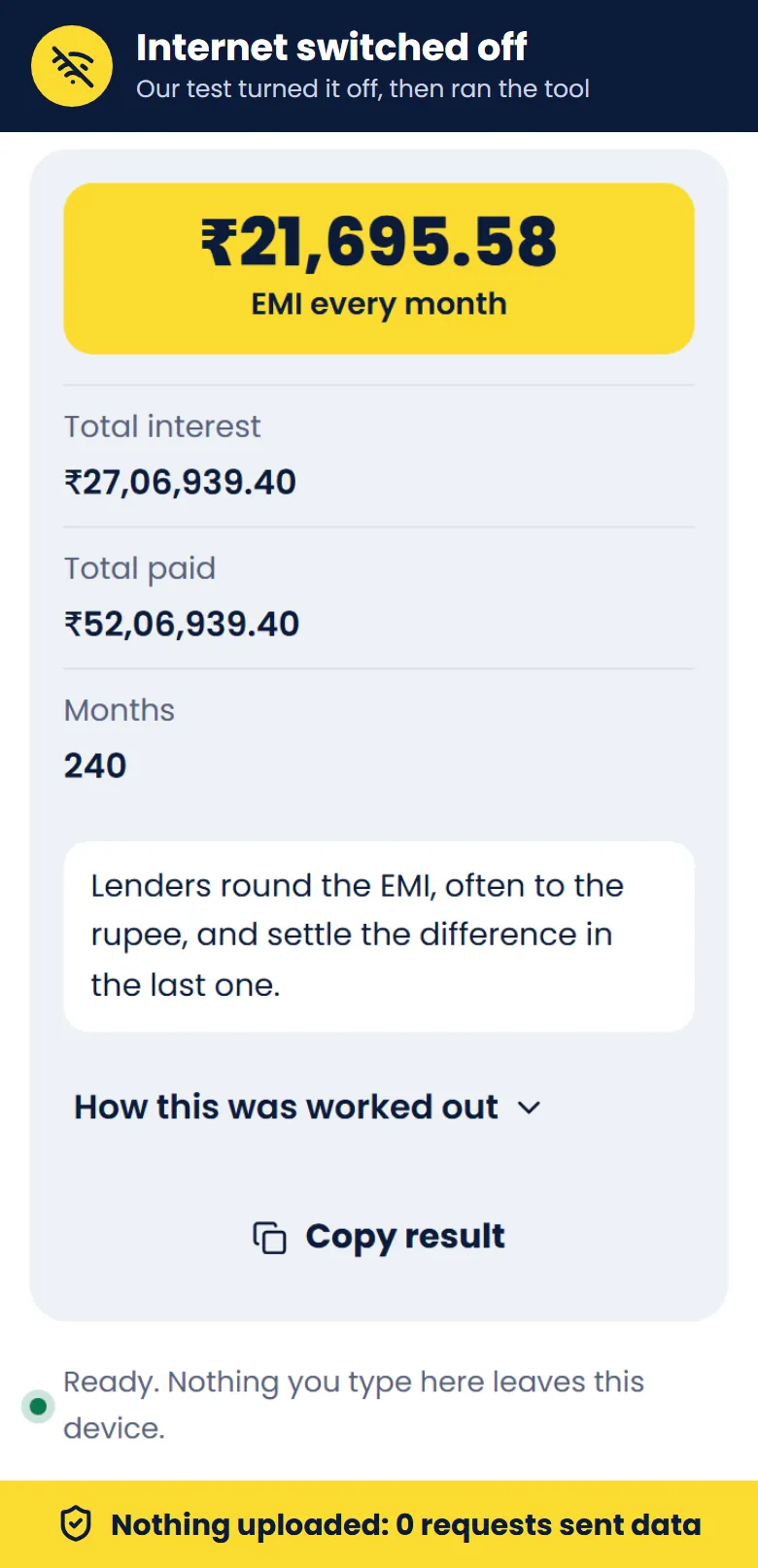
EMI Calculator, free and private: work out the monthly EMI of a home, car or personal loan, with the total interest and the total paid.
Open EMI Calculator