The quick answer
A reducing rate charges interest only on what you still owe, so the interest falls as you repay. A flat rate charges interest on the full loan for the whole tenure, even though you repay part of it every month. That is why a flat rate always looks lower than a reducing rate that costs the same.
The difference is large. A loan of ₹5,00,000 at 7% flat for 5 years costs ₹1,75,000 of interest, with an EMI of ₹11,250, and that is the same as a reducing rate of 12.50%. So a “7%” loan is really dearer than a bank's 11% reducing-rate loan. To compare any two offers, turn the flat rate into its reducing rate with the Flat to Reducing Rate Calculator, then compare like with like. It matters most for the small, quick loans people take without much thought, for a phone, a bike or a course, where a flat rate is common and the true cost is easy to miss.
How a flat rate works
A flat rate is simple interest on the whole loan: loan × rate × years. The interest is worked out once, at the start, and spread evenly over the EMIs. It is sometimes called an add-on rate, since the interest is added on to the loan before it is divided into instalments.
- The interest: ₹5,00,000 × 7% × 5 years = ₹1,75,000.
- The total to repay: ₹5,00,000 + ₹1,75,000 = ₹6,75,000.
- The EMI: ₹6,75,000 ÷ 60 months = ₹11,250.
Divided evenly, each EMI is ₹8,333.33 of the loan and ₹2,916.67 of interest, every month, so the interest never falls even though, by the last year, you owe only a small part of the loan. The Simple Interest Calculator gives the same ₹1,75,000, since a flat rate's interest is simple interest.
How a reducing rate works
With a reducing rate, also called a reducing-balance or diminishing-balance rate, the interest each month is charged on the balance you still owe. As the balance falls, so does the interest, and more of each EMI goes to the loan itself. Home loans, most bank personal loans and the EMI Calculator use reducing rates. When you repay part of such a loan early, the balance drops at once and so does all the interest still to come, which is why prepaying a reducing-rate loan early in its life saves the most.
Seen as a reducing-rate loan at 12.5041%, the same ₹11,250 EMIs pay about ₹5,210 of interest in the first month, when all ₹5,00,000 is owed, and only about ₹116 in the last month, when almost nothing is left. That falling interest is exactly what a flat rate's single number hides. Over the whole loan, the borrower at 12.5041% reducing pays the same ₹1,75,000 as the one at 7% flat: the two are one loan described in two ways, and only the reducing rate can be compared fairly with other offers.
Comparing two real-looking offers
Say a dealer offers ₹5,00,000 for 5 years at 7% flat, and a bank offers the same amount for the same time at 11% reducing. The flat offer sounds cheaper. Here are the two side by side:
| Offer | EMI | Total interest |
|---|---|---|
| 7% flat (12.50% reducing) | ₹11,250.00 | ₹1,75,000.00 |
| 11% reducing | ₹10,871.21 | ₹1,52,272.69 |
The “7%” loan costs ₹22,727.31 more in interest and ₹378.79 more every month. The fair way to compare is always the same: convert the flat rate, then compare the EMI, the total paid and the reducing rates side by side. The calculator's guide walks through the same comparison. If an offer states only the EMI, the Loan Interest Rate Calculator finds the reducing rate from the loan, the EMI and the number of EMIs.
The same flat rate is different for each tenure
A flat rate doesn't turn into one fixed reducing rate: the answer depends on how long the loan runs. For 7% flat:
- 6 months: 11.90% reducing.
- 1 year: 12.68%.
- 2 years: 12.91%.
- 3 years: 12.83%.
- 5 years: 12.50%.
- 10 years: 11.69%.
The reducing rate is highest around two years and then falls slowly, while the total interest keeps growing every year. The loan amount doesn't change it at all: ₹50,000 or ₹50 lakh at 7% flat for 5 years is 12.50% either way.
Why “double it” is only a rough guide
People often say a flat rate is “about double” its reducing rate, or use the formula flat × 2n ÷ (n + 1), with n the number of months. For 7% flat over 60 months that formula gives 13.77%, while the true figure is 12.50%: more than a whole percentage point out. For a 3-year loan, the true reducing rate comes to about 1.7 to 1.9 times the flat rate: 5% flat is 9.31%, 10% flat is 17.92%, and 15% flat is 25.98%.
The rule is off because it treats the loan as if you owed exactly half of it on average, while in a real loan the balance falls slowly at first and quickly at the end, so you owe more than half for most of the time. There is no exact formula for the reducing rate: it has to be found by trying rates until the EMI matches. A spreadsheet's RATE function does it, and the calculator does it exactly, comparing exact EMIs on either side of each hundredth of a percent so the rounding is always right.
Worked examples
Each of these was worked out with the calculator, exactly:
| Loan | EMI | Interest | Reducing rate |
|---|---|---|---|
| ₹1,00,000 at 10% flat, 1 year | ₹9,166.67 | ₹10,000 | 17.97% |
| ₹2,00,000 at 12% flat, 2 years | ₹10,333.33 | ₹48,000 | 21.57% |
| ₹3,00,000 at 9% flat, 4 years | ₹8,500 | ₹1,08,000 | 15.99% |
| ₹10,00,000 at 8% flat, 5 years | ₹23,333.33 | ₹4,00,000 | 14.13% |
| ₹50,000 at 15% flat, 1 year | ₹4,791.67 | ₹7,500 | 26.62% |
In every case the reducing rate is far above the flat rate, and the shorter or smaller the loan, the easier it is to overlook: ₹7,500 of interest on a ₹50,000 loan for a year sounds modest, but 26.62% is a very high rate.
Where you will meet flat rates
Flat rates are most often quoted for two-wheeler and car loans at dealers, loans for phones and appliances, some personal loans, and loans from small lenders, because the smaller number is easier to advertise. They are not wrong or hidden: they are a different way of stating a cost, and the EMI is what you actually pay. The tell-tale sign is interest worked out as loan × rate × years. Whenever you see that, or the word flat, convert the rate before comparing.
A “no-cost EMI” is a different case: the rate shown is 0%, but the interest may be built into the price or taken back as a discount you don't get. Compare the total you pay with the price you would pay in one go.
Fees, and the APR on the Key Facts Statement
Neither rate tells the whole cost: processing fees, insurance and other charges come on top. Under the Reserve Bank of India's circular of 15 April 2024 on the Key Facts Statement for loans and advances, every new retail and MSME term loan sanctioned from 1 October 2024 by a bank, a co-operative bank or an NBFC must come with a Key Facts Statement that includes a computation sheet of the annual percentage rate, the APR, and the loan's repayment schedule; the APR includes all the charges the lender levies.
So ask for the Key Facts Statement before you sign, and compare offers by their APR as well as by their reducing rate and EMI. The calculator converts the rate alone, which is the part a flat quote hides; the APR adds the fees. With a processing fee, the APR is always above the reducing rate, since you pay the fee but don't get to use that money.
Paying a flat-rate loan off early
With a reducing-rate loan, a part payment saves interest straight away, because interest is charged on what remains. With a flat-rate loan the interest was fixed when the loan started, so what a prepayment saves depends entirely on the lender's terms: some reduce the interest still to come, others do not, and some charge a fee for closing early. If you might repay early, ask how a prepayment is worked out before you take the loan, and get the answer in writing. A loan that is cheap only if it runs its full term is not cheap if you plan to clear it in a year.
Questions to ask before you sign
- Is the rate flat or reducing? If it is flat, convert it.
- What is the APR on the Key Facts Statement, with every fee in it?
- What are the processing fee and the insurance, and are they paid upfront or added to the loan?
- Are any EMIs paid in advance, at the start? That raises the real cost.
- What does it cost to prepay or close early, and is the interest reduced?
Write the answers down for each offer, and compare the EMI, the total paid and the APR side by side. A dealer or lender who sees that you know the reducing rate may well offer a better deal. If two offers come out close, the one with lower fees, a fair prepayment rule and no advance EMIs is usually the better choice.
Try it: type the loan, the flat rate and the tenure to see the reducing rate it really is.
Open the Flat to Reducing Rate Calculator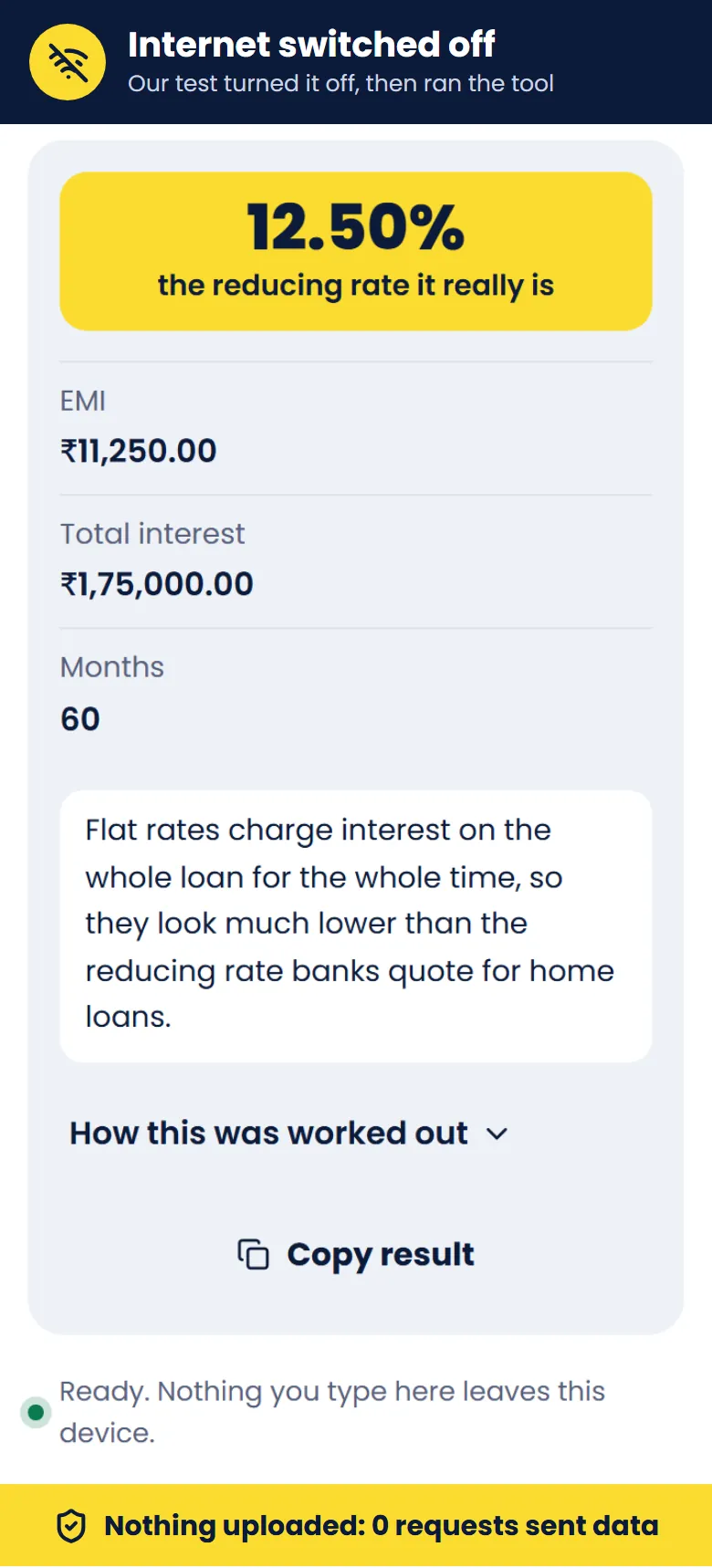
Flat to Reducing Rate Calculator, free and private: see the real reducing-balance rate of a loan quoted at a flat rate, and its EMI.
Open Flat to Reducing Rate Calculator