What Days Between Dates does
Days Between Dates counts the days from one date to another. Type the two dates and the answer appears at once: the number of days, the same span in weeks and days and in years, months and days, and how many of the days are weekdays, Monday to Friday, and how many are Saturdays and Sundays. You choose whether the end date is counted, with the working shown step by step.
The start date begins as today, so the page also counts the days from today to any date. It all happens in your browser: nothing you type is uploaded or kept.
When it helps:
- How many days are left until an exam, a wedding, a trip or a due date.
- How long something lasted: a project, a stay, a course or a loan.
- Working days between two dates, Monday to Friday.
- A span in weeks, for a pregnancy diary, a course plan or a training schedule.
Step by step
- Type the start date: the day and the year, and choose the month by its name. It starts as today; "Use today's date" brings today back after you change it. Digits typed in Hindi and other scripts are read as 0 to 9.
- Type the end date the same way.
- Choose whether to count the end date: No, up to the end date, or Yes, which adds one day.
- Read the answer: the days in large type, then the weeks and days, the years, months and days, the weekdays and the weekends, and both dates with their weekdays.
- Open "How this was worked out" to see the four steps, and Copy result for the answer as text.
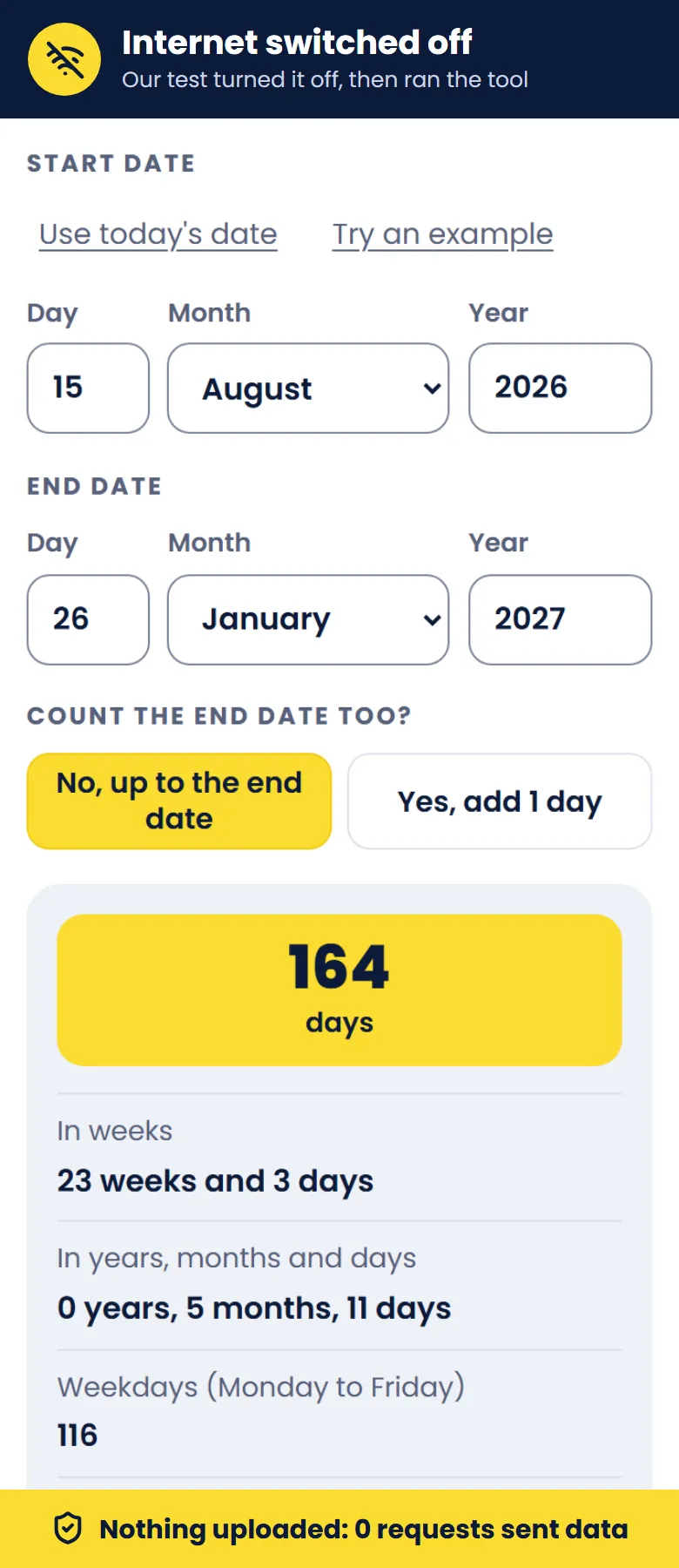
Try an example puts in 15 August 2026 and 26 January 2027.
The rules, in full
These are the calculator's rules, and the same rules are checked by our tests.
| Part | The rule | Example |
|---|---|---|
| Days | The start date and each day after it, up to but not including the end date; one more when the end date is counted | 1 to 2 January: 1 day, or 2 counting both |
| Weeks | The days in whole weeks of 7, and the days left over | 164 days: 23 weeks and 3 days |
| Years, months and days | Whole years, then whole months, then days, by the Age Calculator's rule: a month later is the same day number, or the month's last day when it is shorter | 31 January to 29 February 2024: 1 month, 0 days |
| Weekdays | Monday to Friday among the days counted; no public holidays are taken off | The example: 116 weekdays |
| Order | An end date before the start date is counted the other way round, and a note says so | 1 March 2027 to 1 November 2026: 120 days |
| Range | Years 1900 to 9999 on the Gregorian calendar, leap years included | 29 February 2024 is a day; 29 February 2026 is not |
Real results from our tests
We tested the Days Between Dates with headless Chromium 148, the open-source browser Chrome is built on, on a Windows laptop with an Intel Core i7-1185G7 and 32 GB of memory, on 1 November 2026. Other work was running on the laptop at the same time, so times vary a little from run to run: each time below is the middle one of 3 runs.
Checked against a second program. Python's own datetime and calendar modules, with none of the page's code, counted 10,000 random pairs of dates from 1900 to 9999, with and without the end date, and the page gave the same answers every time: the days, the weeks and days, the years, months and days, and the weekdays and weekends.
The answer is drawn at once. The page worked out an answer in 1.70 milliseconds or less, in the middle of 3 runs of 200 different inputs worked out in a row, not counting the moment the browser takes to paint the screen.
Size and offline. On a first visit the page downloads about 0.1 MB for the tool: the page, its styles, its scripts and the fonts, with Google's ad code not counted. In our test we switched the network off after the page had loaded and pressed Try an example: the answer showed 0.1 seconds later or less in each of 15 runs.
Phone-sized screen. We also ran the tests on a phone-sized screen in headless Chromium (390 × 844 pixels, with touch). That is not a real phone. Every button and box was 44 pixels high or more, and the page did not scroll sideways. These tests don't cover Safari or Firefox.
Try it yourself: press "Try an example" at the top of this page. It puts 15 August 2026 and 26 January 2027 in the boxes, and the answer is 164 days: 23 weeks and 3 days, or 5 months and 11 days, with 116 weekdays. Then choose to count the end date: 165 days.
Counting the end date, or not
The one choice that changes the answer is whether the end date counts. Not counting it gives the gap between the two dates: from 15 August 2026 to 26 January 2027 is 164 days, the number of nights a guest would stay. Counting it gives the days the span covers, both dates included: 165 days, the number of days a course running from the first date to the last would take.
Neither is wrong; they answer different questions. A whole year shows the difference clearly: 1 January to 31 December 2026 is 364 days not counting the end date, and 365 days, exactly one year, counting it. When a rule, a form or an agreement asks for a number of days, read how it counts, and choose to match; if it doesn't say, ask the office that set it.

Years, months and days
Months have different lengths, so a span in months needs a rule. This page uses the same rule as our Age Calculator: a month later is the same day number in the next month, or that month's last day when it is shorter. So 31 January 2024 to 29 February 2024 is exactly 1 month, and the page adds a note when the rule was used.
The example shows how it counts: from 15 August 2026, 5 whole months bring you to 15 January 2027 without passing 26 January 2027, and 11 more days reach it, so the span is 0 years, 5 months and 11 days. Counting the end date, it is 5 months and 12 days. Days and weeks need no rule at all, so they are the safest numbers to quote.
Weekdays and weekends
The page counts how many of the days are weekdays, Monday to Friday, and how many are Saturdays and Sundays. Each whole week has 5 weekdays, and the days left over are counted by name: in the example, 23 whole weeks give 115 weekdays, and the 3 days left over, a Saturday, a Sunday and a Monday, add 1, for 116 weekdays and 48 weekend days.
Public holidays are not taken off, because they differ from state to state, from bank to bank and from year to year: the note under every answer says so. For working days, take the holidays in your span off the weekday count yourself; for a job that works on Saturdays, add the Saturdays back.
Everyday uses
- A countdown: keep the start as today and type the day of the exam or the trip.
- Days of a stay or a trip, not counting the end date for nights.
- A course or a leave, counting both dates.
- Working days for a plan, from the weekday count, less the holidays.
- The date a number of days away: use Add Days to Date, which works the other way round.
For your age on a date, in years, months and days, use the Age Calculator.
Worked examples
Some spans people often count, with the end date not counted unless the row says so:
| From and to | Days | Weeks and days | Weekdays |
|---|---|---|---|
| 1 January 2026 to 15 August 2026 | 226 | 32 weeks, 2 days | 162 |
| 1 November 2026 to 25 December 2026 | 54 | 7 weeks, 5 days | 39 |
| 2 to 27 November 2026, both counted | 26 | 3 weeks, 5 days | 20 |
| 1 November 2026 to 1 May 2027 | 181 | 25 weeks, 6 days | 130 |
| 1 April 2026 to 31 March 2027, both counted | 365 | 52 weeks, 1 day | 261 |
| 1 January 2000 to 1 November 2026 | 9,801 | 1,400 weeks, 1 day | 7,000 |
A financial year, 1 April to 31 March, counted with both dates, is 365 days, or exactly 1 year, 0 months and 0 days, with 261 weekdays. In years, months and days, 1 November 2026 to 1 May 2027 is exactly 6 months, though it is 181 days, and 1 January 2000 to 1 November 2026 is 26 years and 10 months.
Common mistakes
- Swapping the day and the month. 03/08 can be 3 August or 8 March; choosing the month by name avoids it.
- Counting the end date when the rule doesn't, or the other way round: the answers differ by one day.
- Treating months as 30 days. Months are 28 to 31 days long, so 6 months can be 181 to 184 days; quote days when it must be exact.
- Taking weekdays as working days. Holidays are not taken off; subtract the ones in your span.
- Forgetting the leap day. The page counts 29 February in leap years; a hand count by 365 days a year misses it.
- Using the wrong year. Check both years in the boxes; today's date is the start until you change it.
Reading the answer
The large figure is the number of days, counted the way you chose. Under it come the same span in weeks and days, in years, months and days, the weekdays and the Saturdays and Sundays, and the two dates with their weekdays, so you can check you typed the right ones: the example runs from Saturday, 15 August 2026 to Tuesday, 26 January 2027. A line says whether the end date was counted, and notes say when the dates were swapped or the month-end rule was used. Copy result gives all of it as four lines of text, ready to paste.
Leap years and the calendar
The page counts on the Gregorian calendar, the one most of the world uses, with its leap year rule: a year is a leap year if it divides by 4, except years ending in 00, which must divide by 400. So 2024 and 2028 have 29 February, 2026 does not, 2000 did and 2100 will not. Every leap day inside a span is counted, so 31 January 2024 to 29 February 2024 is 29 days, and the same span in 2026, which has no 29 February, can't be typed at all: the page asks for a real date.
Because whole days are counted on the calendar, the answer never depends on time zones or on the time of day: a date is a date. The only thing taken from your device is today's date, for the start date until you change it.
Days in each month
Counting by hand, these are the lengths to add up:
| Month | Days | Month | Days |
|---|---|---|---|
| January | 31 | July | 31 |
| February | 28, or 29 in a leap year | August | 31 |
| March | 31 | September | 30 |
| April | 30 | October | 31 |
| May | 31 | November | 30 |
| June | 30 | December | 31 |
Thirty days has September, April, June and November, as the old rhyme says; all the rest have 31, except February. A year has 365 days, or 366 in a leap year, and 52 weeks and 1 day, or 2 in a leap year, which is why a date's weekday moves on by one each year, and by two after a leap day.
Counting by hand
To check the example by hand, count what is left of the first month, then the whole months, then the days of the last month. From 15 August 2026, 16 days are left in August; then come September's 30, October's 31, November's 30 and December's 31; then the 26 days of January 2027: 16 + 30 + 31 + 30 + 31 + 26 = 164. Counting the end date adds one: 165.
The other forms come from the same count. 164 is 23 × 7 + 3, so 23 weeks and 3 days. In months, 15 August to 15 January is 5 whole months, and 15 to 26 January is 11 days more: 5 months and 11 days.
A year in days
A year is not always the same number of days. 1 November 2026 to 1 November 2027 is 365 days, with 260 weekdays; 1 November 2027 to 1 November 2028 is 366, because 29 February 2028 falls in between, with 262 weekdays. In years, months and days, both are exactly 1 year. When a rule says a year, check whether it means the calendar year or 365 days.
Counting down from today
The start date is today's date until you change it, so the page works as a countdown. On Sunday, 1 November 2026, Christmas Day, Friday, 25 December 2026, is 54 days away, or 7 weeks and 5 days, with 39 weekdays; 31 March 2027, the last day of the financial year, a Wednesday, is 150 days away, or 4 months and 30 days, with 107 weekdays. Count the end date as well if the last day itself counts.
Private: your dates stay on your device
What you type never leaves your device. The calculator runs inside your browser and has no upload step: it never sends the dates you type anywhere, and it doesn't save them, so closing the page forgets them. The page's Content Security Policy lets it contact only this site and Google's ad service, which pays for the site; our code never gives your numbers to the ad code. You can check it yourself in your browser's network panel (F12 on a computer): working out the answer adds no request that carries what you typed.
Read our privacy policy and how we prove your files are never uploaded.
Tips
- Choose the month by name, so the day and the month can't be swapped.
- Decide on the end date before you read the answer, and match the rule you are following.
- Quote days or weeks when a span must be exact; months depend on a rule.
- Take holidays off the weekday count for working days.
- Copy the result to keep the answer with both dates.
Limits
- No public holidays are taken off the weekdays.
- Whole dates only: no times of day or time zones; today is your device's date.
- Years 1900 to 9999, on the Gregorian calendar.
- Months follow one rule, the Age Calculator's; other tools may count months another way.
- Not a legal count. Laws, courts and offices have their own ways of counting days; follow theirs.
Terms explained
- Inclusive
- Counting both the start and the end date.
- Weekday
- Monday to Friday.
- Leap year
- A year with 29 February: every fourth year, but not years ending in 00 unless they divide by 400.
- Gregorian calendar
- The calendar most of the world uses, with its leap year rule.
- Month-end rule
- The rule that a month after the 31st is the next month's last day when it is shorter.