What the RD calculator does, and when you need it
A recurring deposit, an RD, takes the same amount from you every month for a fixed time, at a fixed rate, and pays it all back with interest at the end. Banks and post offices offer them for anything from 6 months to 10 years. It is the deposit for people who save from each month's income rather than from a lump sum: ₹2,000 a month for a phone, ₹5,000 a month for fees next year.
Type the monthly deposit, the yearly rate and the number of months, and this calculator shows the maturity amount, the interest earned and the total deposited, worked out the way Indian banks work out RDs, with interest added every quarter. It all happens in your browser: nothing you type is uploaded or kept.
When it helps:
- Before opening an RD, to see what a monthly amount becomes.
- Saving for a known cost on a known date, such as fees, a wedding or a vehicle's down payment.
- Comparing two banks' rates, or an RD with an FD or a SIP.
Step by step
- Type the monthly deposit in rupees, such as 2,000. Commas the Indian or the international way and Hindi digits are read.
- Type the interest rate the bank quotes, as a yearly percentage, such as 6.5.
- Type the time in months, such as 36 for 3 years, from 1 to 600.
- Read the answer: the maturity amount in large type, then the interest earned and the total deposited.
- Open “How this was worked out” for how each deposit grows, and use Copy result for a one-line summary.
Try an example fills in ₹2,000 a month at 6.5% for 36 months, and Clear empties the boxes.
What the page does, exactly
These are the calculator's rules in full, and the same rules are checked by our tests.
| Part | The rule | Example |
|---|---|---|
| What you can type | Digits, also those of Hindi and other scripts, a dot for decimals, and commas the Indian or the international way | 2,000 and 2000 are the same |
| The boxes' limits | At least ₹1 a month, a rate from 0% to 30% a year, and 1 to 600 whole months | 36.5 months gets a message under its box |
| Each deposit | Made at the start of its month, and grows for the months it stays, with interest added every quarter: M × (1 + r ÷ 400)months ÷ 3 | The first of 36 deposits grows for 36 months, the last for 1 |
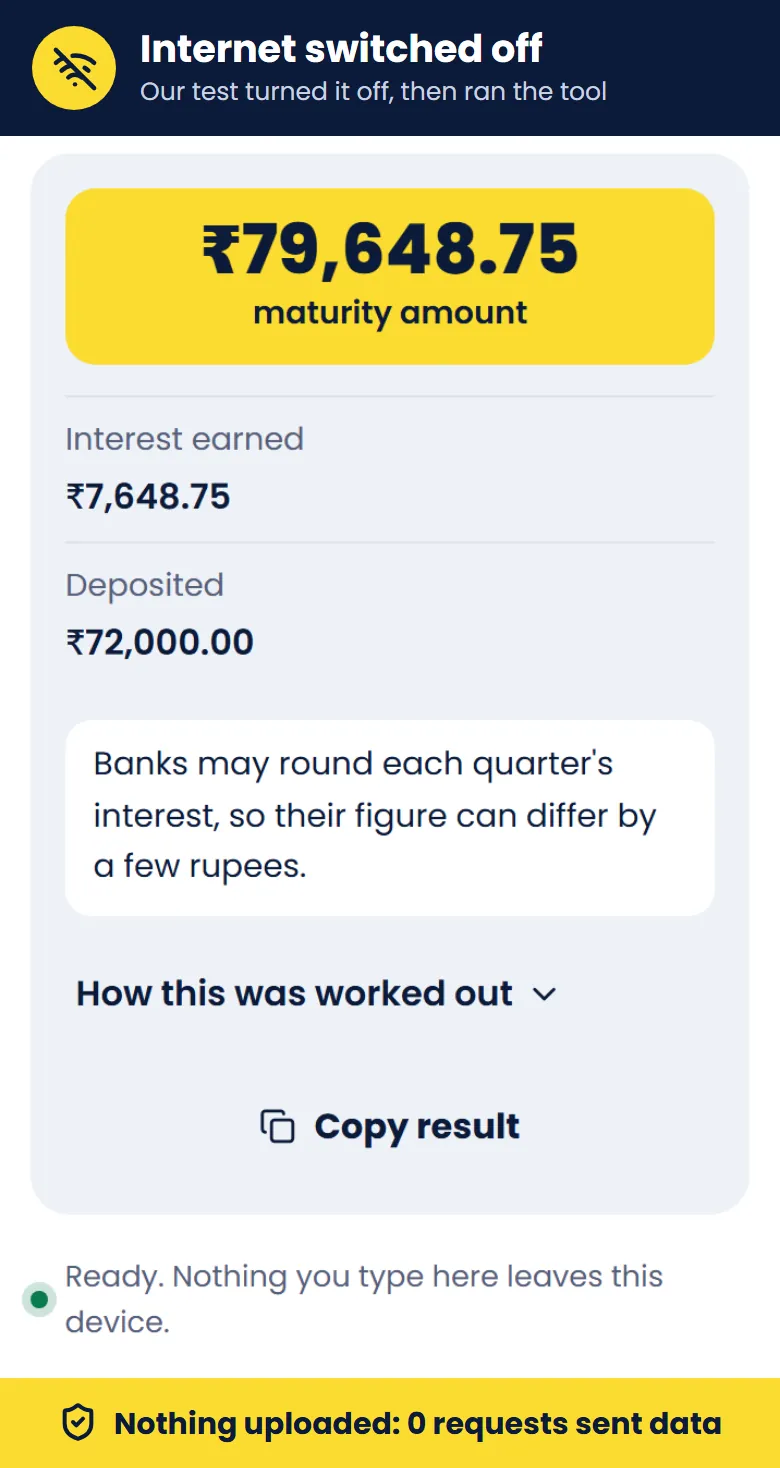
| The maturity amount | All the deposits' amounts added up | ₹2,000 a month at 6.5% for 36 months: ₹79,648.75 |
| Rounding | A month is a third of a quarter, so the growth has a cube root in it: it is worked out to 60 decimal places, far beyond what any amount needs. Amounts are rounded to the paisa, half a paisa up, only when they are written, in the Indian way | ₹7,648.75 of interest |
What the rules don't decide: banks may round each quarter's interest, count days rather than months, or credit interest on slightly different dates, so their figure can differ by a few rupees. The calculator assumes every instalment is paid on time, at one rate.
Real results from our tests
We tested the RD Calculator with headless Chromium 148, the open-source browser Chrome is built on, on a Windows laptop with an Intel Core i7-1185G7 and 32 GB of memory, on 1 November 2026. Other work was running on the laptop at the same time, so times vary a little from run to run: each time below is the middle one of 3 runs.
Checked against a second program. Python's decimal numbers, with 120 digits and none of the page's code, worked out 10,000 random recurring deposits of ₹1 to ₹10 lakh a month, at rates from 0% to 30% and for 1 to 600 months, and the page's code gave the same 30,000 amounts every time, to the paisa: the maturity amount, the interest and the deposits of each. The boxes were typed as people type them, with Indian and international commas, in Hindi, Bengali and Gujarati digits, and with a % sign after the rate.
The answer is drawn at once. The page drew the answer to a typed amount in 0.17 milliseconds (the middle of 3 runs of 200 amounts typed in a row), not counting the moment the browser takes to paint the screen. Even 600 months at a rate typed to 40 digits, the longest sum the page does, was drawn in 0.5 milliseconds.
Size and offline. On a first visit the page downloads about 0.1 MB for the tool: the page, its styles, its scripts and the fonts, with Google's ad code not counted. In our test we switched the network off after the page had loaded and pressed Try an example: the maturity amount showed 0.1 seconds later or less in each of 15 runs.
Phone-sized screen. We also ran the tests on a phone-sized screen in Chromium (390 × 844 pixels, with touch). That is not a real phone. Every button and box was 44 pixels high or more, and the page did not scroll sideways.
Try it yourself: press "Try an example" at the top of this page. It puts 2,000, 6.5 and 36 in the boxes and the maturity amount is ₹79,648.75. Then change the months to 60: it is ₹1,41,981.64.

How an RD grows
An RD is many small deposits, each growing for a different time. With ₹2,000 a month for 36 months at 6.5%, interest added every quarter:
- The first deposit stays 36 months, 12 quarters, and grows to ₹2,000 × 1.0162512, about ₹2,427.
- The 19th deposit stays 18 months, 6 quarters: about ₹2,203.
- The last deposit stays one month, a third of a quarter: about ₹2,011.
Adding up all 36 gives ₹79,648.75, of which ₹72,000 is what you put in. So the early deposits earn most of the interest: the first year's twelve earn far more than the last year's, which is one more reason not to stop an RD early. Banks print the same idea as a formula with a cube root, because a month is a third of a quarter; the calculator adds the deposits up exactly as that formula does.
Tenure and rate
A longer RD earns more, because the early deposits grow for longer. ₹5,000 a month at 7%:
- 12 months: ₹62,310.66 from ₹60,000, for ₹2,310.66 of interest.
- 60 months: ₹3,59,663.95 from ₹3,00,000: ₹59,663.95 of interest.
- 120 months: ₹8,68,508.67 from ₹6,00,000: ₹2,68,508.67 of interest.
The interest is smaller than an FD's on the same total, because the money goes in bit by bit: on average, each rupee is in the RD for about half the tenure. Compare RD rates for the tenure you want, since banks often pay different rates for different tenures. A one-year RD earns only a little interest; its real value is the habit of saving every month.
Worked examples
- A phone in two years: ₹3,000 a month at 6.5% for 24 months gives ₹77,055.18.
- A year of savings: ₹10,000 a month at 7% for 12 months gives ₹1,24,621.32.
- Fees in three years: ₹2,000 a month at 6.5% for 36 months gives ₹79,648.75, ₹7,648.75 of it interest.
- A small, steady habit: ₹1,000 a month at 6.7% for 60 months gives ₹71,365.83 from ₹60,000.
Missed instalments
An RD expects every instalment on time. Banks and the post office usually charge a small penalty for a late instalment, and after several missed ones may close the RD, paying back what was deposited with a lower rate of interest. The rules differ between banks, so read your RD's terms. The calculator shows what an RD paid in full gives; a missed month lowers the result by more than its own amount, because that deposit and its interest are missing from then on. A standing instruction from your savings account is the easiest way never to miss one.
Closing an RD early
Most RDs can be closed before maturity. Banks then usually pay the rate for the time the money actually stayed, minus a penalty set in their rules, so you get back your deposits and less interest than the calculator shows. To see roughly what you would get, type the months already paid and the bank's rate for that shorter tenure, less the penalty; the bank's own figure is the one that counts. If you need only part of the money for a while, many banks offer a loan against an RD instead, which leaves the RD and its rate running.
Tax on RD interest
RD interest is income and is taxed at your slab rate, like FD interest. A bank deducts tax at source (TDS) once the interest you earn from it in a financial year, on RDs and FDs together, passes a threshold: since 1 April 2025, ₹50,000 a year, or ₹1,00,000 for senior citizens (Finance Bill 2025 memorandum, read on 1 November 2026). The calculator shows interest before tax. If your income is below the taxable limit, Form 15G, or 15H for senior citizens, asks the bank not to deduct TDS.
RD or FD?
An FD needs the whole amount on day one and earns interest on all of it for the whole time; an RD builds the amount month by month. With the money already in hand, an FD earns more: ₹60,000 in an FD at 7% for a year, added every quarter, ends at ₹64,311.54, while ₹5,000 a month in an RD at the same rate ends at ₹62,310.66. Without it, an RD is how you build the sum, and when it matures, the amount can go into an FD. Many people run both: an RD for monthly saving, rolled into an FD each year. The FD Calculator works out the second step.
RD or SIP?
Both take a fixed amount every month. An RD's rate is fixed and known; a SIP in a mutual fund has no fixed return and can fall as well as rise. ₹5,000 a month for 10 years is ₹8,68,508.67 in an RD at 7%, against an estimate of ₹11,61,695.38 in the SIP Calculator at a steady 12%, which no fund promises. Money needed on a fixed date, soon, suits an RD; money for goals many years away is often split between the two.
Why the bank's figure can differ a little
- Rounding: some banks round each quarter's interest to the rupee.
- Days, not months: some count the actual days each deposit stays.
- The day of the month the instalment is taken can shift interest by a little.
- A different rate for senior citizens or for staff; type the rate you are offered.
If the difference is more than a few rupees, ask the bank for its RD maturity table, which lists the maturity value for each instalment amount.
The post office RD
The post office's National Savings Recurring Deposit runs for 5 years, from ₹100 a month in multiples of ₹10 with no upper limit, and can be continued for another 5 years at maturity. Half the balance can be withdrawn after the first year, and the account can be closed early after 3 years, at the post office savings account's lower rate. Its interest rate is set by the government every quarter: 6.7% a year since 1 October 2023, as the National Savings Institute's table shows (NSI), kept unchanged for October to December 2026 by the Department of Posts' order of 30 September 2026 (SB Order 12/2026), both read on 1 November 2026.
₹1,000 a month at 6.7% for 60 months works out to ₹71,365.83 here. The post office publishes maturity values for each instalment amount, and its own rounding can make its figure differ by a few rupees; its figure is the one paid.
Working back from a goal
To find the instalment a goal needs, see what ₹1 a month becomes, then divide. Type 1 as the deposit with your rate and months: at 6.5% for 24 months, ₹1 a month becomes about ₹25.69. A goal of ₹1,00,000 in two years then needs ₹1,00,000 ÷ 25.69, about ₹3,893 a month. Round it up to a convenient ₹3,900 and check: the maturity amount is ₹1,00,171.74, just over the goal.
Who can open one, and paying ahead
At the post office, an RD can be opened by an adult alone or by up to three adults jointly, and a guardian can open one for a minor, so parents often run one in a child's name for a known expense years ahead. Banks offer similar choices, and many let you open an RD online in a few minutes from your savings account. The post office also lets you pay 6 or 12 instalments in advance, for a small rebate. The calculator assumes one instalment at the start of each month; paying ahead, or a bank that counts days rather than months, changes the figure slightly, so treat the result as a close estimate and the bank's or post office's statement as the final word.
Private: your numbers stay on your device
Your deposits, rates and months never leave your device. The calculator runs inside your browser and has no upload step: it never sends the numbers you type anywhere, and it doesn't save them, so closing the page forgets them. The page's Content Security Policy lets it contact only this site and Google's ad service, which pays for the site; our code never gives your numbers to the ad code. You can check it yourself in your browser's network panel (F12 on a computer): working out a maturity amount adds no request that carries your numbers.
Read our privacy policy and how we prove your files are never uploaded.
Tips
- Set up a standing instruction so no instalment is missed.
- Match the tenure to the goal's date, so you never close early.
- Compare rates for that tenure across banks and the post office.
- Keep the bank's maturity figure and check it against the calculator.
- Open one RD for each goal, so that each matures when its money is needed.
Limits
- Interest added every quarter, as Indian banks usually do; other ways of adding it aren't offered.
- Every instalment on time, the same each month, at one rate.
- Before tax: TDS and income tax are not taken off.
- Not advice. It works out the numbers; the bank's own figure is the one that counts.
- Browsers. We tested only in Chromium, the engine behind Chrome and Edge, with computer and phone-sized screens. We did not test on real phones, in Safari or in Firefox, so we cannot promise how they behave.
Terms explained
- Recurring deposit (RD)
- A deposit of the same amount every month for a fixed time, at a fixed rate.
- Instalment
- Each monthly deposit.
- Maturity amount
- What you receive at the end: all the instalments plus the interest.
- Quarterly compounding
- Interest added every three months, so that it earns interest too.
- TDS
- Tax deducted at source: tax the bank takes off interest above a yearly limit.
- Standing instruction
- An order to your bank to move the instalment from your account every month.