What the temperature converter does, and when you need it
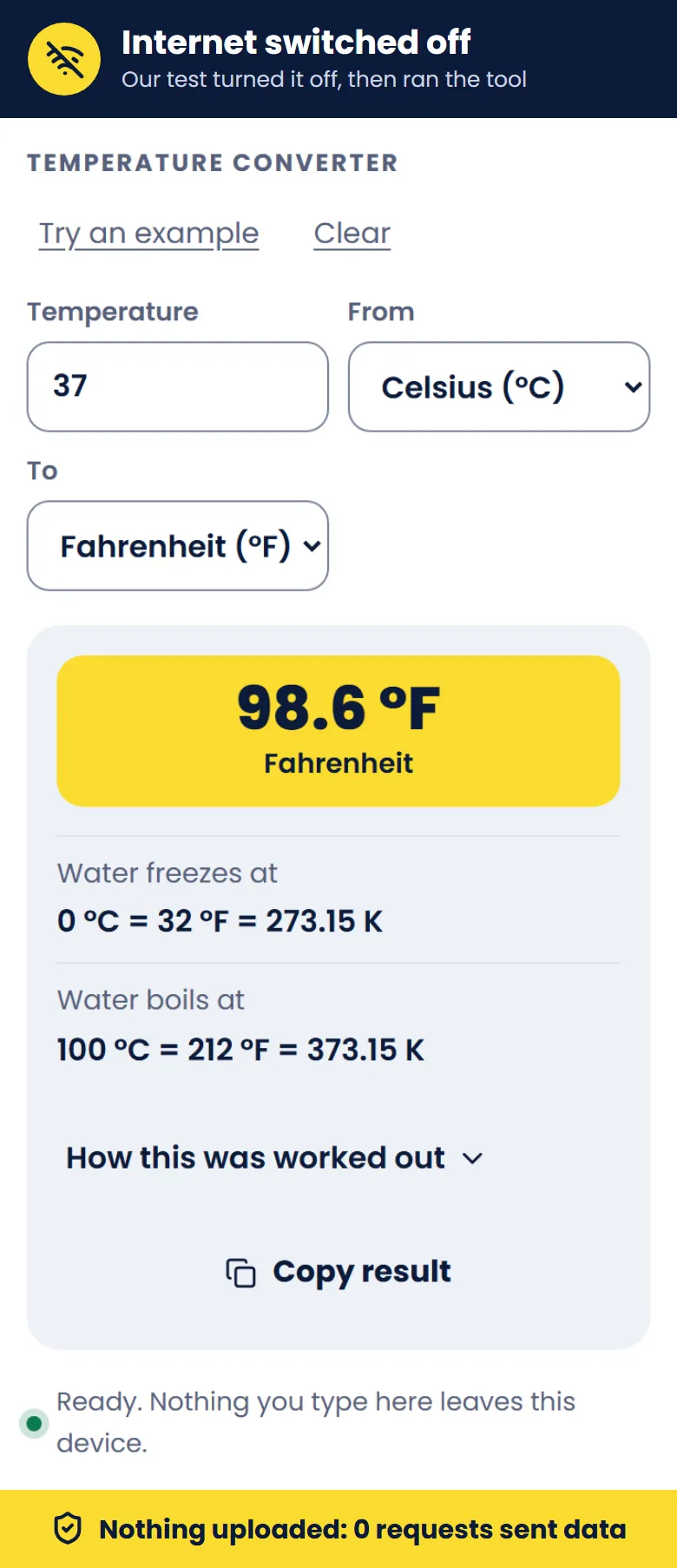
Type a temperature, choose its scale and the scale you want, and this converter gives the answer at once, with the formula used. 37 °C is exactly 98.6 °F; 100 °F is 37.7778 °C. It converts between Celsius, Fahrenheit and Kelvin, works out every sum exactly, and writes the answer to four decimal places at most.
It all happens in your browser: nothing you type is uploaded or kept.
When it helps:
- A thermometer in Fahrenheit, or a doctor abroad who asks in Fahrenheit.
- Recipes from abroad with oven temperatures in Fahrenheit.
- Weather reports from countries that use Fahrenheit.
- Science lessons, where Kelvin is the scale of the formulas.
- Appliances and manuals written for other markets, such as an air conditioner or an oven that shows Fahrenheit.
The Length Converter, Weight Converter and Area Converter work the same way, from exact definitions.
Step by step
- Type the temperature, such as 37. Decimals and a minus sign are fine, and Hindi digits are read.
- Choose the scale it is in, such as Celsius, and the scale you want, such as Fahrenheit.
- Read the answer in large type, with the freezing and boiling points of water for comparison.
- Open “How this was worked out” for the formula with your numbers, and use Copy result for a one-line summary.
Try an example fills in 37 °C to Fahrenheit, and Clear empties the box.
What the page does, exactly
These are the converter's rules in full, and the same rules are checked by our tests.
| Part | The rule | Example |
|---|---|---|
| What you can type | Digits, also those of Hindi and other scripts, a dot for decimals and a minus sign, from −459.67 to 1,00,00,00,000 | -40, 98.6 |
| The formulas | °F = °C × 9 ÷ 5 + 32; °C = (°F − 32) × 5 ÷ 9; K = °C + 273.15 | 37 × 9 ÷ 5 + 32 = 98.6 |
| The sums | Worked out exactly, in fractions, not in the computer's binary approximations | 98.6 °F is exactly 37 °C |
| How it is written | To 4 decimal places at most, half away from zero; written in full when that is exact | 37.7778 °C; 26.85 °C |
| Below absolute zero | A note says so when the temperature is below 0 K, which nothing can reach | −300 °C is below absolute zero |
Real results from our tests
We tested the Temperature Converter with headless Chromium 148, the open-source browser Chrome is built on, on a Windows laptop with an Intel Core i7-1185G7 and 32 GB of memory, on 1 November 2026. Other work was running on the laptop at the same time, so times vary a little from run to run: each time below is the middle one of 3 runs.
Checked against a second program. Python's exact fractions, with none of the page's code, converted 25,000 random temperatures from −459.67 to 10,000, between every pair of the three scales, and the page's code gave the same 25,000 answers every time, to 4 decimal places. The boxes were typed as people type them, with Indian and international commas, and in Hindi, Bengali and Gujarati digits.
The answer is drawn at once. The page drew the answer to a typed temperature in 0.16 milliseconds (the middle of 3 runs of 200 temperatures typed in a row), not counting the moment the browser takes to paint the screen.
Size and offline. On a first visit the page downloads about 0.1 MB for the tool: the page, its styles, its scripts and the fonts, with Google's ad code not counted. In our test we switched the network off after the page had loaded and pressed Try an example: the answer showed 0.1 seconds later or less in each of 15 runs.
Phone-sized screen. We also ran the tests on a phone-sized screen in Chromium (390 × 844 pixels, with touch). That is not a real phone. Every button and box was 44 pixels high or more, and the page did not scroll sideways.
Try it yourself: press "Try an example" at the top of this page. It puts 37 in the box, from Celsius to Fahrenheit, and the answer is 98.6 °F. Then change it to -40: -40 °F, the one temperature the two scales share.

The three scales
- Celsius puts water's freezing point at 0 °C and its boiling point, at sea level, at 100 °C. India, and almost every country, uses it for weather, cooking and medicine.
- Fahrenheit puts the same two points at 32 °F and 212 °F, 180 degrees apart. The United States uses it every day, and older Indian thermometers and some medical charts still do.
- Kelvin starts at absolute zero, the coldest anything can be, and its steps are the same size as Celsius degrees, so 0 °C is 273.15 K. Science uses it because it has no negative numbers. Kelvin has no degree sign: it is “300 K”, not “300 °K”.
The formulas, by hand
A Fahrenheit degree is smaller than a Celsius degree: 180 of them span what 100 Celsius degrees do, so one Celsius degree is 9/5, or 1.8, Fahrenheit degrees. And the scales start in different places, 32 apart. So:
- Celsius to Fahrenheit: multiply by 9, divide by 5, add 32. 37 °C × 9 ÷ 5 = 66.6, plus 32 is 98.6 °F.
- Fahrenheit to Celsius: take away 32, multiply by 5, divide by 9. 100 °F − 32 = 68, × 5 ÷ 9 = 37.7778 °C.
- Celsius to Kelvin: add 273.15. 25 °C is 298.15 K.
Keep the order: subtract 32 before multiplying when going to Celsius, and add 32 after multiplying when going to Fahrenheit.
A quick way in your head
For a rough Fahrenheit figure, double the Celsius and add 30: 25 °C becomes about 80 °F, against the exact 77 °F. For a rough Celsius figure, take 30 from the Fahrenheit and halve it: 86 °F becomes about 28 °C, against the exact 30 °C. The shortcut is closest around 10 °C and drifts away from it, so for medicine or cooking, use the exact answer here.
Body temperature and fever
A body temperature of about 37 °C is 98.6 °F, the figure many thermometers mark as normal, though a healthy person's temperature varies a little through the day and between people. 38 °C is 100.4 °F, and 39 °C is 102.2 °F. A temperature reading is a medical question beyond the arithmetic: for a fever in a baby, a high fever or one that lasts, ask a doctor, whichever scale your thermometer uses.
Ovens and cooking
Recipes from America give oven temperatures in Fahrenheit. 350 °F, a common baking temperature, is 176.6667 °C, and ovens here are usually set to 180 °C, which is exactly 356 °F. 200 °C is 392 °F. Oven dials are seldom accurate to a few degrees, so round to the nearest setting your oven has; an oven thermometer shows the real temperature inside. Deep frying is usually done at about 175 to 190 °C, which is 347 to 374 °F. British recipes sometimes give a gas mark instead of degrees: gas mark 4 is 350 °F, about 180 °C.
Weather
A pleasant 25 °C day is 77 °F; a summer afternoon of 45 °C is 113 °F. When a weather report from America says 104 °F, that is exactly 40 °C. Below freezing, Fahrenheit numbers are still positive down to 0 °F, which is −17.7778 °C, so a forecast of 20 °F is well below freezing: −6.6667 °C. Most weather apps can show either scale, usually from a units setting.
Kelvin and absolute zero
Absolute zero, 0 K, is the temperature at which nothing could be colder: −273.15 °C, or −459.67 °F. Nothing can reach it, though laboratories have come within a tiny fraction of a degree. The converter accepts temperatures down to −459.67 in any scale and adds a note when a temperature is below absolute zero, such as −300 °C, which would be −26.85 K. Room temperature, about 300 K, is 26.85 °C. Kelvin also describes the colour of light: a warm white bulb is around 2,700 K and a cool daylight one around 6,500 K, though no bulb is anywhere near that hot.
Air conditioners and fridges
Appliances made for other markets may show Fahrenheit. An air conditioner set to 24 °C is at 75.2 °F; a fridge kept at about 4 °C is at 39.2 °F; and a freezer at −18 °C is at −0.4 °F, just below zero on the Fahrenheit scale. Most such appliances can be switched to Celsius in their settings menu, which saves converting each time.
Boiling point and altitude
Water boils at 100 °C, 212 °F, only at sea level. Higher up, the air pressure is lower and water boils at a lower temperature, a few degrees lower in the hills, which is why rice and dal take longer to cook there and why a pressure cooker helps. The converter converts temperatures; it doesn't know where you are, so the freezing and boiling points it shows are the sea-level ones.
Reading a thermometer
Digital thermometers can usually be switched between Celsius and Fahrenheit, often by holding a button; look for the letter C or F on the screen before you write the reading down. Readings taken under the tongue, under the arm and in the ear differ a little, so use the same place each time and follow the thermometer's instructions, waiting for the beep before reading it.
In science lessons
Physics and chemistry formulas, such as the gas laws, need temperatures in kelvin. 27 °C is 300.15 K, often rounded to 300 K in textbook problems. Because a kelvin is the same size as a Celsius degree, a rise of 10 °C is also a rise of 10 K, so differences need no converting between those two scales.
Where the scales came from
Daniel Gabriel Fahrenheit set out his scale in the 1720s, and Anders Celsius his in 1742; Celsius's scale at first ran the other way, with 0 for boiling water and 100 for freezing, and was turned round soon after. Kelvin's scale, named after the physicist Lord Kelvin, came in the nineteenth century, and its unit, the kelvin, is today one of the SI's seven base units.
Where the scales meet
There is one temperature that reads the same in Celsius and Fahrenheit: −40. −40 °C × 9 ÷ 5 + 32 = −72 + 32 = −40 °F. Above −40, a Fahrenheit number is always larger than the Celsius number for the same temperature; below it, smaller. It makes a good check on the formulas.
Temperature differences
A change in temperature converts differently from a temperature. A rise of 10 °C is a rise of 18 °F, not 50 °F, because the 32 applies only to temperatures, not to differences. So if a report says the day was 5 degrees warmer in Celsius, that is 9 degrees in Fahrenheit, and the same 5 degrees in Kelvin. The converter converts temperatures; for a difference, multiply by 9/5 or 5/9 and leave out the 32.
Why four decimal places
Fahrenheit to Celsius often gives a recurring decimal: 100 °F is 37.777… °C, with sevens for ever. The converter writes four decimal places, 37.7778, and rounds the last one half away from zero. Thermometers show one decimal at most, so round the answer to one place for use: 37.8 °C. When a conversion comes out exact, such as 98.6 °F to 37 °C, the converter writes it in full and the working says so.
Below freezing
Type a minus sign for temperatures below zero. −10 °C is 14 °F, still above zero on the Fahrenheit scale, because Fahrenheit's zero is far colder than Celsius's: 0 °F is −17.7778 °C. That is why a winter forecast in Fahrenheit can sound mild while being well below freezing.
Worked examples
- 18 °C in Fahrenheit: 64.4 °F.
- 212 °F in Celsius: 100 °C, exactly.
- 0 °F in Celsius: −17.7778 °C.
- 300 K in Celsius: 26.85 °C.
- −40 °C in Kelvin: 233.15 K.
Making your own chart
If you convert the same temperatures often, such as oven settings or fever readings, make a small chart once: work out each value here, copy the results, and print the list or keep it on the fridge. A chart for an oven might run from 150 °C to 250 °C in steps of 10, and one for fever from 36 °C to 41 °C in steps of half a degree.
Quick table
| What | Celsius | Fahrenheit | Kelvin |
|---|---|---|---|
| Absolute zero | −273.15 °C | −459.67 °F | 0 K |
| The scales meet | −40 °C | −40 °F | 233.15 K |
| Water freezes | 0 °C | 32 °F | 273.15 K |
| A warm day | 25 °C | 77 °F | 298.15 K |
| Body temperature | 37 °C | 98.6 °F | 310.15 K |
| Water boils, at sea level | 100 °C | 212 °F | 373.15 K |
Common mistakes
- Adding 32 at the wrong time: add it after multiplying by 9/5, and take it away before multiplying by 5/9.
- Converting a difference like a temperature, with the 32 included.
- Writing °K: Kelvin is written K, without a degree sign.
- Trusting the quick rule for fevers or baking, where a few degrees matter.
Private: your numbers stay on your device
The temperatures you type never leave your device. The converter runs inside your browser and has no upload step: it never sends the numbers you type anywhere, and it doesn't save them, so closing the page forgets them. The page's Content Security Policy lets it contact only this site and Google's ad service, which pays for the site; our code never gives your numbers to the ad code. You can check it yourself in your browser's network panel (F12 on a computer): converting a temperature adds no request that carries your numbers.
Read our privacy policy and how we prove your files are never uploaded.
Tips
- Check −40: any formula you use should turn −40 into −40.
- Remember 37 °C = 98.6 °F and 100 °C = 212 °F as two fixed points.
- For ovens, round to the nearest setting on the dial.
- For a fever, note the scale with the reading when you tell a doctor.
- Switch the device to Celsius when it allows, instead of converting every time.
Limits
- Three scales: Celsius, Fahrenheit and Kelvin; old scales such as Réaumur and Rankine aren't here.
- Temperatures, not differences: for a change in temperature, use 9/5 without the 32.
- Four decimal places at most, which is far more than any thermometer shows.
- Not medical advice: it converts readings; what a reading means is for a doctor.
- Browsers. We tested only in Chromium, the engine behind Chrome and Edge, with computer and phone-sized screens. We did not test on real phones, in Safari or in Firefox, so we cannot promise how they behave.
Terms explained
- Celsius
- The scale with water freezing at 0 °C and boiling at 100 °C, at sea level.
- Fahrenheit
- The scale with water freezing at 32 °F and boiling at 212 °F.
- Kelvin
- The scale that starts at absolute zero, with Celsius-sized steps.
- Absolute zero
- 0 K, −273.15 °C: the lowest possible temperature.
- Degree
- One step on a temperature scale; Fahrenheit's are 5/9 the size of Celsius's.