What a CGPA is, and why a percentage is asked for
A CGPA, a cumulative grade point average, is the average of the grade points a student earned over a school stage or a degree, usually out of 10. Many forms, colleges and employers still ask for a percentage instead, so the CGPA has to be turned into one, and every board and university publishes its own rule for that. If you have marks instead, our post on how to calculate the percentage of your marks shows the sum for several subjects, uneven totals and a target.
CGPA to Percentage Calculator turns a CGPA into a percentage, and a percentage back into a CGPA, by the formula your own board or university publishes. It lists six formulas, from CBSE, Anna University, Delhi University, JNTU Hyderabad, Savitribai Phule Pune University and VTU, each with the institution's own words, what it covers, a link to the page or document where we read it, and the day we read it. For anyone else, you can type your institution's formula yourself. Everything is worked out in your browser, exactly; nothing you type is uploaded or saved.
What it doesn't do: it doesn't decide which formula applies to you, and it doesn't give a certificate. A college, a company or a form may ask for the certificate or the formula of the institution that gave the CGPA.
Step by step: converting a CGPA
- Choose the direction: CGPA to percentage, or Percentage to CGPA.
- Choose your board or university from the list, or Another institution to type a formula yourself.
- Read the card under the list: the formula in plain words, the source's own words, what it applies to, the pages where we read it, and the day we last checked.
- Type your CGPA, or your percentage. Hindi and other Indian digits are read, and a % sign is left out.
- Read the answer: the percentage in large figures with the formula named, an Exact value row when it was rounded, and notes, such as CBSE calling its result indicative.
- Open How this was worked out for each step, and press Copy result to keep the answer with its formula and source.
Try an example fills in a CGPA of 8.2. Decimal places, 2 to begin with, sets how the answer is written.
The formulas, and where each one was read
Every formula on this page is one that a board or a university publishes, and we read it on the page or in the document listed on 13 October 2026. The words in the second column are the source's own, except that a long dash is written as a hyphen. A board or university can change its formula, so check your own regulations as well.
| Board or university | The formula, as the source writes it | What the source says it covers | Where we read it |
|---|---|---|---|
| CBSE (Class X CGPA) | Overall indicative percentage of marks = 9.5 x CGPA | The CGPA of the Class X grades: the average of the grade points of all subjects except the additional sixth subject. The same document gives the rule for one subject: its grade point times 9.5. |
|
| Anna University (R-2015, R-2018, R-2019) | Percentage of Marks = CGPA X 10 | All UG and PG programmes of Regulations R-2015, R-2018 and R-2019, in a letter of the Office of the Additional Controller of Examinations (University Departments). | |
| Delhi University (PG courses, CBCS) | Final Percentage of marks = CGPA based on overall four semesters x 9.5 | Post-graduate (M.A., M.Sc., M.Com and M.B.A.) courses under the Choice Based Credit System: the final percentage of final year students, from the CGPA of all four semesters. |
|
| JNTU Hyderabad (B.Tech R16, R22) | % of Marks = (final CGPA - 0.5) x 10 | B.Tech programmes of Regulations R16 and R22: the percentage equivalent to the final CGPA, at the end of the programme. The regulations say the formula "may be used". |
|
| Pune University (SPPU) | Percentage of marks obtained by candidate = CGPA * 8.9 | The examination section's sheet "Conversion from CGPA to percentage" does not say which programmes it covers: check the regulations of your programme. |
|
| VTU (2015, 2017, 2018 schemes) | Percentage = ( CGPA - 0.75) * 10 | The 2015, 2017 and 2018 schemes only (the page says: "Standard formula to calculate percentage from CGPA for 2015,2017 and 2018 scheme only"). |
|
What the page does, exactly
These are the page's rules in full, and the same rules are checked by our tests.
| Part | The rule | Example |
|---|---|---|
| Choosing a formula | You choose a board or a university from the list. The page never chooses for you, and there is no formula that is meant for everyone. Each choice shows its formula, the source's own words, what the source says it covers, the pages it was read on, and the day we read them | CBSE, Anna University, VTU |
| The shape of a formula | Every formula is written as: percentage = (CGPA minus a number) times a number, plus a number. The first and the last number are 0 when a formula has none | CBSE: CGPA × 9.5; VTU: (CGPA - 0.75) × 10 |
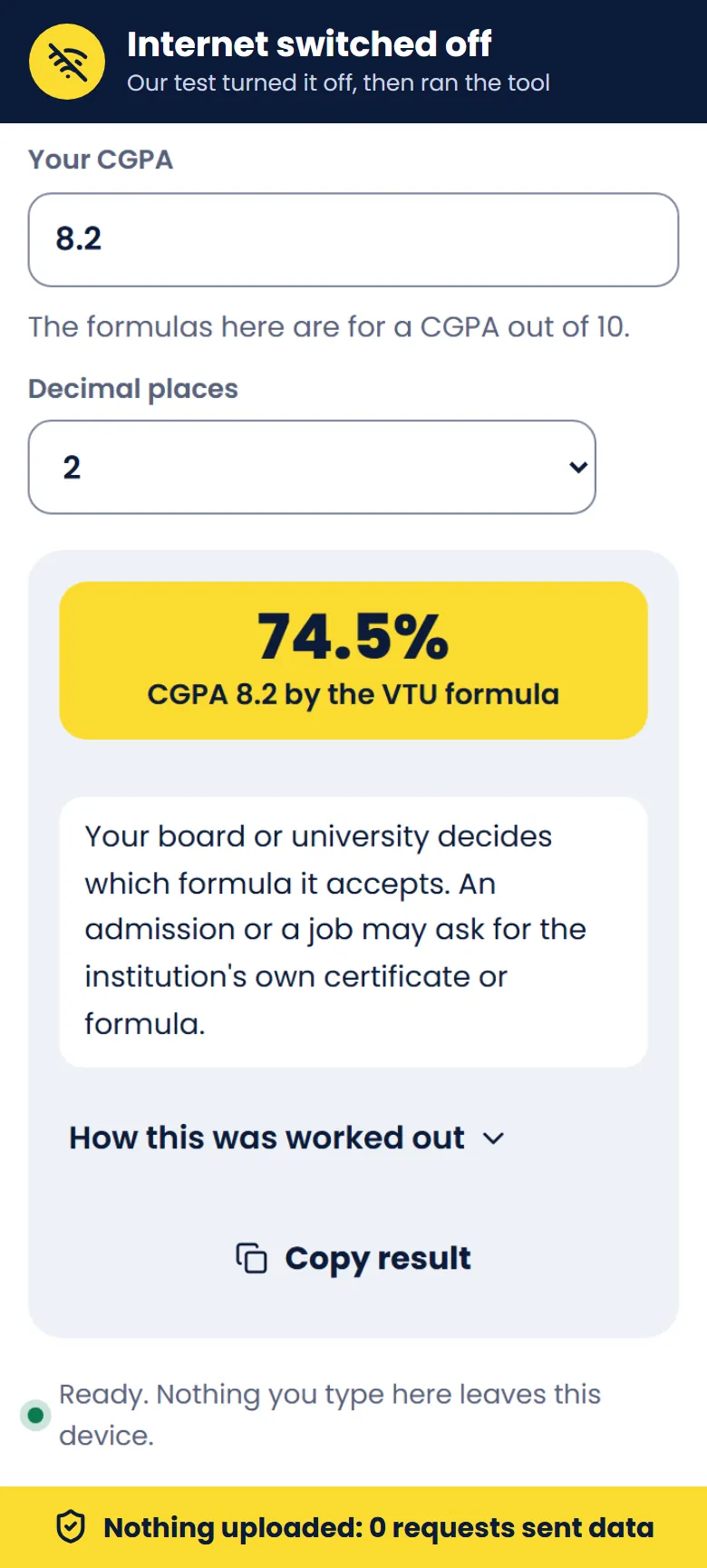
| A CGPA to a percentage | The CGPA minus the first number, times the second number, plus the third. A listed formula is for a CGPA out of 10: a CGPA above 10 or below 0 gets a message, not a guess. A formula that gives less than 0% for a low CGPA (VTU below 0.75, JNTU Hyderabad below 0.5) says so | CBSE: a CGPA of 8.2 is 77.9%; VTU: 8.2 is 74.5% |
| A percentage to a CGPA | The same formula turned round: take away the third number, divide by the second, add back the first. The boards and universities publish a CGPA to a percentage, not this direction, so it is the formula turned round and the page says so. A percentage that no CGPA from 0 to 10 gives (above 95% for CBSE) is explained, with the highest percentage the formula gives | CBSE: 77.9% is a CGPA of 8.2 |
| A formula of your own | Another institution: type the three numbers of the formula your institution gives you. The first and the third may be empty (0); the second is needed; negative numbers are fine. There is no limit of 10 on the CGPA, since your formula may be for another scale. The answer must be a percentage from 0 to 100. The page cannot vouch for a formula that you type | CGPA × 7.1 + 11: a CGPA of 8.2 is 69.22% |
| What you can type | Digits (also those of Hindi, Tamil and other scripts), a dot for decimals, a minus sign in your own formula, a % sign at the end (left out). A comma used as a decimal point is not guessed at: the page asks for a dot. Up to 40 digits. A mistake is said once you pause or leave the box, not while you are still typing | 8.2, ८.२ (Hindi digits for 8.2) |
| Exact numbers, and rounding | Every number is kept as an exact fraction, with no rounding until the answer is written. You choose 0, 1, 2, 3, 4, 6, 8 or 10 decimal places; 2 to begin with. An answer that has no more places than that is written as it is. Any other is rounded half away from zero and written with all the places, and a row gives the exact value (as a decimal when it ends, otherwise as a fraction) | SPPU: a CGPA of 8.25 is 73.43%, exactly 73.425% |
| The working, and Copy result | "How this was worked out" gives the steps in plain words with the exact numbers. Copy result gives a sentence with the answer, the formula in your own words and in the source's, the first source's link and the day we read it, and a reminder that your board or university decides which formula it accepts | "A CGPA of 8.2 is 74.5% by the VTU formula." |
What the rules don't decide: which formula a college, a company or a government form accepts is its own decision, and it may ask for the certificate or the formula of the institution that gave your CGPA. Formulas also change with schemes and regulations, so the scheme each one covers and the day we last read it both matter. A CGPA out of 4, 5 or 7 needs its own institution's formula. And the page knows nothing about any one student's grades: it does the arithmetic of a published formula.
Real results from our tests
We tested the CGPA to Percentage Calculator with headless Chromium 148, the open-source browser Chrome is built on, on a Windows laptop with an Intel Core i7-1185G7 and 32 GB of memory, on 13 October 2026. Other work was running on the laptop at the same time, so times vary a little from run to run: each time below is the middle one of 3 runs.
Every formula has its source. The page lists 6 formulas, and each one was read on the board's or university's own page or document on 13 October 2026: 8 pages and documents in all, each listed with its link, its date and what it says it covers. A formula that we could not read on the official page of its institution was left out. The page shows the day of reading next to each formula, so a visitor can see how old it is.
The answer is drawn at once. The page drew the answer to a typed CGPA in 0.08 milliseconds (the middle of 3 runs of 200 numbers typed in a row, with every formula and both directions), not counting the moment the browser takes to paint the screen.
Checked against a second program. Python's fractions and decimals, none of the page's code and with the 6 formulas typed again by hand, worked out 30,000 conversions, and the page's code gave the same every time: 136,779 results in all. They were a CGPA to a percentage and a percentage back to a CGPA, by every formula and by formulas of the person's own (with a first and a third number, with negative numbers, and with a multiplier of 0), typed with signs, zeros in front, a % sign and Hindi digits, and written to 0, 1, 2, 3, 4, 6, 8 and 10 decimal places. 24,059 of them had an answer and 10,543 of those were rounded, 580 from an exact tie (8.25 times 8.9 is exactly 73.425, which has to go up to 73.43). 5,941 had no answer, such as a CGPA above 10 or a percentage that no CGPA gives, and for each of them the page gave its reason and no number.
Size and offline. On a first visit the page downloads about 0.1 MB for the tool: the page, its styles, its script and the fonts, with Google's ad code not counted. In our test we switched the network off after the page had loaded and chose the VTU formula and typed a CGPA of 8.2: the answer showed 0.1 seconds later or less in each of 15 runs, and less than 0.1 second later in 11 of them.
Phone-sized screen. We also ran every test on a phone-sized screen in Chromium (390 × 844 pixels, with touch). That is not a real phone. Every button and box was 44 pixels high or more, and the page did not scroll sideways.
Try it yourself: press "Try an example" at the top of this page. It puts 8.2 in the box and, for CBSE, the answer is 77.9%. Then choose VTU in the list: the answer is 74.5%, and the card above shows the formula, the university's page and the day we read it. Choose "Percentage to CGPA" and type 74.5: the answer is 8.2.

Why your board or university decides, and what to show a college or an employer
There is no single national rule for turning a CGPA into a percentage. Each board or university sets its own, and the six on this page show how different they are: CBSE multiplies by 9.5, Anna University by 10, a Pune University sheet by 8.9, VTU takes away 0.75 and multiplies by 10, and JNTU Hyderabad takes away 0.5 and multiplies by 10. The same CGPA of 8.2 is 77.9% by CBSE's formula, 82% by Anna University's, 72.98% by Pune's, 74.5% by VTU's and 77% by JNTU Hyderabad's.
So the formula that counts is the one your own institution publishes, for your scheme or regulation. A form, a college or a company may also ask for a certificate from that institution, and this page gives the arithmetic of a published formula, not a certificate.
- Not listed? Ask your examination office, or look in your regulations or on your grade card, then choose Another institution and type the formula.
- A CGPA out of 4, 5 or 7? The listed formulas are for a CGPA out of 10. Use your own institution's formula.
- A newer scheme? Check the scheme in the table above against yours: a formula read for one scheme may not cover the next.
CBSE's multiplier of 9.5, explained
CBSE's own documents, read on 13 October 2026, say three things. The CGPA is the average of the grade points of all subjects except the additional sixth subject; for a candidate with a compulsory subject under NSQF, it is out of six subjects. "An indicative equivalence of Grade Point and percentage of marks" is worked out as 9.5 times the grade point for one subject, and as 9.5 times the CGPA overall. And the grades of Classes IX and X are not combined: the CGPA is shown in Class X.
So a CGPA of 9.2 is 87.4%, 8.2 is 77.9%, and the highest, 10, is 95%. Note CBSE's word "indicative": the result is an equivalence for guidance, not the marks the student actually scored, and the page says so under every CBSE answer.
Common mistakes with CGPA conversions
- Using another institution's formula. A CGPA of 8.2 is 77.9% by CBSE's formula but 74.5% by VTU's. Use your own board's or university's.
- Multiplying by 10 out of habit. By a formula of 9.5, 8.2 is 77.9%, not 82%: the gap is more than four marks in a hundred.
- A CGPA out of 4 or 7 in a formula for 10. The answer means nothing; the page refuses a CGPA above 10 for a listed formula.
- An old scheme's formula for a new one. VTU's page gives its formula for the 2015, 2017 and 2018 schemes only.
- Treating a CGPA worked back from a percentage as official. Institutions publish the formula one way, CGPA to percentage; the page turns it round for you, but nobody issues that number.
- Rounding twice. Round only the final answer; the page keeps the exact value until the end.
Private: what you type stays on your device
Your CGPA and percentages never leave your device. The tool runs inside your browser and has no upload step: it never sends the CGPA and percentages you type, paste or open anywhere, and it does not save them, so closing the page forgets them. The page's Content Security Policy lets it contact only this site and Google's ad service, which pays for the site; our code never gives your CGPA and percentages to the ad code. You can check it yourself in your browser's network panel (F12 on a computer): converting adds no request that carries your CGPA and percentages.
That matters because what people type here is their own result, often on the way to an application. Our privacy policy says the same in full, and How we prove it shows how to check any of our tools. Once loaded, the page works with the internet switched off: in our test with the network off, the answer showed 0.1 seconds later or less in each of 15 runs.
Tips
- Read the card before you trust the answer: what the formula covers, and the day we read it.
- Check your own regulations or grade card for the formula: some print it.
- Open the source link to see the institution's own words.
- Use Copy result to keep the formula and its source with the number, for a form or an email.
- Choose 2 decimal places for forms, unless the form says otherwise.
- Not listed? Type your institution's formula under Another institution.
Limits
- Official formulas only. Only a formula that a board or university publishes on its own page or document, read by us, is listed. If yours is not, use Another institution and type its numbers: the page cannot vouch for them.
- A CGPA out of 10. The listed formulas are for a CGPA out of 10. A CGPA out of another number needs the formula of the institution that gave it.
- Not a certificate. The page does the arithmetic of a published formula. A college, a company or a form may ask for your institution's own certificate or formula, and your institution decides which formula it accepts.
- The day we read it. A board or university can change a formula. Each one says what it covers, with the day we last read it. Your own regulations come first.
- A percentage to a CGPA is worked out. The institutions publish a CGPA to a percentage. The other way is the same formula turned round, and an institution may not accept it.
- Not saved. The numbers and the answers are forgotten when you close the page.
- Browsers. We tested only in Chromium, the engine behind Chrome and Edge, with computer and phone-sized screens. We did not test on real phones, in Safari or in Firefox, so we cannot promise how they behave.
Terms explained
- CGPA
- Cumulative Grade Point Average, the average of the grade points a student has earned over a programme or a school stage, usually out of 10.
- SGPA
- Semester Grade Point Average, the same average for one semester.
- Grade point
- The number a letter grade stands for, such as 10 for the top grade.
- Indicative percentage
- CBSE's own words: an equivalence that is worked out for guidance, not the marks the student scored.
- Scheme and regulations
- The year-wise set of rules a programme follows, such as R-2019 or the 2018 scheme; a formula can differ between them.
- Conversion formula
- The rule a board or university publishes for turning a CGPA into a percentage.