What the inflation calculator does, and when you need it
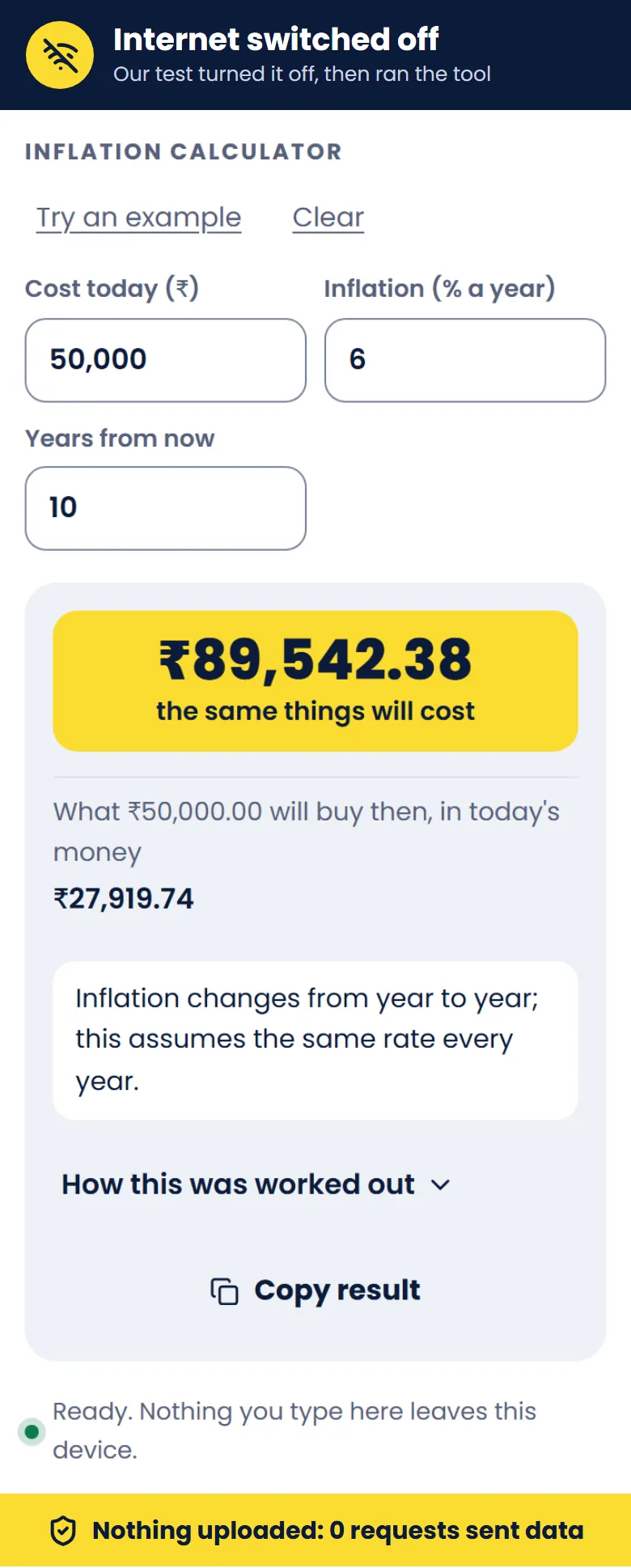
Inflation is the rise in prices over time. When prices rise 6% a year, what costs ₹50,000 today costs ₹53,000 next year, and more each year after, because each year's rise is on the higher price. Over 10 years that ₹50,000 becomes about ₹89,542. The same rise works the other way on money: ₹50,000 kept at home for those 10 years will buy only what about ₹27,920 buys today.
Type today's cost, the inflation rate and the number of years, and this calculator shows what the same things will cost then, and what today's amount will buy then in today's money, with the working. It all happens in your browser: nothing you type is uploaded or kept.
When it helps:
- Planning a goal years away: a child's education, a wedding, a house, retirement.
- Judging a return: is 7% a year on a deposit really growing your money?
- Comparing then and now: what a salary or a price from years ago means today.
Step by step
- Type today's cost in rupees, such as 50,000. Commas the Indian or the international way and Hindi digits are read.
- Type the inflation rate as a yearly percentage, such as 6.
- Type the years from now, such as 10. Part of a year works: 10.5 is ten and a half.
- Read the answer: the future cost in large type, and below it what today's amount will buy then, in today's money.
- Open “How this was worked out” for the formula with your numbers, and use Copy result for a one-line summary.
Try an example fills in ₹50,000 at 6% for 10 years, and Clear empties the boxes.
What the page does, exactly
These are the calculator's rules in full, and the same rules are checked by our tests.
| Part | The rule | Example |
|---|---|---|
| What you can type | Digits, also those of Hindi and other scripts, a dot for decimals, and commas the Indian or the international way | 50,000 and 50000 are the same |
| The boxes' limits | A cost of 0 or more, inflation from 0% to 50% a year, 0 to 100 years | Inflation of 60 gets a message under its box |
| Future cost | Today's cost × (1 + rate ÷ 100)years | ₹50,000 at 6% for 10 years: ₹89,542.38 |
| What it will buy | Today's amount ÷ (1 + rate ÷ 100)years, in today's money | ₹27,919.74 |
| Rounding | Whole years are worked out exactly, in whole numbers and fractions; a part of a year needs a root, worked out to 60 decimal places. Amounts are rounded to the paisa, half a paisa up, only when they are written, in the Indian way | ₹92,189.53 for 10.5 years |
What the rules don't decide: the calculator keeps one rate for every year, though real inflation changes from year to year, and different things, such as food, fees and rent, rise at different rates.
Real results from our tests
We tested the Inflation Calculator with headless Chromium 148, the open-source browser Chrome is built on, on a Windows laptop with an Intel Core i7-1185G7 and 32 GB of memory, on 1 November 2026. Other work was running on the laptop at the same time, so times vary a little from run to run: each time below is the middle one of 3 runs.
Checked against a second program. Python's decimal numbers, with 120 digits and none of the page's code, worked out 25,000 random prices of ₹0 to ₹5 crore, at inflation rates from 0% to 50% and for 0.1 to 100 years, and the page's code gave the same 50,000 amounts every time, to the paisa: the future cost and what the money will buy then, of each. The boxes were typed as people type them, with Indian and international commas, in Hindi, Bengali and Gujarati digits, and with a % sign after the rate. 7 of the amounts sat exactly on half a paisa, and every one was rounded up, as it should be.
The answer is drawn at once. The page drew the answer to a typed amount in 0.08 milliseconds (the middle of 3 runs of 200 amounts typed in a row), not counting the moment the browser takes to paint the screen. Even 99.99 years at a rate typed to 40 digits, with the part year worked out to 60 digits, was drawn in 0.8 milliseconds.
Size and offline. On a first visit the page downloads about 0.1 MB for the tool: the page, its styles, its scripts and the fonts, with Google's ad code not counted. In our test we switched the network off after the page had loaded and pressed Try an example: the future cost showed 0.1 seconds later or less in each of 15 runs.
Phone-sized screen. We also ran the tests on a phone-sized screen in Chromium (390 × 844 pixels, with touch). That is not a real phone. Every button and box was 44 pixels high or more, and the page did not scroll sideways.
Try it yourself: press "Try an example" at the top of this page. It puts 50,000, 6 and 10 in the boxes and the future cost is ₹89,542.38. Then change the years to 20: it is ₹1,60,356.77.

The formula, by hand
Each year multiplies the price by (1 + rate). For ₹50,000 at 6% for 10 years:
- One year's rise: 1 + 6 ÷ 100 = 1.06.
- Ten years: 1.06 multiplied by itself 10 times, about 1.7908.
- The future cost: ₹50,000 × 1.7908, about ₹89,540; with every decimal kept, the calculator works out exactly ₹89,542.38.
- What ₹50,000 will buy then: ₹50,000 ÷ 1.7908, about ₹27,920; exactly, ₹27,919.74 in today's money.
It is the same formula as compound interest, with prices in place of savings, which is why the Compound Interest Calculator gives the same future figure at the same rate.
What money will buy
The second figure is the one people forget. Money kept as cash, or in an account paying less than inflation, loses buying power every year without a single rupee disappearing. At 6% inflation, ₹1,00,000 buys what about ₹55,839 buys today after 10 years, and what about ₹31,180 buys today after 20. That is why savings for long goals are usually kept in something that grows at least as fast as prices.
Choosing a rate
India's inflation is measured by the Consumer Price Index, published every month by the government's statistics office, and it moves from year to year. For long plans, people usually pick a steady figure and try a higher one too: ₹1,00,000 for 10 years becomes ₹1,62,889.46 at 5%, ₹1,79,084.77 at 6% and ₹1,96,715.14 at 7%. Some costs rise faster than the average: school and college fees and medical costs often do, so goals for them deserve a higher rate.
The rule of 72
Divide 72 by the inflation rate to see roughly how many years it takes prices to double: at 6%, about 12 years; at 8%, about 9; at 4%, about 18. Something that costs ₹1 lakh today will cost about ₹2 lakh in 12 years at 6%, and the calculator gives the exact figure: ₹2,01,219.65.
Goals years away
A goal priced in today's rupees is short of what you will need. A degree that costs ₹10,00,000 today will cost about ₹23,96,558 in 15 years at 6%. Work out the future cost here first, then the monthly saving for it with the Goal SIP Calculator, or a deposit with the FD Calculator. Do the same for retirement: monthly expenses of ₹30,000 today become about ₹1,28,756 a month in 25 years at 6%.
Savings against inflation
The return that matters is the one after inflation, the real return. A deposit at 7% with prices rising 6% grows your buying power by only about 1% a year, and by less once tax on the interest is paid. A savings account at a lower rate than inflation loses buying power. Long-term investments are judged by how far they beat inflation over the years, not by their rate alone; type the return minus inflation into the SIP or Lumpsum calculator to see a result in today's money.
Salaries and rent
A raise below inflation is a cut in what the salary buys. With prices up 6%, a 4% raise leaves you about 2% worse off. Turned around, the calculator shows what an old figure is worth now: a salary of ₹50,000 ten years ago, at 6% a year, is about ₹89,542 in today's prices. The same goes for rent agreements with a yearly increase: compare the increase with inflation to see whether the rent is really rising.
Worked examples
- ₹50,000 at 4% for 10 years: ₹74,012.21, and ₹50,000 then buys what ₹33,778.21 buys now.
- ₹1,00,000 at 6% for 20 years: ₹3,20,713.55; ₹1,00,000 then buys what ₹31,180.47 buys now.
- ₹10,00,000 at 6% for 15 years: ₹23,96,558.19.
- ₹50,000 at 6% for ten and a half years: ₹92,189.53, the half year worked out by the same formula.
What an old price means today
The calculator works backwards too. To see what a price from years ago is worth in today's money, type the old price as today's cost and the years since: a bill of ₹1,000 from 20 years ago, at 6% a year, is about ₹3,207 in today's prices. Grandparents' stories of a cinema ticket for a few rupees, or a salary of a few hundred a month, make sense once the years of inflation are counted in.
Planning for retirement
Retirement is where inflation matters most, because the years are long twice over: the years until you retire, and the years you live on savings afterwards. Monthly expenses of ₹30,000 today become about ₹1,28,756 a month in 25 years at 6%, more than ₹15 lakh a year, and they keep rising after retirement too. A plan that saves for today's expenses falls far short. Work out the future monthly cost first, then the savings it needs, and check the plan again every few years with the inflation of those years.
Your emergency fund
An emergency fund, a few months of expenses kept where you can reach them at once, needs a top-up as prices rise. Six months of ₹30,000 is ₹1,80,000 today; at 6% inflation, the same six months will cost about ₹2,40,880 in five years. Raise the fund each year by roughly the year's inflation so it still covers the same months.
Your own inflation rate
The published inflation figure is an average over a typical household's spending. Yours may differ: a family paying school fees, rent in a big city and medical bills often faces higher inflation than the average, and one with a home of its own and no loans may face less. To estimate your own, note what your main costs were a year ago and what they are now. Use that rate for your own goals, and the higher of the two when in doubt.
Loans and inflation
Inflation helps borrowers with a fixed EMI. An EMI of ₹20,000 stays ₹20,000 for the whole loan, but at 6% inflation, in 10 years it is worth only what about ₹11,168 is worth today, and salaries usually rise with prices. That is part of why a long home loan feels lighter in its later years. It works only while the rate stays fixed and income keeps pace; a floating rate can rise with inflation too. The EMI Calculator works out the EMI itself.
Setting prices for a business
A shop, a tutor or a freelancer who never raises prices earns less each year in real terms. A fee of ₹1,000 kept for 5 years at 6% inflation is worth only what about ₹747 is worth today by the fifth year. Raising prices a little each year, roughly by inflation, keeps their value steady, and is easier on customers than one large rise after several years. The calculator shows what today's price should become to keep pace: ₹1,000 at 6% for 5 years is about ₹1,338.
When prices fall
Some things get cheaper over time, such as phones and computers of the same power, while the average price level rises. The calculator takes rates from 0% upwards, so it shows rising prices; for something whose price falls by a steady percentage, work it out by hand: price × (1 − rate ÷ 100)years. A gadget that loses 20% of its price a year is worth about a third of its price after 5 years, which is useful to know when deciding whether to buy now or wait. A sale is different: it lowers one price once, and the Discount Calculator works out what you pay.
Costs that rise faster
The inflation rate in the news is an average over many things, and a single cost can rise faster or slower. School and college fees, for example, can rise faster than prices in general. For a particular goal, type the rise you have seen in that cost, not the average.
The difference grows with time. Fees of ₹1,00,000 a year that rise 10% a year become ₹2,59,374.25 in 10 years; at 6% a year they would be ₹1,79,084.77. That gap of about ₹80,000 a year is why a plan for a child’s education needs the right rate as much as the right amount. Work out the future fee here, then the monthly saving it needs with the Goal SIP Calculator, which turns any future amount into a SIP. For a daughter's education, the Sukanya Samriddhi Calculator shows what that government scheme's account will hold, and our post on what ₹1.5 lakh a year becomes at 21 works out what that amount will buy in today's money.
Private: your numbers stay on your device
Your amounts, rates and years never leave your device. The calculator runs inside your browser and has no upload step: it never sends the numbers you type anywhere, and it doesn't save them, so closing the page forgets them. The page's Content Security Policy lets it contact only this site and Google's ad service, which pays for the site; our code never gives your numbers to the ad code. You can check it yourself in your browser's network panel (F12 on a computer): working out a future cost adds no request that carries your numbers.
Read our privacy policy and how we prove your files are never uploaded.
Tips
- Price long goals in future rupees before working out what to save.
- Try two rates, a steady one and a higher one.
- Use a higher rate for education and medical costs.
- Judge returns after inflation and after tax.
Limits
- One rate for every year; real inflation changes.
- One basket: different costs rise at different rates.
- Not a forecast: it shows what a steady rate would do, not what prices will be.
- Browsers. We tested only in Chromium, the engine behind Chrome and Edge, with computer and phone-sized screens. We did not test on real phones, in Safari or in Firefox, so we cannot promise how they behave.
Terms explained
- Inflation
- The rise in prices over time, as a percentage a year.
- CPI
- The Consumer Price Index: the measure of inflation for a typical basket of household spending.
- Buying power
- What an amount of money can buy; it falls as prices rise.
- Real return
- A return after inflation: roughly the return minus the inflation rate.
- Today's money
- A future amount expressed in what it would buy now.
- Rule of 72
- 72 divided by a yearly rate: roughly the years for prices or money to double.