What the step-up SIP calculator does
A step-up SIP, also called a top-up SIP, is a monthly investment that rises every year, usually when your pay does. You start with an amount you can manage today and raise it each year by a percentage, such as 10%, or by a fixed amount, such as ₹500. Because the larger instalments come later, a step-up builds a much bigger sum than a level SIP of the same first amount.
This calculator shows what such a SIP grows to: the value at the end, what you put in, the gain, and the monthly SIP in the last year, with the working and a year-by-year table, exact to the paisa. It all happens in your browser: nothing you type is uploaded or kept.
When it helps:
- Starting small: seeing what a modest SIP raised every year can reach.
- Choosing the step-up: 5%, 10% or 15% a year, or a fixed ₹500 or ₹1,000.
- Comparing with a level SIP of the same first amount.
- Checking a fund house's figure for the same return and step-up.
Step by step
- Type the monthly investment in year 1, such as
5,000. - Choose how it rises every 12 months: by a percentage or by a fixed amount, and type the step-up, such as
10for 10% or500for ₹500. - Type the expected return as a yearly percentage, up to 50%, and the time in years, up to 60.
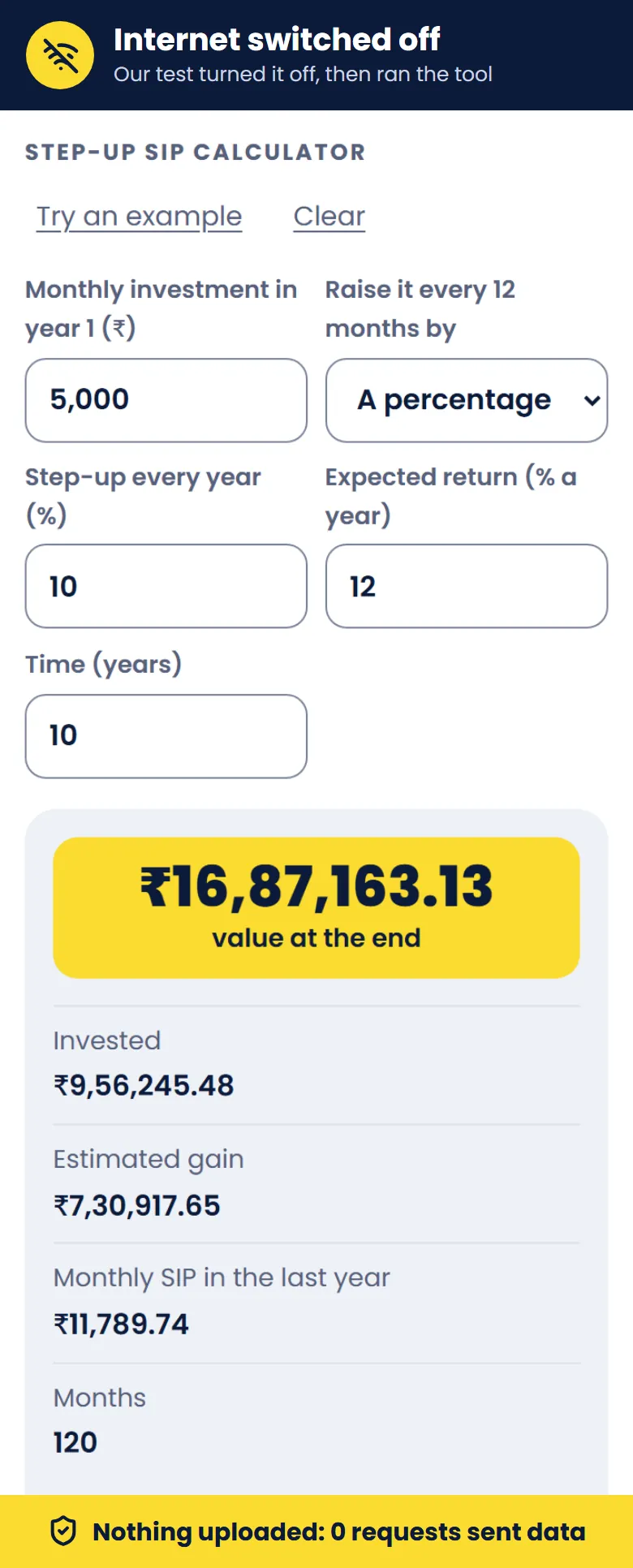
- Read the answer: the value at the end in large type, then what you invest, the estimated gain, the SIP in the last year and the number of months.
- Open "How this was worked out" for the steps and the year-by-year table. Copy result gives a one-line summary.
Try an example fills in ₹5,000 a month rising 10% a year, at 12% for 10 years, and Clear empties the boxes.
The rules, in full
These are the calculator's rules, and the same rules are checked by our tests.
| Part | The rule | Example |
|---|---|---|
| Monthly rate | The yearly return ÷ 12 ÷ 100, added once a month, as the SIP calculator does | 12% a year: 1% a month |
| Payments | Each at the start of its month | The first grows for all 120 months of 10 years |
| The step-up | Every 12 months from the first payment. A percentage is on the last year's SIP, so it compounds; a fixed amount is added | 10%: ₹5,000, ₹5,500, ₹6,050; ₹500: ₹5,000, ₹5,500, ₹6,000 |
| Exact SIPs | The raised SIPs are exact, never rounded on the way, and shown to the paisa | Year 7: ₹8,857.805, shown as ₹8,857.81 |
| A part-year | A time that isn't whole years ends with a shorter year | 2.5 years: a year 3 of 6 months |
| Rounding | Exact until written, half a paisa up; gain = value − invested, so they add up | ₹16,87,163.13 − ₹9,56,245.48 = ₹7,30,917.65 |
Real results from our tests
We tested the Step-up SIP Calculator with headless Chromium 148, the open-source browser Chrome is built on, on a Windows laptop with an Intel Core i7-1185G7 and 32 GB of memory, on 1 November 2026. Other work was running on the laptop at the same time, so times vary a little from run to run: each time below is the middle one of 3 runs.
Checked against a second program. Python's own exact fractions, with none of the page's code, worked out 10,000 random step-up SIPs (in percent and in rupees, returns from 0% to 50%, times up to 60 years, with and without a last part-year) and the page gave the same answers every time, to the paisa: the value, the amount invested, the gain, the last year's SIP and every row of the year-by-year table.
The answer is drawn at once. The page worked out an answer in 1.50 milliseconds or less, in the middle of 3 runs of 200 different inputs worked out in a row, not counting the moment the browser takes to paint the screen. Over 60 years at 12% a year, rising 10% a year, the longest time the page takes, an answer took 30 milliseconds or less. A return typed to 40 digits makes the exact sums far longer: then an answer took up to 0.44 seconds.
Size and offline. On a first visit the page downloads about 0.1 MB for the tool: the page, its styles, its scripts and the fonts, with Google's ad code not counted. In our test we switched the network off after the page had loaded and pressed Try an example: the answer showed 0.1 seconds later or less in each of 15 runs.
Phone-sized screen. We also ran the tests on a phone-sized screen in headless Chromium (390 × 844 pixels, with touch). That is not a real phone. Every button and box was 44 pixels high or more, and the page did not scroll sideways. These tests don't cover Safari or Firefox.
Try it yourself: press "Try an example" at the top of this page. It puts ₹5,000 a month rising 10% a year at 12% for 10 years in the boxes, and the value at the end is ₹16,87,163.13, from ₹9,56,245.48 invested. Then choose a fixed amount and type 500: it is ₹15,72,678.12.
The formula, by hand
A step-up SIP is a row of ordinary SIPs, one for each year, each with its own monthly amount. Each year's payments grow like a SIP of that year's amount for its 12 months, M × ((1 + i)12 − 1) ÷ i × (1 + i), where i is the monthly rate; then that sum keeps growing by (1 + i) a month until the end. Add the years up and you have the value.
For the example, the SIP is ₹5,000 in year 1, ₹5,500 in year 2, ₹6,050 in year 3 and, compounding at 10% a year, ₹11,789.74 in year 10. The value at the end of year 1 is ₹64,046.64; by the end of year 2 it is ₹1,42,620.66; and after all 10 years it is ₹16,87,163.13. What you put in is each year's SIP × 12, added up: ₹9,56,245.48.
A spreadsheet can check it: one row a year, the year's SIP in one column, and =FV(1%, 12, -SIP, 0, 1) for the year's own value, carried forward with × 1.01^12 for each later year.

A percentage or a fixed amount
A percentage step-up grows faster as the years go on, because each rise is on a larger SIP: 10% on ₹5,000 is ₹500, but 10% on ₹10,717.94 in year 9 is ₹1,071.79. A fixed step-up adds the same amount each year: ₹500 a year takes ₹5,000 to ₹9,500 by year 10.
Over 10 years at 12%, ₹5,000 rising 10% a year grows to ₹16,87,163.13 from ₹9,56,245.48 invested; rising ₹500 a year, it grows to ₹15,72,678.12 from ₹8,70,000.00. Over longer times the gap widens, because the percentage keeps compounding. A percentage suits pay that rises by a percentage; a fixed amount is easier to plan and to stick with.
Against a level SIP
With the step-up set to 0, the calculator is a plain SIP: ₹5,000 a month for 10 years at 12% grows to ₹11,61,695.38, the same figure the SIP Calculator gives. The 10% step-up adds ₹5,25,467.75 to that, for ₹3,56,245.48 more put in. The extra value comes mostly from the extra money, and the rest from its growth.
Seen the other way, a step-up lets you start lower for the same goal. If a level SIP for your goal is more than you can manage today, start with what you can and raise it every year; the Goal SIP Calculator works out the level SIP for a goal, and this page shows what a lower start with a step-up reaches.
The year-by-year table
Under the working, "Year by year" opens a table with each year's monthly SIP, the amount invested so far and the value at the end of the year. For the example, year 1 is ₹5,000.00 a month, ₹60,000.00 invested and ₹64,046.64 at its end; year 5 is ₹7,320.50, ₹3,66,306.00 and ₹4,92,285.20; year 10 is ₹11,789.74, ₹9,56,245.48 and ₹16,87,163.13.
A time that isn't whole years, such as 2.5 years, ends with a shorter year in the table, shown with its months. On a phone, each row shows as a small card.
Planning with it
A step-up only works if you keep raising the SIP, so choose a rise you can keep up in a lean year as well as a good one. Many people tie it to their yearly pay rise, and raise the SIP the month the new pay starts. If a fund house offers an automatic top-up, check its own rules, such as how it rounds the new amount and when it applies it; this page shows the exact sum and says when a raised SIP is not a whole paisa.
Returns are not guaranteed: an equity fund's value rises and falls, and the calculator assumes the same return every month. Plan with a careful return, check every year, and remember that prices rise too: the Inflation Calculator shows what the end value will be worth in today's money.
Worked examples
₹5,000 a month to start, at a steady 12% a year, with no step-up, 5% a year and 10% a year:
| Time and step-up | Value at the end | Invested | SIP in the last year |
|---|---|---|---|
| 10 years, none | ₹11,61,695.38 | ₹6,00,000.00 | ₹5,000.00 |
| 10 years, 5% | ₹13,93,471.16 | ₹7,54,673.55 | ₹7,756.64 |
| 10 years, 10% | ₹16,87,163.13 | ₹9,56,245.48 | ₹11,789.74 |
| 15 years, none | ₹25,22,880.00 | ₹9,00,000.00 | ₹5,000.00 |
| 15 years, 10% | ₹43,41,924.72 | ₹19,06,348.90 | ₹18,987.49 |
| 20 years, none | ₹49,95,739.60 | ₹12,00,000.00 | ₹5,000.00 |
| 20 years, 5% | ₹68,68,811.64 | ₹19,83,957.25 | ₹12,634.75 |
| 20 years, 10% | ₹99,44,357.74 | ₹34,36,499.97 | ₹30,579.55 |
The longer the time, the more a step-up adds: over 20 years, a 10% step-up takes the same first ₹5,000 from ₹49,95,739.60 to ₹99,44,357.74, almost double, but the SIP in the last year is ₹30,579.55, so check that the last year's amount is one you could really pay.
Common mistakes
- A step-up you can't keep. A 10% rise every year for 20 years makes the last SIP about six times the first. Choose a rise that matches how your income really grows.
- Mixing up percent and rupees. A 10% step-up and a ₹500 step-up are the same only in the first year; choose the kind you mean before you type.
- Comparing values without the money put in. A step-up SIP ends higher partly because you invest more; compare the gain too, or the value for the same total invested.
- Planning with a hopeful return. The calculator assumes the same return every month; real funds rise and fall.
- Forgetting rising prices. A crore in 20 years buys less than a crore today; the Inflation Calculator shows how much less.
- Skipping the yearly check. Look at what the fund is worth each year and adjust the plan, rather than waiting for the end.
Reading the answer
The large figure is the value at the end, for the steady return you typed. Invested is every month's payment added up, at each year's raised amount; estimated gain is the value less what you invested. The monthly SIP in the last year shows how high the step-up takes the payment, and Months gives the number of payments. Copy result puts all of it on one line to compare plans. The table under the working shows the value growing year by year, so you can see where the plan stands at any point, for example after 5 years.
Questions to ask before you start a step-up SIP
- How much can I invest now? Start there, not at the amount the goal seems to need.
- How fast does my income grow? Match the step-up to it, as a percentage or a fixed amount.
- Can I keep the last year's SIP? The table shows it; make sure it is realistic.
- Does my fund house top up automatically? Ask how it rounds the new amount and when it starts.
- What is the goal and its date? The Goal SIP Calculator gives the level SIP for it; a step-up lets you start lower than that.
A step-up and a goal work well together: find the level SIP the goal needs, then try a lower first SIP with a step-up here until the value at the end reaches the goal.
Starting lower for the same sum
A level SIP would need ₹7,263 a month for 10 years at 12% to reach ₹16,87,478.71, just over the example's ₹16,87,163.13. The step-up gets there from ₹5,000, ₹2,263 lower in the first month, rising to ₹11,789.74 in year 10. It puts in more in total, ₹9,56,245.48 against ₹8,71,560.00, because its larger instalments come later and have less time to grow. What it gives you is an easier start: the first years ask less of you, and the larger instalments come when your pay has, you hope, risen too.
Other starts and step-ups over the same 10 years at 12%: ₹4,000 rising 10% a year grows to ₹13,49,730.51, from ₹7,64,996.38 invested; ₹5,000 rising by a fixed ₹1,000 a year grows to ₹19,83,660.86, from ₹11,40,000.00, with ₹14,000 a month in the last year.
The value in today's money
The value at the end is in the rupees of that year, not today's. If prices rise 6% a year, the example's ₹16,87,163.13 in 10 years will buy about what ₹9,42,103 buys today, and at that rate prices roughly double in 12 years. So set the goal in future rupees too: the Inflation Calculator turns today's price into the price in the year you need it. A step-up that keeps pace with your pay also helps the SIP keep pace with prices.
Private: your numbers stay on your device
What you type never leaves your device. The calculator runs inside your browser and has no upload step: it never sends your amounts, step-ups, returns or years anywhere, and it doesn't save them, so closing the page forgets them. The page's Content Security Policy lets it contact only this site and Google's ad service, which pays for the site; our code never gives your numbers to the ad code. You can check it yourself in your browser's network panel (F12 on a computer): working out the answer adds no request that carries what you typed.
Read our privacy policy and how we prove your files are never uploaded.
Tips
- Start with what you can manage, and let the step-up do the rest.
- Tie the step-up to your pay rise, so the SIP rises when your income does.
- Plan with a careful return and check the plan every year.
- Set the step-up to 0 to compare with a level SIP.
- Look at the last year's SIP: make sure it is an amount you could really pay.
Limits
- One steady return every month; real returns rise and fall.
- A step-up every 12 months from the first payment; no step-up on another date.
- Exact SIPs: a fund house may round a raised SIP to the rupee.
- No tax or costs are taken off; type a return after costs.
- Not advice. It works out the numbers; the choice of fund and plan is yours.
Terms explained
- SIP
- A systematic investment plan: a fixed amount invested in a fund every month.
- Step-up
- A rise in the SIP every year, by a percentage or a fixed amount. Also called a top-up.
- Compounding
- Returns earning returns of their own, and a percentage step-up rising on the last raised SIP.
- Estimated gain
- The value at the end less what was invested.
- Level SIP
- A SIP of the same amount every month.