What the Sukanya Samriddhi calculator does
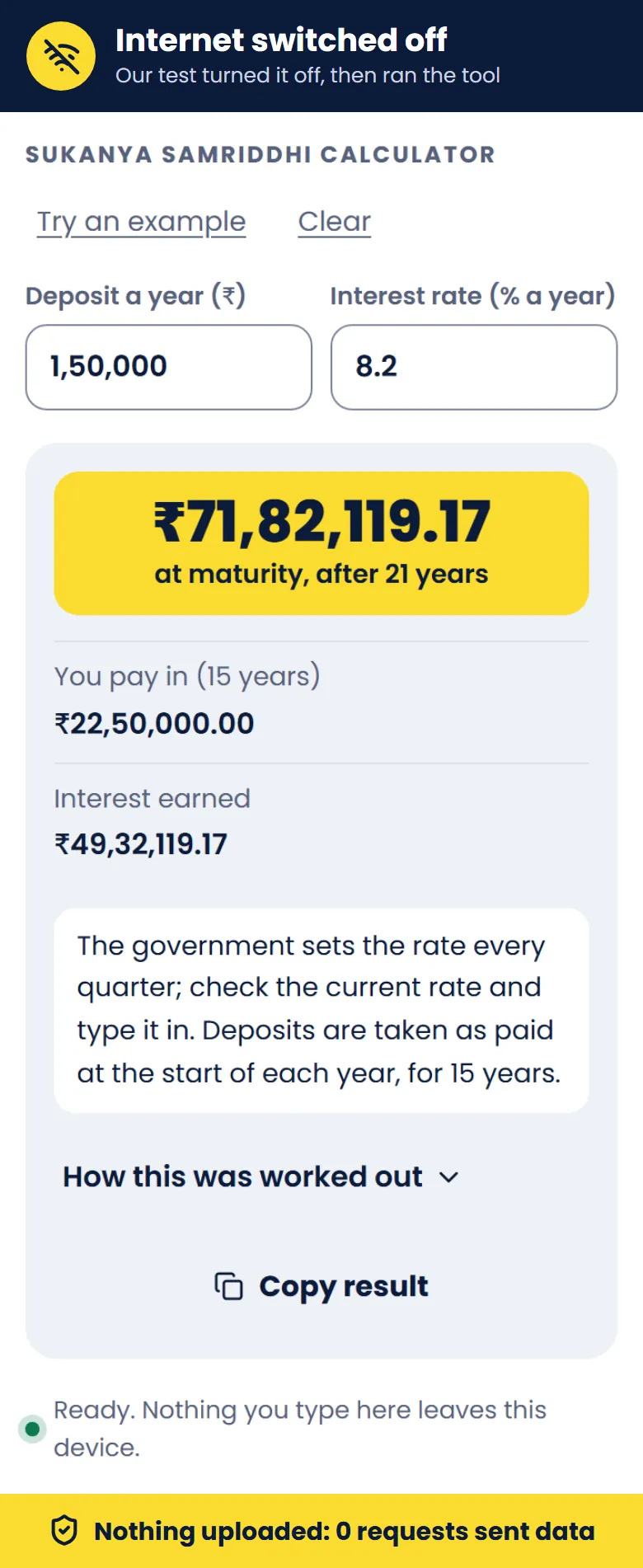
Sukanya Samriddhi is the government's savings scheme for a daughter: a parent or guardian opens the account before she turns 10, pays in for 15 years, and the account matures 21 years after it was opened. This calculator shows what it will be worth then. At the current 8.2% a year, ₹1,50,000 paid in every year grows to ₹71,82,119.17: ₹22,50,000 of deposits and ₹49,32,119.17 of interest.
Type the deposit you plan to make each year and the interest rate, and the calculator shows the amount at maturity, what you pay in and the interest, with the working. It all happens in your browser: nothing you type is uploaded or kept.
When it helps:
- Before opening an account, to see what a yearly amount you can afford will become.
- Choosing the yearly deposit: comparing ₹12,000, ₹50,000 and the full ₹1,50,000.
- Planning her education or wedding, with the amount the account may hold when she is about 21.
- When the rate changes, to see how the new rate changes the end figure.
Step by step
- Type the deposit a year in rupees, from ₹250 to ₹1,50,000, the scheme's limits. Commas the Indian or the international way and Hindi digits are read.
- Type the interest rate as a yearly percentage. The rate since 1 January 2024 is 8.2%; the government can change it every quarter.
- Read the answer: the amount at maturity in large type, then what you pay in over 15 years and the interest earned.
- Open “How this was worked out” to see the formula, and use Copy result for a one-line summary.
Try an example fills in ₹1,50,000 a year at 8.2%, and Clear empties the boxes.
What the page does, exactly
These are the calculator's rules in full, and the same rules are checked by our tests.
| Part | The rule | Example |
|---|---|---|
| What you can type | Digits, also those of Hindi and other scripts, a dot for decimals, and commas the Indian or the international way | 1,50,000 and 150000 are the same |
| The boxes' limits | A deposit from ₹250 to ₹1,50,000 a year, the scheme's own limits, and a rate from 0.1% to 20% | ₹2,00,000 gets a message under its box |
| Deposits | The same deposit every year for 15 years, each paid at the start of its year | 15 deposits of ₹1,50,000 are ₹22,50,000 |
| Interest | Compounded once a year at the rate you type, on every deposit until the end of year 21 | The first deposit grows for 21 years, the last for 7 |
| Maturity | The sum of each deposit grown for its years: deposit × (1 + r)22 − year, for years 1 to 15 | ₹71,82,119.17 at 8.2% |
| Rounding | Every sum is worked out exactly, in whole numbers and fractions rather than the computer's binary approximations; amounts are rounded to the paisa, half a paisa up, only when they are written, in the Indian way | ₹49,32,119.17 of interest |
What the rules don't decide: the calculator uses one rate for all 21 years, while the government sets the rate every quarter. It takes each deposit as paid at the start of the financial year, in April, and the same deposit every year.
Real results from our tests
We tested the Sukanya Samriddhi Calculator with headless Chromium 148, the open-source browser Chrome is built on, on a Windows laptop with an Intel Core i7-1185G7 and 32 GB of memory, on 1 November 2026. Other work was running on the laptop at the same time, so times vary a little from run to run: each time below is the middle one of 3 runs.
Checked against a second program. Python's decimal numbers, with 120 digits and none of the page's code, worked out 25,000 random accounts with deposits of ₹250 to ₹1,50,000 a year, with and without paise, at rates from 1% to 20%, and the page's code gave the same 75,000 amounts every time, to the paisa: the amount at maturity, the deposits and the interest of each. The boxes were typed as people type them, with Indian and international commas, in Hindi, Bengali and Gujarati digits, and with a % sign after the rate.
The answer is drawn at once. The page drew the answer to a typed amount in 0.09 milliseconds (the middle of 3 runs of 200 amounts typed in a row), not counting the moment the browser takes to paint the screen. Even a rate typed to 40 digits, the longest sum the page does, was drawn in 2.0 milliseconds.
Size and offline. On a first visit the page downloads about 0.1 MB for the tool: the page, its styles, its scripts and the fonts, with Google's ad code not counted. In our test we switched the network off after the page had loaded and pressed Try an example: the amount at maturity showed 0.1 seconds later or less in each of 15 runs.
Phone-sized screen. We also ran the tests on a phone-sized screen in Chromium (390 × 844 pixels, with touch). That is not a real phone. Every button and box was 44 pixels high or more, and the page did not scroll sideways.
Try it yourself: press "Try an example" at the top of this page. It puts 1,50,000 and 8.2 in the boxes and the amount at maturity is ₹71,82,119.17. Then change the deposit to 50,000: it is ₹23,94,039.72.

The formula, by hand
Each year's deposit grows, with interest added once a year, from the year it is paid to the end of year 21. For ₹1,50,000 a year at 8.2%:
- The first deposit grows for 21 years: 1.082 multiplied by itself 21 times is about 5.2333, so it becomes about ₹7,84,989.
- The fifteenth deposit, the last, grows for 7 years: 1.082 to the power 7 is about 1.7362, so it becomes about ₹2,60,425.
- Add up all fifteen, from 1.08221 down to 1.0827: that is about 47.8808 for each rupee paid in a year, so about ₹71,82,120 in all; with every decimal kept, the calculator works out exactly ₹71,82,119.17.
A spreadsheet gives the same with =FV(8.2%, 15, -150000, 0, 1) for the balance after 15 years, multiplied by 1.082 to the power 6 for the last six years: about ₹44,75,989 grows to ₹71,82,119.
The scheme's rules
The National Savings Institute, part of the Ministry of Finance, sums up the scheme on its website, and its published rules give the details. The main points:
- Who: a parent or guardian opens the account in the name of a girl who has not yet turned 10. She can have only one account, and a family can open accounts for two girls, with more allowed for twins or triplets.
- Where: at a post office or an authorised bank, and the account can be moved anywhere in India.
- Papers: the girl's birth certificate, with proof of the guardian's identity and address.
- Who runs it: the guardian, until she is 18; then she runs the account herself.
- How much: at least ₹250 and at most ₹1,50,000 in a financial year.
- For how long: deposits are made for 15 years from the day the account is opened, and the account matures 21 years after opening. No interest is paid after 21 years, so close it then.
- Interest: compounded once a year and added at the end of each financial year, at the rate the government announces.
If a year's minimum is missed, the account is in default; it can be brought back by paying the missed minimum with a small penalty for each year. Rules change from time to time, so check the current terms at your post office or bank when you open the account.
Fifteen years in, six to grow
A Sukanya Samriddhi account has two parts. For the first 15 years you pay in; for the last 6 you pay nothing and the balance keeps earning interest. With ₹1,50,000 a year at 8.2%, the balance is ₹44,75,989.33 when the deposits stop, and the six years of interest alone take it to ₹71,82,119.17, more than ₹27 lakh of growth without another rupee from you. The dates follow the account, not her age: opened when she is 2, the deposits end when she is 17 and the account matures when she is 23.
The early deposits matter most. The first ₹1,50,000 grows for 21 years, to ₹7,84,989.30; the last grows for 7 years, to ₹2,60,424.65. A deposit made in April earns interest for the whole year, which is why the calculator takes each deposit as paid at the start of the year; paying later in the year, or in parts through the year, earns a little less. Our post on what ₹1.5 lakh a year becomes shows the balance year by year.
What different deposits give
At 8.2%, every rupee paid in each year for 15 years becomes about ₹47.88 after 21 years:
| Deposit a year | You pay in | At maturity |
|---|---|---|
| ₹250, the minimum | ₹3,750 | ₹11,970.20 |
| ₹12,000, ₹1,000 a month | ₹1,80,000 | ₹5,74,569.53 |
| ₹50,000 | ₹7,50,000 | ₹23,94,039.72 |
| ₹1,00,000 | ₹15,00,000 | ₹47,88,079.45 |
| ₹1,50,000, the maximum | ₹22,50,000 | ₹71,82,119.17 |
If you save ₹1,000 a month, paying the year's ₹12,000 in April, rather than in twelve parts, earns the most interest.
The rate since 2014
The government reviews the rate every quarter, and a new rate applies to the whole balance, not only to new deposits. That is unlike a bank fixed deposit, whose rate is fixed for its term when you open it. The National Savings Institute lists every rate since the scheme began:
| Period | Rate a year |
|---|---|
| 3 Dec 2014 to 31 Mar 2015 | 9.1% |
| Apr 2015 to Mar 2016 | 9.2% |
| Apr 2016 to Sep 2016 | 8.6% |
| Oct 2016 to Mar 2017 | 8.5% |
| Apr 2017 to Jun 2017 | 8.4% |
| Jul 2017 to Dec 2017 | 8.3% |
| Jan 2018 to Sep 2018 | 8.1% |
| Oct 2018 to Jun 2019 | 8.5% |
| Jul 2019 to Mar 2020 | 8.4% |
| Apr 2020 to Mar 2023 | 7.6% |
| Apr 2023 to Dec 2023 | 8.0% |
| Since 1 Jan 2024 | 8.2% |
The Department of Posts kept 8.2% for October to December 2026. Over 21 years the rate will change, so try a few: ₹1,50,000 a year gives ₹65,93,071.43 at 7.6%, the lowest rate so far, ₹69,80,092.77 at 8%, and ₹82,84,210.09 at 9.2%, the highest.
Withdrawals and closing early
- For higher education: once she turns 18 or passes Class 10, whichever comes first, up to half of the balance at the end of the previous financial year can be taken out, against an offer of admission or a fee slip.
- For marriage: the account can be closed early for her marriage once she is 18, from a month before the wedding to three months after it.
- In hardship: the rules allow early closure on grounds such as her serious illness or the guardian's death, and the account closes if she dies.
A withdrawal lowers the balance that earns interest, so the amount at maturity will be less than the calculator shows. The calculator assumes no withdrawals. For any of these, ask at the post office or bank that holds the account for the form and the papers it needs.
Tax
The National Savings Institute's page says deposits qualify for a deduction under Section 80C of the Income Tax Act, and the interest is free of income tax under Section 10. The 80C deduction is available only to those who choose the old tax regime. Tax law changes, so check the current rules for your year on the Income Tax Department's website or with a tax adviser.
Sukanya Samriddhi and PPF
Both are government schemes with a ₹1,50,000 yearly limit, but they differ. Sukanya Samriddhi, at 8.2%, is only for a girl under 10 and runs for 21 years. The Public Provident Fund, at 7.1%, is open to any resident Indian and runs for 15 years, with extensions of 5 years at a time. ₹1,50,000 a year in PPF grows to ₹40,68,209.22 after 15 years; see the PPF Calculator. The periods differ, so compare the rates rather than the end amounts. Many parents with a daughter use both: Sukanya Samriddhi for her, PPF for the family.
Planning with it
Twenty-one years is a long time for prices. A degree that costs ₹10,00,000 today would cost about ₹23,96,558 in 15 years if prices rise 6% a year; the Inflation Calculator works out the future cost of any goal. Compare it with what the account will hold, and if it falls short, the Goal SIP Calculator shows the monthly SIP that could fill the gap. Sukanya Samriddhi gives a known rate set by the government; a SIP in an equity fund may earn more over long periods but can also fall, so many families use both.
Private: your numbers stay on your device
Your deposits and rates never leave your device. The calculator runs inside your browser and has no upload step: it never sends the numbers you type anywhere, and it doesn't save them, so closing the page forgets them. The page's Content Security Policy lets it contact only this site and Google's ad service, which pays for the site; our code never gives your numbers to the ad code. You can check it yourself in your browser's network panel (F12 on a computer): working out the maturity adds no request that carries your numbers.
Read our privacy policy and how we prove your files are never uploaded.
Tips
- Open it early: an account opened when she is a baby matures when she is 21.
- Pay in April: a deposit at the start of the financial year earns interest for the whole year.
- Never miss the minimum: ₹250 a year keeps the account out of default.
- Check the rate each quarter and type the new one here to keep the plan honest.
- Close it at 21: the balance earns no interest after maturity.
- Keep the passbook up to date, or the bank's statement, and check each year's interest against this calculator.
Limits
- One rate for all 21 years; the real rate changes from quarter to quarter.
- The same deposit every year, paid at the start of the year, for all 15 years.
- No withdrawals or early closure.
- Paisa, not rupees. The published rules credit each year's interest rounded to the rupee, so a passbook can differ from the calculator by a few rupees.
- Not advice. It works out the numbers; whether the scheme suits your family is your choice.
- Browsers. We tested only in Chromium, the engine behind Chrome and Edge, with computer and phone-sized screens. We did not test on real phones, in Safari or in Firefox, so we cannot promise how they behave.
Terms explained
- Sukanya Samriddhi Account
- The government's small savings scheme for a girl, opened before she is 10.
- Guardian
- The parent or legal guardian who opens and runs the account until she takes it over.
- Maturity
- 21 years from the day the account is opened, when the balance is paid out.
- Financial year
- 1 April to 31 March, the year the deposit limits and interest follow.
- Compounding
- Interest added to the balance, so the next year's interest is earned on it too.
- Default
- An account in which a year's minimum deposit was not paid.