What the fuel cost calculator does, and when you need it
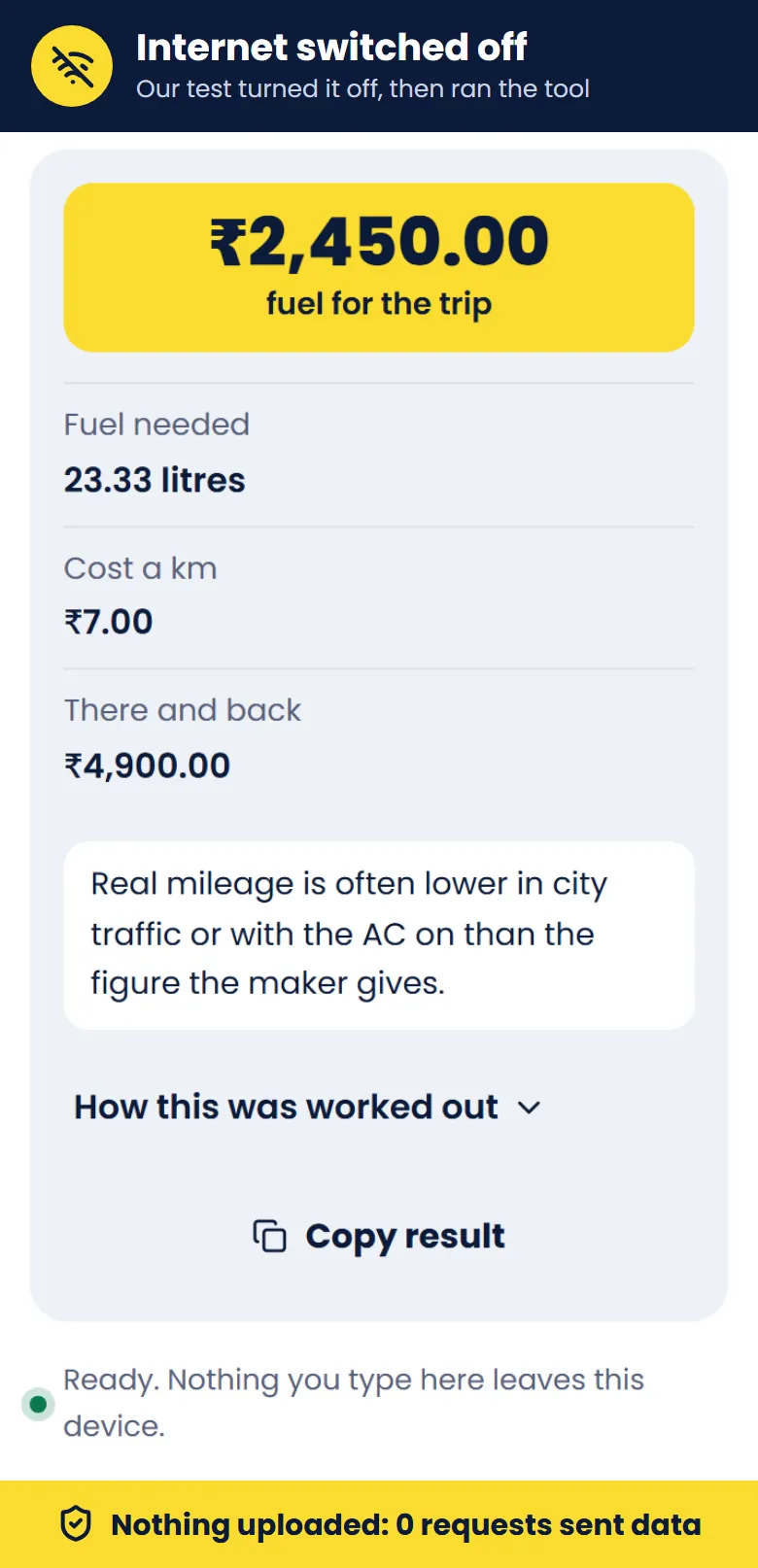
Type the distance, your vehicle's mileage and the price of fuel, and this calculator shows what the fuel for the trip will cost, how many litres it needs, the cost of each kilometre, and the cost there and back. A 350 km drive in a car that does 15 km a litre, with petrol at ₹105 a litre, needs 23.33 litres and costs ₹2,450.00, or ₹7.00 a kilometre.
It all happens in your browser: nothing you type is uploaded or kept.
When it helps:
- Before a road trip, to budget the fuel and compare it with train or bus fares.
- For a daily commute, to see what a month of driving costs.
- Sharing a ride, so everyone pays a fair part of the fuel.
- Choosing a vehicle, by comparing the cost of a kilometre in each.
- Claiming travel costs at work, with the working to show.
Step by step
- Type the distance in kilometres, such as 350. Commas the Indian or the international way and Hindi digits are read.
- Type the mileage in kilometres a litre, such as 15: what your vehicle really gives, if you know it.
- Type the fuel price in rupees a litre, from the pump or your city's price today.
- Read the answer: the fuel cost in large type, then the litres, the cost a kilometre and the cost there and back.
- Open “How this was worked out” to see the sums with your numbers, and use Copy result for a one-line summary.
Try an example fills in 350 km at 15 km a litre and ₹105 a litre, and Clear empties the boxes.
What the page does, exactly
These are the calculator's rules in full, and the same rules are checked by our tests.
| Part | The rule | Example |
|---|---|---|
| What you can type | Digits, also those of Hindi and other scripts, a dot for decimals, and commas the Indian or the international way | 1,000 and 1000 are the same |
| The boxes' limits | A distance from 0.01 km to 1 crore km, a mileage from 0.1 to 1,000 km a litre, a price from ₹0.01 to ₹10,000 a litre | A mileage of 0 gets a message under its box |
| The cost | Distance × price ÷ mileage, worked out exactly, not from the litres rounded first | 350 × ₹105 ÷ 15 = ₹2,450.00 |
| Litres | Distance ÷ mileage, written to two decimal places | 350 ÷ 15 = 23.33 litres |
| Cost a km | Price ÷ mileage, to the paisa | ₹105 ÷ 15 = ₹7.00 |
| There and back | Twice the exact cost, the same as typing twice the distance; when that is a paisa off twice the one-way cost as written, a note says so | ₹4,900.00 |
| Rounding | Every sum is worked out exactly, in whole numbers and fractions rather than the computer's binary approximations; amounts are rounded to the paisa, half a paisa up, only when they are written | ₹5,555.56 for 1,000 km at 18 km a litre and ₹100 |
What the rules don't decide: the calculator uses the mileage you type for the whole distance. Traffic, hills, speed and load change real mileage, as below.
Real results from our tests
We tested the Fuel Cost Calculator with headless Chromium 148, the open-source browser Chrome is built on, on a Windows laptop with an Intel Core i7-1185G7 and 32 GB of memory, on 1 November 2026. Other work was running on the laptop at the same time, so times vary a little from run to run: each time below is the middle one of 3 runs.
Checked against a second program. Python's decimal numbers, with 120 digits and none of the page's code, worked out 25,000 random trips of 1 km to 1 crore km, at 1 to 1,000 km a litre and ₹0.01 to ₹10,000 a litre, and the page's code gave the same 100,000 values every time: the cost, the cost a km and the cost there and back to the paisa, and the litres to two decimal places, of each. The boxes were typed as people type them, with Indian and international commas, and in Hindi, Bengali and Gujarati digits. 2,626 of the values sat exactly on half a paisa or half a hundredth of a litre, and every one was rounded up, as it should be.
The answer is drawn at once. The page drew the answer to a typed amount in 0.09 milliseconds (the middle of 3 runs of 200 amounts typed in a row), not counting the moment the browser takes to paint the screen.
Size and offline. On a first visit the page downloads about 0.1 MB for the tool: the page, its styles, its scripts and the fonts, with Google's ad code not counted. In our test we switched the network off after the page had loaded and pressed Try an example: the fuel cost showed 0.1 seconds later or less in each of 15 runs.
Phone-sized screen. We also ran the tests on a phone-sized screen in Chromium (390 × 844 pixels, with touch). That is not a real phone. Every button and box was 44 pixels high or more, and the page did not scroll sideways.
Try it yourself: press "Try an example" at the top of this page. It puts 350, 15 and 105 in the boxes and the fuel costs ₹2,450.00. Then change the distance to 1,000 and the mileage to 18: ₹5,833.33, or ₹11,666.67 there and back.

The formula, by hand
Fuel cost = distance × price ÷ mileage. For 350 km at 15 km a litre and ₹105 a litre:
- The litres: 350 ÷ 15 = 23.33 litres, a little over 23 and a third.
- The cost: 350 × 105 ÷ 15 = 36,750 ÷ 15 = ₹2,450.
Multiplying before dividing keeps the sum exact. Rounding the litres first and then multiplying, 23.33 × ₹105, gives ₹2,449.65, 35 paise short; the calculator never rounds in the middle, which is why its answer is ₹2,450.00.
Real mileage, not the brochure figure
The mileage in an advertisement is measured on a standard test, not in your traffic. Real mileage is usually lower in the city, with stop-and-go traffic and the air conditioning on, and often better on an open highway at a steady speed. The same 500 km at ₹92.50 a litre costs ₹3,083.33 at 15 km a litre but ₹3,854.17 at 12: the mileage you type matters as much as the fuel price. If you don't know your real figure, a careful estimate is a little below the brochure's.
Measuring your own mileage
- Fill the tank to the top, and note the odometer reading.
- Drive as usual until the tank is fairly low.
- Fill it to the top again, and note the litres it took and the new reading.
- Divide the kilometres driven by the litres: 480 km on 32 litres is 15 km a litre.
Repeat it a few times, in the city and on the highway, and you will have two honest figures to use here.
The cost of a kilometre
The cost a kilometre is the fuel price divided by the mileage, and it is the easiest way to compare vehicles. At ₹105 a litre, a car that does 15 km a litre costs ₹7.00 a kilometre; a motorcycle that does 40 costs ₹2.63. At ₹100 a litre, 12 km a litre costs ₹8.33 a kilometre and 18 costs ₹5.56. Fuel is only part of a vehicle's running cost: servicing, tyres, insurance and parking come on top.
A month of commuting
For a daily drive, type the month's distance. A 30 km round trip to work on 22 working days is 660 km a month: at 15 km a litre and ₹105 a litre, that is 44.00 litres and ₹4,620.00 a month, or ₹55,440 over twelve such months. On a motorcycle that does 45 km a litre, the same 30 km a day costs ₹70.00 a day.
The same sum compares two vehicles for the same month: 660 km in the car costs ₹4,620.00, and on the motorcycle ₹1,540.00, ₹3,080 less. Whether the saving is worth the ride in the rain or the heat is for you to weigh.
Planning a road trip
Add up the distance from a map app, including the drive around town once you arrive. A 1,000 km journey at 18 km a litre with fuel at ₹100 needs 55.56 litres and costs ₹5,555.56 one way. Fuel prices differ from state to state because of local taxes, so a long trip may see a few different prices; using the highest you expect gives a safe budget. Tolls aren't fuel, so add them separately. On empty stretches of highway pumps can be far apart, especially at night, so start a long drive with a full tank.
A full car, a loaded roof carrier and the air conditioning on a hot day all lower mileage, so for a family trip in summer, type a mileage a little below your usual figure.
There and back
The calculator shows the cost there and back as twice the exact one-way cost, which is the same as typing twice the distance. Usually it is simply double the one-way figure, but not always to the paisa: 1,000 km at 18 km a litre and ₹100 costs ₹5,555.56 one way, and there and back is ₹11,111.11, not ₹11,111.12, because the exact one-way cost is ₹5,555.5556. When that happens, a note under the answer says so.
CNG and electric
The sum is the same for any fuel bought by the unit; only the units change. For CNG, type the mileage in kilometres a kilogram and the price a kilogram: 300 km at 25 km a kg, with CNG at ₹80 a kg as an example, costs ₹960.00. For an electric car, type kilometres a kilowatt-hour and the price of a unit of electricity: 300 km at 7 km a unit and ₹8 a unit costs ₹342.86. The page still says litres; read them as kilograms or units.
Using less fuel
- Keep the tyres at the right pressure, shown in the owner's manual or on the door frame.
- Drive smoothly: gentle starts and steady speeds use less fuel than hard braking and sudden acceleration.
- Don't carry what you don't need in the boot or on the roof.
- Switch off the engine at long waits, where it is safe to.
- Service the vehicle on time: a clogged air filter or old oil costs mileage.
Each saving shows up as a better mileage figure; measure it again after a month and type the new figure here.
When the fuel price changes
A change in the price at the pump changes every trip by the same share. For the 660 km commute above at 15 km a litre, petrol at ₹105 costs ₹4,620.00 a month; at ₹110, ₹4,840.00, ₹220 more. A quick way to see it: the litres you use in a month, 44 here, times the rise in the price, ₹5, is the extra cost each month.
Car, train or bus?
For a long trip, compare the fuel for each person with the fare. 1,000 km by car at 18 km a litre and ₹100 a litre is ₹5,555.56 of fuel; shared by four people, that is ₹1,388.89 each, before tolls and parking. Check the train or bus fare on the operator's own website for the same date, and weigh the time, the comfort and the driving against the money. For one person travelling alone, the train or bus is often far cheaper; for a family, the car can be.
Claiming fuel at work
Many employers repay official travel at a fixed rate a kilometre. Compare it with your own cost a kilometre: at ₹7.00 of fuel a kilometre, a rate of ₹10 leaves ₹3 a kilometre towards servicing, tyres and wear. Keep a note of each trip's distance; the working shown here, with the distance, the mileage and the price, makes a clear record for a claim.
Mileage in other units
Some cars and reviews give fuel use in litres per 100 km instead of kilometres a litre. To turn it into the mileage this calculator takes, divide 100 by it: 6.5 litres per 100 km is 100 ÷ 6.5, about 15.38 km a litre. The other way round, 15 km a litre is 100 ÷ 15, about 6.67 litres per 100 km. A lower litres-per-100-km figure, like a higher mileage, means less fuel. For a distance in miles, the Length Converter turns it into kilometres first.
Private: your numbers stay on your device
Your distances and prices never leave your device. The calculator runs inside your browser and has no upload step: it never sends the numbers you type anywhere, and it doesn't save them, so closing the page forgets them. The page's Content Security Policy lets it contact only this site and Google's ad service, which pays for the site; our code never gives your numbers to the ad code. You can check it yourself in your browser's network panel (F12 on a computer): working out a fuel cost adds no request that carries your numbers.
Read our privacy policy and how we prove your files are never uploaded.
Tips
- Use your real mileage, measured from a full tank to a full tank.
- Use today's price where you will fill up; prices differ by state and change over time.
- Add a margin for detours, traffic and air conditioning on a long trip.
- Compare the cost a kilometre, not the brochure mileage, when choosing a vehicle.
- Note the odometer at the start and the end of a trip, so next time you can type the real distance.
Limits
- One mileage and one price for the whole trip.
- Fuel only: tolls, parking, servicing and wear aren't counted.
- No fuel prices are looked up: type the price yourself.
- Units: the page writes litres; for CNG or electricity, read them as kilograms or units.
- Browsers. We tested only in Chromium, the engine behind Chrome and Edge, with computer and phone-sized screens. We did not test on real phones, in Safari or in Firefox, so we cannot promise how they behave.
Terms explained
- Mileage
- How far a vehicle goes on a litre of fuel, in kilometres; also called fuel efficiency.
- Odometer
- The meter that shows how many kilometres a vehicle has run.
- Cost a km
- The fuel price divided by the mileage: what each kilometre costs in fuel.
- CNG
- Compressed natural gas, sold by the kilogram.
- kWh
- A kilowatt-hour, one unit of electricity on a bill.
- Round trip
- A journey there and back.
- Litres per 100 km
- Fuel use the other way round: the litres needed to drive 100 km.