What the loan prepayment calculator does
A part-payment, or prepayment, is money you pay towards a loan on top of your EMIs. It goes straight to the principal, so every month after it you owe less, and less interest is charged. You then choose what to do with that: keep the same EMI and finish the loan sooner, or keep the same tenure and pay a lower EMI.
This calculator shows both. Type the loan, the rate, the tenure, the part-payment and the EMI after which you pay it, and it shows the interest saved, the month the loan now ends or the new EMI, and what the other choice would have saved, with the working and a year-by-year table, exact to the paisa. It all happens in your browser: nothing you type is uploaded or kept.
When it helps:
- A bonus or a maturing deposit: what it would save if it went into the home loan.
- Choosing between a shorter tenure and a lower EMI before you tell the lender.
- Deciding when: the same part-payment now or in a few years.
- Checking the lender's new schedule after a part-payment.
Step by step
- Type the loan amount, the interest rate a year and the tenure in months, such as
25,00,000,8.5and240. - Type the part-payment, such as
2,00,000, and the EMI number after which you pay it, such as24: it is paid in the same month, right after that EMI. - Choose Keep the EMI, finish sooner, or Keep the tenure, lower the EMI.
- Read the answer: the interest saved in large type and, second, the month of the last EMI or the new EMI. The rows give the EMI, the interest without and with the part-payment, what was owed before it, and the other choice's saving.
- Open "How this was worked out" for the steps and the year-by-year table. Copy result gives a one-line summary.
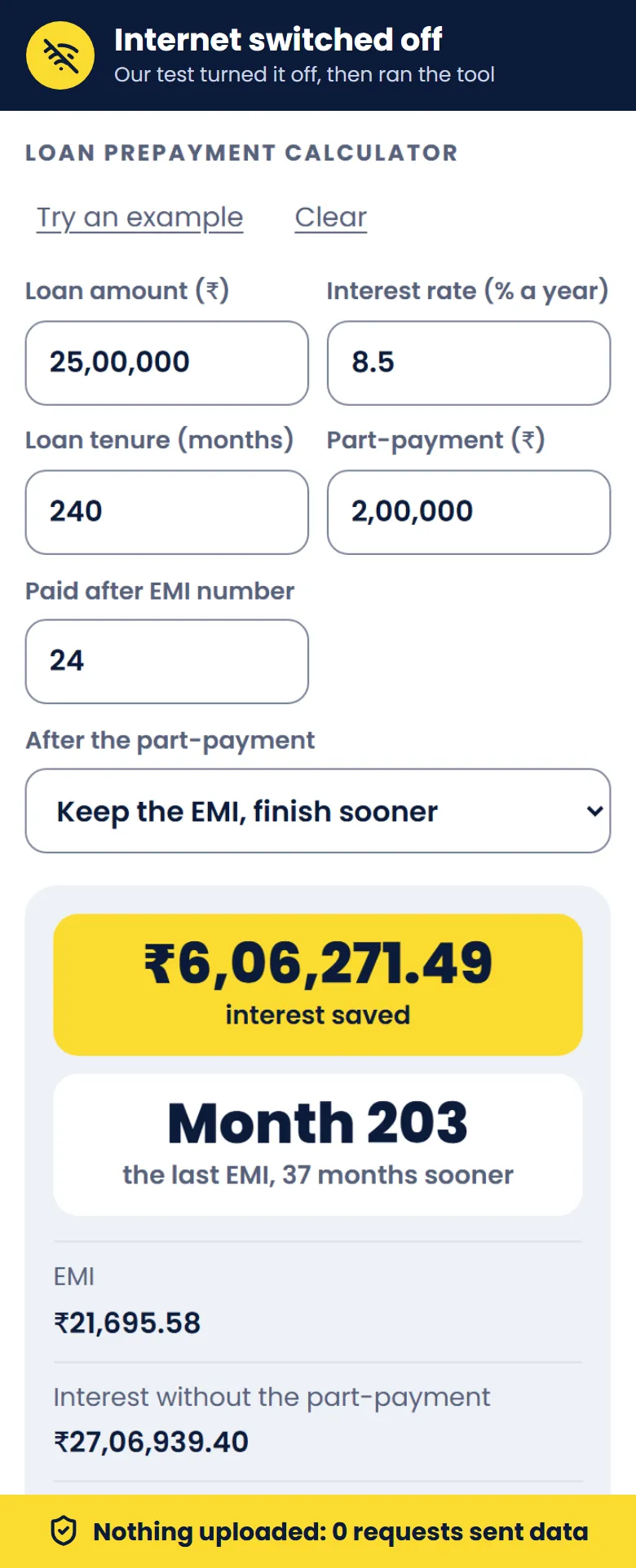
Try an example fills in a loan of ₹25,00,000 at 8.5% for 240 months with ₹2,00,000 paid after EMI 24, and Clear empties the boxes.
The rules, in full
These are the calculator's rules, and the same rules are checked by our tests.
| Part | The rule | Example |
|---|---|---|
| The EMI | The EMI calculator's formula, at the end of each month, exact; shown to the paisa | ₹25,00,000 at 8.5% for 240 months: ₹21,695.58 |
| The part-payment | Paid right after the EMI you choose, in the same month, from EMI 1 to the one before the last | After EMI 24, ₹23,96,090.59 is owed; ₹2,00,000 leaves ₹21,96,090.59 |
| Keep the EMI | The same EMI until the loan is paid; the last month pays only what is due | The last EMI, ₹18,160.58, in month 203 |
| Keep the tenure | A new EMI over the months left, by the same formula | ₹19,884.67 from month 25 |
| A big part-payment | One that is at least what is owed closes the loan, and only what is owed is paid | "Month 24: the loan is closed" |
| Interest saved | Interest without the part-payment minus interest with it; interest = everything paid minus the loan | ₹27,06,939.40 − ₹21,00,667.91 = ₹6,06,271.49 |
Real results from our tests
We tested the Loan Prepayment Calculator with headless Chromium 148, the open-source browser Chrome is built on, on a Windows laptop with an Intel Core i7-1185G7 and 32 GB of memory, on 1 November 2026. Other work was running on the laptop at the same time, so times vary a little from run to run: each time below is the middle one of 3 runs.
Checked against a second program. Python's own exact fractions, with none of the page's code, worked out 10,000 random part-payments (loans, rates, tenures up to 600 months, part-payments that shorten the loan, lower the EMI or close it) and the page gave the same answers every time, to the paisa: the EMI, the interest without and with the part-payment, the saving, the new last month or the new EMI, and every row of the year-by-year table.
The answer is drawn at once. The page worked out an answer in 22 milliseconds or less, in the middle of 3 runs of 200 different inputs worked out in a row, not counting the moment the browser takes to paint the screen. Over 600 months at 8.5%, the longest loan the page takes, an answer took 71 milliseconds or less. A rate typed to 40 digits makes the exact sums far longer: then an answer took up to 1.32 seconds.
Size and offline. On a first visit the page downloads about 0.1 MB for the tool: the page, its styles, its scripts and the fonts, with Google's ad code not counted. In our test we switched the network off after the page had loaded and pressed Try an example: the answer showed 0.1 seconds later or less in each of 15 runs.
Phone-sized screen. We also ran the tests on a phone-sized screen in headless Chromium (390 × 844 pixels, with touch). That is not a real phone. Every button and box was 44 pixels high or more, and the page did not scroll sideways. These tests don't cover Safari or Firefox.
Try it yourself: press "Try an example" at the top of this page. It puts a loan of ₹25,00,000 at 8.5% for 240 months and a part-payment of ₹2,00,000 after EMI 24 in the boxes. Keeping the EMI, the interest saved is ₹6,06,271.49 and the last EMI is in month 203, 37 months sooner. Then choose Keep the tenure: the new EMI is ₹19,884.67.
A shorter tenure or a lower EMI
The same part-payment saves very different amounts depending on what you do with it. In the example, ₹2,00,000 paid after EMI 24 of a ₹25,00,000 loan at 8.5% for 20 years:
- Keep the EMI, finish sooner: the EMI stays ₹21,695.58, the loan ends in month 203 instead of 240, 37 months sooner, and the interest saved is ₹6,06,271.49.
- Keep the tenure, lower the EMI: the EMI falls to ₹19,884.67 from month 25, the loan still ends in month 240, and the interest saved is ₹1,91,157.62.
Keeping the EMI saves more because the money that would have gone on a lower EMI keeps cutting the principal, month after month. Lowering the EMI eases your monthly budget instead. If the present EMI is comfortable, a shorter tenure saves the most; if money is tight, a lower EMI gives room to breathe. The page shows the other choice's saving under every answer, so you can see the trade.

The working, by hand
Three sums do the work. First, the EMI, EMI = P × i × (1 + i)n ÷ ((1 + i)n − 1), with i = 8.5 ÷ 12 ÷ 100 and n = 240: ₹21,695.58, before rounding about ₹21,695.5808. Second, what is owed after k EMIs, P × ((1 + i)n − (1 + i)k) ÷ ((1 + i)n − 1): after EMI 24, ₹23,96,090.59, so the part-payment leaves ₹21,96,090.59.
Third, what follows. Keeping the EMI, the ₹21,96,090.59 left is cleared by 179 more EMIs, the last of them a smaller ₹18,160.58 in month 203. Keeping the tenure, the same ₹21,96,090.59 spread over the 216 months left by the EMI formula gives ₹19,884.67. The interest is everything paid minus the loan: ₹27,06,939.40 without the part-payment, ₹21,00,667.91 with it when the EMI is kept.
Early or late
The earlier a part-payment is made, the more it saves, because each rupee of principal it removes would otherwise have carried interest for every month left. On a long loan the first years are mostly interest, as the EMI Calculator's guide shows, so a part-payment in year 2 cuts far more interest than the same amount in year 15. Try your part-payment after EMI 12, 60 and 120 to see the difference for your loan.
Several small part-payments work the same way as one large one, each from the month it is paid. The calculator takes one part-payment at a time: work out the first, then use the amount still owed as a new loan for the next.
The year-by-year table
Under the working, "Year by year" opens a table with, for each loan year, what was paid, the interest, the principal and what is owed at the end. The year of the part-payment includes it: in the example, year 2 pays ₹4,60,346.97, which is twelve EMIs and the ₹2,00,000, and ends owing ₹21,96,090.59.
Each year's amounts are worked out exactly and rounded to the paisa, so Paid = Interest + Principal in every row, the balance falls by exactly the principal shown, and the table ends at ₹0.00. On a phone, each row shows as a small card.
Your lender's side
Lenders work part-payments out in their own ways: the day the money is credited, how interest for part of a month is charged, rounding, and whether they lower the EMI or shorten the tenure by default. Ask your lender which it applies and whether you can choose, and check the new repayment schedule it gives you against this page.
Some loans carry a charge for prepaying. The EMI Calculator's guide on paying early sets out what the RBI's directions say about such charges; your sanction letter says what applies to your loan. Take any charge off the saving here to see what the part-payment really gains.
Worked examples
The example loan, ₹25,00,000 at 8.5% for 240 months, with ₹2,00,000 paid at different times:
| After EMI | Same EMI: saved | Months sooner | Same tenure: saved |
|---|---|---|---|
| 12 | ₹6,68,336.63 | 40 | ₹2,03,763.21 |
| 24 | ₹6,06,271.49 | 37 | ₹1,91,157.62 |
| 60 | ₹4,42,860.98 | 29 | ₹1,54,506.24 |
| 120 | ₹2,35,769.88 | 20 | ₹97,565.65 |
| 180 | ₹92,182.00 | 13 | ₹46,198.38 |
The same ₹2,00,000 saves more than seven times as much after EMI 12 as after EMI 180, keeping the EMI. The size counts too: after EMI 24, keeping the EMI, ₹50,000 saves ₹1,72,233.15 and ends the loan 10 months sooner, ₹1,00,000 saves ₹3,29,490.39 and 19 months, and ₹5,00,000 saves ₹12,19,805.70 and 79 months.
Common mistakes
- Waiting to save up a large sum. A smaller part-payment now often saves more than a larger one years later, as the table shows.
- Choosing a lower EMI by habit. If the present EMI is comfortable, keeping it and finishing sooner saves far more interest.
- Prepaying with the emergency fund. Money paid into a loan is hard to get back; keep some savings for the unexpected first.
- Ignoring charges. A prepayment charge, if your loan has one, comes off the saving.
- Not checking the new schedule. Make sure the lender has applied the part-payment the way you asked, and lowered the tenure or the EMI.
- Counting the EMI number from the wrong month. The box is the number of EMIs already paid when you make the part-payment.
Reading the answer
The large figure is the interest saved. The second answer depends on your choice: keeping the EMI, it is the month of the last EMI and how many months sooner that is; keeping the tenure, it is the new EMI and the month it starts; and if the part-payment covers everything owed, it says the loan is closed in that month. The rows give the EMI, the interest without and with the part-payment, what was owed just before it, the last EMI's size, and what the other choice would have saved, so you can weigh the two without typing again. Copy result puts the plan and the saving on one line.
Prepay or invest the money?
Money paid into a loan saves interest at the loan's rate, with no risk: paying off part of an 8.5% home loan is like earning a sure 8.5% on that money, before tax. Money invested instead earns whatever the investment returns, which may be more or less and is not certain. So the comparison is between the loan's rate and the return you can expect after tax and costs, and the certainty of each.
Tax can change the sum, because some home loans give a deduction for interest or principal under the old tax regime, and some investments are taxed: check the rules for your year. Many people do some of each: keep an emergency fund, prepay when the loan's rate is high, and invest when they can expect clearly more than the loan costs. The Lumpsum Calculator shows what the same money could grow to if invested instead.
Questions to ask your lender
- Is there a charge for prepaying, and does it depend on the amount or the source of the money?
- Will you shorten the tenure or lower the EMI, and can I choose?
- From which date is the part-payment counted?
- Can I see the new repayment schedule before and after?
Small part-payments add up
A part-payment does not have to be large to be worth making. On the example loan, ₹25,00,000 at 8.5% for 240 months, keeping the EMI after EMI 24:
- ₹10,000 saves ₹35,746.21 of interest, and the loan ends 2 months sooner.
- ₹25,000 saves ₹88,119.00, and 5 months.
- ₹50,000 saves ₹1,72,233.15, and 10 months.
Lowering the EMI instead, ₹10,000 saves ₹9,557.88 and takes the EMI from ₹21,695.58 to ₹21,605.04. A bonus, or part of one, paid early can save several times its size over a long loan.
Paying off the whole loan
If the part-payment is at least what is owed, the loan is closed, and the page says so. After EMI 24 of the example, ₹23,96,090.59 is owed, shown in the answer's rows. Paying it then means the only interest is what the first 24 EMIs carried, ₹4,16,784.53, against ₹27,06,939.40 over the full 240 months, which is more than the ₹25,00,000 borrowed: closing then saves ₹22,90,154.87. A lender's closing figure also includes interest up to the day you pay, and any charge your loan has for closing early.
Private: your numbers stay on your device
What you type never leaves your device. The calculator runs inside your browser and has no upload step: it never sends your loan, rate, tenure or part-payment anywhere, and it doesn't save them, so closing the page forgets them. The page's Content Security Policy lets it contact only this site and Google's ad service, which pays for the site; our code never gives your numbers to the ad code. You can check it yourself in your browser's network panel (F12 on a computer): working out the answer adds no request that carries what you typed.
Read our privacy policy and how we prove your files are never uploaded.
Tips
- Pay early in the loan if you can: it saves the most.
- Keep the EMI if it is comfortable: a shorter tenure saves more than a lower EMI.
- Keep an emergency fund before you prepay: money in a loan is hard to get back.
- Ask about charges and take them off the saving.
- Check the lender's schedule after the part-payment.
Limits
- One part-payment at a time, paid right after an EMI.
- One fixed rate for the whole loan; a floating rate changes over time.
- No charges or fees are taken off the saving.
- EMIs at the end of each month; interest by the day is not used.
- Not advice. Whether to prepay or invest the money instead is your choice.
Terms explained
- Part-payment
- Money paid towards a loan on top of the EMIs; also called a prepayment.
- Principal
- The amount still owed, on which interest is charged.
- Tenure
- The number of months a loan runs.
- Foreclosure
- Paying off the whole loan before its tenure ends.
- Repayment schedule
- The lender's list of each EMI's interest, principal and balance.