What the EMI calculator does, and when you need it
An EMI, an equated monthly instalment, is the same payment every month that pays off a loan and its interest by the end of the tenure. Banks and housing finance companies in India work out EMIs on the reducing balance: each month's interest is charged only on what you still owe, so the interest part of each EMI shrinks over time while the principal part grows.
Type the loan amount, the yearly interest rate and the tenure in years, and this calculator shows the EMI, the total interest, the total you will pay, and the number of months. It uses the same formula lenders use for a reducing-balance loan, shows the working step by step, and works it all out in your browser: nothing you type is uploaded or kept.
When it helps:
- Before you apply, to see what EMI your income can carry and how much a home, a car or a bike really costs over the years.
- Comparing offers. Two banks quote 8.5% and 8.9%: the calculator shows what that gap means in rupees, month by month and in total.
- Choosing a tenure. A longer tenure lowers the EMI but raises the total interest, often by lakhs; the numbers make the trade-off plain.
- Checking a sanction letter. The EMI the lender quotes should match the formula within a rupee or two.
Step by step
- Type the loan amount in rupees. 25,00,000, 2500000 and Hindi digits are all read; commas are fine either way.
- Type the interest rate the lender quotes, as a yearly percentage, such as 8.5.
- Type the tenure in years, such as 20. Part of a year works too: 2.5 years is 30 months.
- Read the answer. The EMI shows as soon as the three boxes are filled, with the total interest, the total paid and the number of months under it.
- Open “How this was worked out” to see the monthly rate, the formula with your numbers, and how the total was found.
- Copy result gives the answer as one sentence, ready for a message or a note.
Try an example fills in a home loan of ₹25,00,000 at 8.5% for 20 years, and Clear empties the boxes. A number that doesn't fit, such as a rate above 50%, gets a calm line under its box once you stop typing.
What the page does, exactly
These are the calculator's rules in full, and the same rules are checked by our tests.
| Part | The rule | Example |
|---|---|---|
| What you can type | Digits, also those of Hindi and other scripts, a dot for decimals, and commas the Indian or the international way | 25,00,000 and 2,500,000 are the same loan |
| The boxes' limits | A loan of at least ₹1, a rate from 0% to 50% a year, and a tenure from 0.1 to 40 years | A rate of 60 gets a message under its box |
| Months | The tenure in years times 12, rounded to a whole month | 20 years is 240 months; 2.5 years is 30 |
| Monthly rate | The yearly rate divided by 12 and by 100 | 8.5% a year is 0.007083 a month |
| The EMI | P × i × (1 + i)n ÷ ((1 + i)n − 1), the reducing-balance formula; with a rate of 0, the loan divided by the months | ₹25,00,000 at 8.5% for 240 months is ₹21,695.58 |
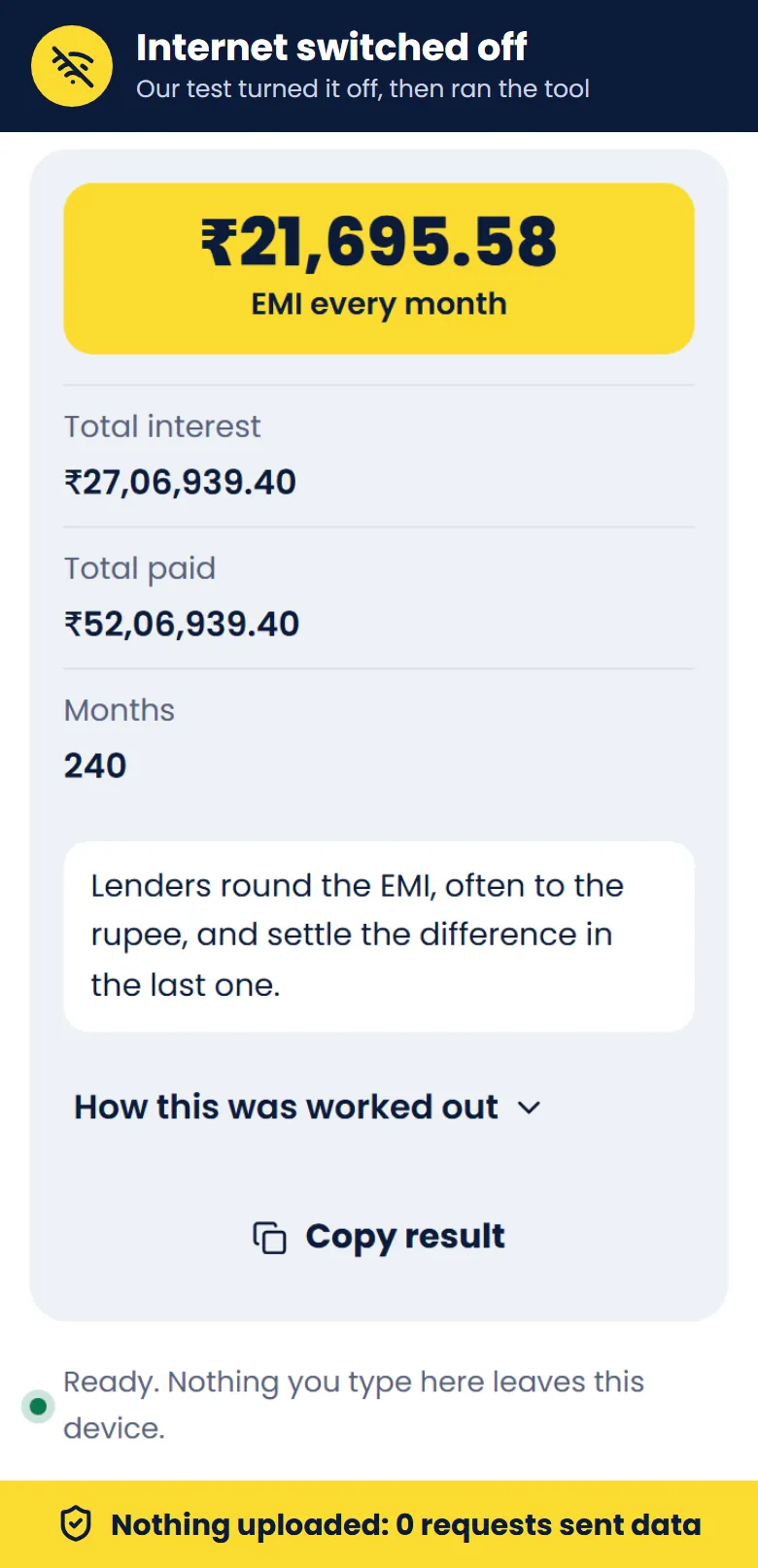
| Total paid and interest | The EMI before it is rounded to the paisa, times the months, and that total minus the loan | ₹52,06,939.40 paid, ₹27,06,939.40 of it interest |
| Rounding | Every sum is worked out exactly, in whole numbers and fractions rather than the computer's binary approximations; amounts are rounded to the paisa, half a paisa up, only when they are written, in the Indian way | ₹1,38,40,442.70 |
What the rules don't decide: the calculator assumes the rate stays the same for the whole tenure and that every EMI is paid on time. It doesn't add processing fees, insurance, or the interest for the days before the first EMI, and it doesn't know your lender's way of rounding. Those are why a bank's figure can be a few rupees off, as explained below.
Real results from our tests
We tested the EMI Calculator with headless Chromium 148, the open-source browser Chrome is built on, on a Windows laptop with an Intel Core i7-1185G7 and 32 GB of memory, on 1 November 2026. Other work was running on the laptop at the same time, so times vary a little from run to run: each time below is the middle one of 3 runs.
Checked against a second program. Python's decimal numbers, with 40 digits and none of the page's code, worked out 25,000 random loans of ₹1 to ₹5 crore, at rates from 0% to 50% and for tenures from a month to 40 years, and the page's code gave the same 75,000 amounts every time, to the paisa: the EMI, the total interest and the total paid of each. The boxes were typed as people type them, with Indian and international commas, in Hindi, Bengali and Gujarati digits, and with a % sign after the rate.
The answer is drawn at once. The page drew the answer to a typed amount in 0.18 milliseconds (the middle of 3 runs of 200 amounts typed in a row), not counting the moment the browser takes to paint the screen. Even a 40-year loan at a rate typed to 40 digits, the longest sum the page does, was drawn in 5.4 milliseconds.
Size and offline. On a first visit the page downloads about 0.1 MB for the tool: the page, its styles, its scripts and the fonts, with Google's ad code not counted. In our test we switched the network off after the page had loaded and pressed Try an example: the EMI showed 0.2 seconds later or less in each of 15 runs, and 0.1 seconds later or less in 14 of them.
Phone-sized screen. We also ran the tests on a phone-sized screen in Chromium (390 × 844 pixels, with touch). That is not a real phone. Every button and box was 44 pixels high or more, and the page did not scroll sideways.
Try it yourself: press "Try an example" at the top of this page. It puts 25,00,000, 8.5 and 20 in the boxes and the EMI is ₹21,695.58. Then change the tenure to 15: the EMI is ₹24,618.49 and the total interest ₹19,31,328.01.

The formula, by hand
The EMI formula looks fierce, but each part has a plain meaning. Take the example loan: P, the principal, is ₹25,00,000; the yearly rate is 8.5%, so the monthly rate i is 8.5 ÷ 12 ÷ 100 = 0.0070833; and the tenure n is 20 years, 240 months.
- Work out (1 + i)n: 1.0070833 multiplied by itself 240 times, about 5.4412. This is how much ₹1 would grow to over the tenure at the loan's rate.
- Multiply P × i × (1 + i)n: 25,00,000 × 0.0070833 × 5.4412, about 96,355.
- Divide by (1 + i)n − 1, about 4.4412: the EMI is ₹21,695.58.
A spreadsheet gives the same with =PMT(8.5%/12, 240, -2500000). The calculator does the same sums without rounding in the middle, and writes the answer to the paisa. Doing it by hand with fewer decimal places can land a few rupees away, which is one reason quick rules of thumb, such as “about ₹868 a month per lakh at 8.5% for 20 years”, are only rough guides. Our post on how an EMI is calculated works a smaller loan through month by month, with the interest and principal of each payment.
Where each EMI goes
Every EMI is the same amount, but what it pays for changes. Each month the lender first takes the interest on what you still owe, and the rest of the EMI reduces the loan. On the example loan:
- The first EMI of ₹21,695.58 holds ₹17,708.33 of interest (one month at 8.5% on ₹25,00,000) and only ₹3,987.25 of principal.
- After 5 years, 60 EMIs and about ₹13.02 lakh paid, you still owe ₹22,03,179.58: only ₹2,96,820.42 of the loan has been repaid.
- Over the whole 20 years, the interest adds up to ₹27,06,939.40, more than the loan itself.
This is why prepaying early in a loan saves the most interest, and why the outstanding balance on a statement falls so slowly at first. It isn't a trick by the lender: it is simply interest charged on a balance that is still large.
Longer or shorter tenure
A longer tenure spreads the loan over more months, so each EMI is smaller, but interest runs for longer. The same ₹25,00,000 at 8.5%:
| Tenure | EMI | Total interest | Total paid |
|---|---|---|---|
| 15 years | ₹24,618.49 | ₹19,31,328.01 | ₹44,31,328.01 |
| 20 years | ₹21,695.58 | ₹27,06,939.40 | ₹52,06,939.40 |
| 25 years | ₹20,130.68 | ₹35,39,203.13 | ₹60,39,203.13 |
The totals use each EMI before it is rounded to the paisa, so the EMI shown times the months can differ from the total by some paise, at most ₹2.40 on a 40-year loan: ₹21,695.58 × 240 is ₹52,06,939.20, while the EMI before rounding, about ₹21,695.5808, makes ₹52,06,939.40.
Going from 20 to 25 years lowers the EMI by only ₹1,564.90 a month, but adds ₹8,32,263.73 of interest. Going from 20 to 15 years raises the EMI by ₹2,922.91 and saves ₹7,75,611.39. A common approach is to take the tenure whose EMI you can carry comfortably, and prepay whenever you can, which shortens the loan without committing to a higher EMI.
What the rate changes
Small differences in the rate add up over a long loan. The same ₹25,00,000 for 20 years:
- At 8%: EMI ₹20,911.00, total interest ₹25,18,640.41.
- At 8.5%: EMI ₹21,695.58, total interest ₹27,06,939.40.
- At 9%: EMI ₹22,493.15, total interest ₹28,98,355.74.
Half a percentage point, 8.5% against 8%, costs ₹784.58 more every month and ₹1,88,298.99 more over the 20 years. That is worth a phone call to compare lenders, or to ask your own bank about moving your loan to its current rate. If a lender quotes only the EMI, the Loan Interest Rate Calculator works out the rate from it.
Home, car and personal loans
The formula is the same for every loan repaid in equal monthly instalments; what changes is the size, the rate and the tenure:
- A home loan of ₹50,00,000 at 8.5% for 30 years: EMI ₹38,445.67, with ₹88,40,442.70 of interest.
- A car loan of ₹8,00,000 at 9.5% for 5 years: EMI ₹16,801.49, with ₹2,08,089.34 of interest. If a dealer quotes a flat rate, turn it into a reducing rate with the Flat to Reducing Rate Calculator before comparing (flat rate vs reducing rate explains why), and add the running cost: the Fuel Cost Calculator shows what each kilometre costs in fuel.
- A personal loan of ₹3,00,000 at 13% for 3 years: EMI ₹10,108.19, with ₹63,894.68 of interest.
- A no-cost EMI on a phone, at 0%: ₹1,00,000 over 12 months is ₹8,333.33 a month. Read the offer's terms: the interest is often built into the price or taken back as a discount you don't get.
Education loans often have a moratorium, months with no EMI while interest still adds up, and some business loans have uneven instalments; for those, the calculator gives the EMI from the moment regular payments start on the amount then owed. When a lender asks for post-dated cheques for the EMIs, Number to Words writes the amount in words, ready for each cheque, and writing a cheque amount in words shows how to fill each one in.
When a floating rate is reset
Most home loans in India have a floating rate, tied to a benchmark such as the RBI's repo rate, so the rate changes during the loan. When it rises, the lender can raise the EMI, lengthen the tenure, or both. The Reserve Bank of India's circular on resetting floating rates on EMI-based personal loans (18 August 2023, read on 1 November 2026) says that at a reset the borrower must be given the choice of a higher EMI, a longer tenure or a mix of both, the option to switch to a fixed rate under the lender's policy, and the option to prepay in part or in full at any time, and that a longer tenure must not leave the loan growing instead of shrinking.
To see the effect of a reset, type the balance you still owe, the new rate and the months left, in years: the calculator gives the new EMI for the same end date. To compare with a longer tenure instead, keep the old EMI in mind and raise the years until the EMI matches.
Paying early
A prepayment goes straight to the principal, so it cuts all the interest that sum would have run up for the rest of the loan, which is why early prepayments save the most. After a prepayment, lenders usually keep the EMI and shorten the tenure, or keep the tenure and lower the EMI; ask which, and choose the shorter tenure if the EMI is comfortable. The Loan Prepayment Calculator works out both for a part-payment: the interest saved and the months cut, or the new EMI.
Charges: the RBI's Pre-payment Charges on Loans Directions, 2025 (2 July 2025, read on 1 November 2026) say that for loans sanctioned or renewed on or after 1 January 2026, lenders may not levy pre-payment charges on floating-rate loans to individuals for purposes other than business, whether you pay part or all of the loan, and from any source. Fixed-rate loans can carry a charge, but only one written in the sanction letter and the loan agreement. Check your own letter for older loans.
Why the bank's figure can differ a little
- Rounding. Many lenders round the EMI up to the next rupee, so ₹21,695.58 becomes ₹21,696.
- Broken-period interest. If the loan is paid out mid-month, the days before the first EMI cycle are charged separately as pre-EMI interest.
- Days, not months. Some lenders charge interest by the day on the actual balance, so months of 28 and 31 days differ slightly.
- Fees and insurance. Processing fees, insurance bundled into the loan, and GST on fees change what you pay, but not the EMI formula; the GST Calculator works out the GST on a fee.
- Moratoriums. Interest added during a moratorium raises the amount the EMI is worked out on.
If the gap is more than a few rupees, ask the lender for the repayment schedule, which lists each EMI's interest and principal; it should follow the same pattern as above.
Private: your numbers stay on your device
Your loan amount, rate and tenure never leave your device. The calculator runs inside your browser and has no upload step: it never sends the numbers you type anywhere, and it doesn't save them, so closing the page forgets them. The page's Content Security Policy lets it contact only this site and Google's ad service, which pays for the site; our code never gives your numbers to the ad code. You can check it yourself in your browser's network panel (F12 on a computer): working out an EMI adds no request that carries your numbers.
A loan plan is private. A calculator that works on a server receives everything you type; here your own browser does the arithmetic. Read our privacy policy and how we prove your files are never uploaded.
Tips
- Keep the EMI comfortable. Leave room in your monthly budget for rate rises, which raise the EMI or the tenure of a floating-rate loan.
- Compare by total interest, not only by EMI: a lower EMI from a longer tenure can cost lakhs more.
- Check the sanction letter's EMI against the calculator; a gap of a rupee or two is rounding, more deserves a question.
- Prepay early when you can: a lump sum in the first years saves the most interest.
- Saving instead of borrowing? The SIP Calculator shows what a monthly investment could grow to, and the FD Calculator what a deposit earns.
- Quick percentages, such as a down payment of 20%, are easiest with the Percentage Calculator.
Limits
- One rate for the whole tenure. For a floating-rate loan, it shows the EMI at today's rate; work out a reset as shown above.
- Equal monthly instalments only. Step-up, balloon and bullet repayments, and moratoriums, are not modelled.
- No fees, insurance or tax. Processing fees, insurance and GST on fees are not added, and tax benefits on home loan interest are not worked out.
- No full schedule. It shows the EMI, the total interest and the total paid, not every month's split.
- Not advice. It works out the numbers; whether a loan suits you is for you and your lender.
- Browsers. We tested only in Chromium, the engine behind Chrome and Edge, with computer and phone-sized screens. We did not test on real phones, in Safari or in Firefox, so we cannot promise how they behave.
Terms explained
- EMI
- Equated monthly instalment: the same payment every month, covering interest and part of the loan.
- Principal
- The amount borrowed, or the part of it still owed.
- Tenure
- How long the loan runs, in years or months.
- Reducing balance
- Interest charged each month only on what is still owed, which is how Indian lenders work out EMIs.
- Floating rate
- A rate that moves with a benchmark, such as the RBI's repo rate, during the loan.
- Prepayment
- Paying part or all of the loan before it is due, which goes straight to the principal.
- Amortisation
- Paying a loan off bit by bit; the schedule lists each EMI's interest and principal.