What JPG to PNG does, and when you need it
JPG to PNG saves each of your JPG pictures again as a PNG file. It all happens inside your browser: your pictures are not uploaded, and there is no sign-up and no watermark. Add one picture or many, press Convert, and save the PNGs. Your original JPGs are never changed.
People use it when:
- A form, app or print shop asks for PNG. Some take only PNG pictures. Read what the form says first, because many take JPG too.
- They will edit a picture again and again. Each time a JPG is saved as a JPG, it loses a little more detail. A PNG copy keeps what it has, however often you edit and save it.
- They want to share a photo without its hidden details. The PNG made here does not carry the camera, the date or the GPS place where the photo was taken.
- A program wants PNG and all they have is JPG. Many phone photos and pictures saved from the web are JPGs, which is not always the format the next program wants.
Two things to know first. The PNG does not get sharper or cleaner than the JPG was: the JPG's own blur and blocky patches stay. And a PNG of a photo is much bigger, about 8 times bigger for a phone photo in our tests. Real results has the numbers, and PNG or JPG helps you choose.
How the conversion works
A JPG stores a picture in a compact way, leaving out tiny details the eye hardly notices. Opening it rebuilds the picture as a grid of coloured dots called pixels. A PNG stores that grid without leaving anything out. This page does just that, on your own device:
- Your browser opens the JPG and rebuilds its pixels. If a phone stored the photo sideways with a note about it, the picture is turned upright now.
- If you chose a max width and the picture is wider, the browser makes it smaller.
- The browser's own PNG saver writes the pixels into a new file.
The work runs in a background worker, one picture at a time, so the page stays smooth while a big photo is converted. Apart from two small script files of ours, nothing is downloaded for it, because your browser already knows how to open and save pictures.
The exact rules:
- Pixels. At Keep size the PNG has the same pixels as the JPG, one for one. A separate program, Pillow, compared our PNGs with their JPGs and found an average difference of 0.00.
- Size. The PNG has the picture's upright width and height, unless you choose a max width. A phone photo stored as 4000 × 3000 with a note to turn it comes out 3000 × 4000.
- Colours. They come out in sRGB, the standard colours of screens. A black-and-white JPG stays black and white. A print JPG in CMYK colours is changed to screen colours by your browser, so it may look slightly different, and its row says so.
- Hidden details. The camera, the date and the GPS place are not copied (see Privacy).
- Names. photo.jpg becomes photo.png. A picture that is already a PNG gets "-converted" added, so logo.png becomes logo-converted.png. If a ZIP would hold two pictures with one name, the second becomes photo (2).png.
- Other pictures. PNG, WebP and GIF pictures can be added too, and become PNGs the same way. A moving GIF or WebP gives only its first frame.
Real results from our tests
We converted test pictures with this page in headless Chromium 148, the open-source browser Chrome is built on, on a Windows laptop with an Intel Core i7-1185G7 and 32 GB of memory, on 9 October 2026. Our own script drew the pictures to look like real ones (phone photos with the camera, date and place stored inside, a screenshot, a logo); they are smoother than many real photos, so your own files may give other sizes. Sizes and times are the ones the page showed on each picture's row. We timed each test two or three times on a computer busy with other work, and the time from pressing Convert to the end varied (the 12-megapixel photo took 2.2 to 7.6 seconds).
| Picture | Before | After | Time | What happened |
|---|---|---|---|---|
| Phone photo, 12 megapixels, 3000 × 4000 | 2.26 MB | 18.1 MB | 2.2 s | Turned upright; camera, date and GPS place left out |
| The same photo, max width 1600 | 2.26 MB | 5.58 MB | 0.8 s | Saved at 1600 × 2133 pixels |
| WhatsApp photo, 1200 × 1600 | 45 KB | 303 KB | 0.1 s | Every pixel kept |
| Print file in CMYK colours, 1600 × 1200 | 789 KB | 3.42 MB | 0.4 s | Changed to screen colours |
| Photo with 48 megapixels, 8000 × 6000 | 9.47 MB | 79.0 MB | 6.1 s | Full size on this computer |
All 13 pictures of our test (two 12-megapixel photos, the WhatsApp photo, a black-and-white photo, the print file and eight small phone pictures) were converted in one go in 5.5 seconds.
A separate program (Pillow) checked every saved PNG: each matched the JPG pixel for pixel as Pillow reads it (an average difference of 0.00), all 8 orientations a phone camera can record came out upright, and no PNG held the camera, the date, the GPS place or any other hidden details.
Memory: the browser's busiest process used about 200 MB with the page open, at most 361 MB while it converted the 12-megapixel photo and at most 769 MB for the 48-megapixel one.
Try it yourself: press "Try with sample pictures" at the top of this page. It draws two JPGs in your browser (a landscape photo and a cafe receipt), so you can try everything without your own files.
Try the samplesStep by step: converting JPG to PNG
- Add your JPGs. Press Choose JPG pictures and pick them, or drop them anywhere on the page, or paste them. On a phone, the button opens your gallery or your files. To see how it works first, press Try with sample pictures.
- Check the Size. Keep size is already chosen and leaves every picture's pixels alone. Choose Max width if you want wide pictures made smaller (more on Size).
- Press Convert to PNG. The button counts your pictures, like "Convert 3 pictures to PNG". Each row shows what it is doing: Waiting, Reading, Opening the picture, Converting, Saving as PNG. The line under the tool says "Working on 3 files. Nothing is uploaded." meanwhile.
- Save your PNGs. A finished row shows a small preview, the size before and after, and a Download button. From two finished pictures, Download all as ZIP appears too.
Taking pictures out, and stopping. Every row has an × button that removes it, whether it is waiting, being converted or finished. The picture being converted also has a Stop button, and a stopped picture says "Stopped. Press Convert to try it again." From two rows, Clear all removes every picture.
Changing the Size afterwards. Nothing is redone by itself. A finished picture that the change affects offers a button such as "Redo at 800 px wide" or "Redo at full size", and keeps its earlier PNG for download until you press it. With two or more, "Apply to all 3 files" does them together. A picture narrower than the new max width is not offered a redo, because it would come out the same.

Keep size, or a max width
Size decides how many pixels the PNG has. Pixels are the dots a picture is made of, and more pixels mean a bigger file.
- Keep size is the default. The PNG has the same width and height as the JPG, as it looks upright.
- Max width makes pictures wider than the number you type smaller, keeping their shape. The page fills in 1600. Pictures that are not wider are left alone: no picture is ever made bigger.
Max width looks only at the width, and the height follows, rounded down to a whole pixel. Here are examples worked out with the page's own rule:
| Picture | Max width | The PNG is |
|---|---|---|
| 4000 × 3000, a wide photo | 1600 | 1600 × 1200 |
| 3000 × 4000, a tall phone photo | 1600 | 1600 × 2133 |
| 1200 × 1600 | 800 | 800 × 1066 |
| 1200 × 1600 | 1600 | 1200 × 1600, as it was |
The number must be from 16 to 16384. If it is not, the page says "Type a width from 16 to 16384 pixels." and converts nothing until you fix it. A picture that was made smaller says so on its row, for example "Made smaller: 4000 × 3000 to 1600 × 1200 pixels."
What it does to the file size. In our test, the 12-megapixel phone photo (3000 × 4000, 2.26 MB) became an 18.1 MB PNG at Keep size. At a max width of 1600 it became 1600 × 2133 and 5.58 MB, and the page finished it in 0.8 seconds instead of 2.2. So the PNG was 2.5 times the size of the JPG instead of 8.0 times.
Which one to pick. Use Keep size for pictures you will print, edit or store. Use Max width when the PNG is only for a screen, a form or a message. A PNG of a photo stays bigger than its JPG either way, so if a size limit in KB is your problem, a PNG is the wrong format (see the next part).
PNG or JPG: which one to use
- JPG is lossy. It throws away detail you are unlikely to notice, so photo files stay small. Each time you save a JPG as a JPG again, a little more is thrown away.
- PNG is lossless. It keeps every pixel exactly, and saving it again loses nothing. The price is size: a photo has so many different colours that a PNG cannot pack it small.
After converting, the PNG holds exactly what the JPG had. What the JPG lost has already gone and does not come back. If the JPG was blurry, or has blocky patches around text, the PNG looks just the same, only in a bigger file.
| What you have | Usually better | Why |
|---|---|---|
| A photo of people, places or food | JPG | The file is far smaller, and the lost detail is hard to see |
| A screenshot, chart, drawing or text | PNG | Sharp edges and flat colours stay clean, and the file is often small |
| A logo or signature with a see-through background | PNG | A JPG cannot be see-through |
| A picture you will edit many times | PNG while editing | No loss at each save; make a JPG at the end for sharing |
| A form that limits the size in KB | JPG | A PNG of a photo is many times bigger |
Measured sizes. The PNG of our 12-megapixel phone photo was 8.0 times the size of the JPG (2.26 MB became 18.1 MB). The small WhatsApp-style photo grew from 45 KB to 303 KB (6.8 times), the 48-megapixel photo from 9.47 MB to 79.0 MB (8.3 times), and a black-and-white photo from 54 KB to 561 KB. Our test pictures were drawn by a script and are smoother than many real photos, so your files may give other sizes. For photos, expect a PNG several times bigger. For a picture with big flat areas, like a drawing, the gap is usually smaller.
A good habit: edit as PNG, share as JPG. Make the PNG here, do your editing, and save a JPG at the end with PNG to JPG, where you pick the quality.
Does PNG give a transparent background?
No. A PNG can have see-through parts, but converting does not make any. A JPG has no see-through parts at all: every pixel is a solid colour. The PNG made here has the same pixels, so a white background stays white, and a photographed signature keeps the paper around it.
Taking a background away is a different job. Something has to decide which pixels are the subject and which are the background, and this page does not do that. It has no background remover. What you can do instead:
- Ask for the original. If it is a logo, whoever made it usually has the file with the see-through background.
- Use an editor or a background remover. Apps and websites exist for this. Save the result as PNG, because a JPG cannot keep see-through parts. If the picture is private, pick one that works on your own device.
- Be careful with "make white see-through" tools. The white in a JPG is rarely pure white, because JPG leaves faint speckles near edges, so such a tool can leave a rough fringe.
See-through parts that already exist are kept. If you add a PNG or WebP picture that has them, they stay see-through in the PNG this page saves. In our check, an 800 × 800 logo with a see-through background came out with its see-through parts exactly as they were. Because it was already a PNG, it was named logo-converted.png.
Phone photos come out the right way up
A phone stores a photo in the same shape whichever way you hold it, and adds a small note saying which way up it should be shown. Your gallery reads the note and turns the photo for you. A converter that ignores the note gives you a PNG lying on its side.
This page reads the note and turns the picture upright before it saves, so the PNG needs no note and looks right in every program. Our 12-megapixel test photo was stored as 4000 × 3000 pixels with a note to turn it, and the PNG came out 3000 × 4000. We checked all eight notes a camera can write, four turns and four that also flip the picture. In every case the marked corners came out in the right places, 8 of 8. A picture that was turned says on its row, "Turned upright, the way the camera recorded it."
If a JPG already looks sideways in your gallery, its note is missing, perhaps removed by an app the photo passed through. The PNG is then sideways too, because there is nothing to go by. Turn the photo in your gallery or photo app first.
Using it on a phone. There is nothing to install. Open this page in your phone's browser, tap Choose JPG pictures and pick photos from your gallery or files. The PNGs are saved where your browser saves downloads, and your phone may ask you to confirm first. PNGs are big, so if your phone slows down, convert fewer pictures at a time or choose a Max width.
What we tested. We used Chromium with its screen set to a phone's size (390 × 844, touch), which is not a real phone. There, the 12-megapixel photo became the same 18.1 MB PNG, its row showed 1.6 seconds, and the time from pressing Convert to the end was 1.8 to 2.1 seconds. The page showed no sideways scrolling at any width from 320 to 1280 pixels, in light and dark.
Photos from WhatsApp. WhatsApp makes a photo smaller when you send it, so a forwarded photo is usually small. Our WhatsApp-style test photo (1200 × 1600) was 45 KB and became a 303 KB PNG, 6.8 times bigger. That is still a small file. The PNG size becomes a real problem with big camera photos, like the 18.1 MB one above.
iPhone. iPhones often save photos as HEIC, which this page cannot convert (see Problems and quick fixes). To take JPG photos instead, choose Settings > Camera > Formats > Most Compatible. Photos you took before stay HEIC.
Privacy and hidden photo details
Photos are often private: family pictures, Aadhaar and PAN cards, certificates, medical papers. With PDFGuild they stay on your phone or computer. Your browser opens each picture, converts it and saves the PNG, all on your device.
The tool itself has no upload step: it never sends your files anywhere. Its Content Security Policy, a rule the website gives your browser, also lets the page contact only this site and Google's ad service, which shows the ads that keep the tools free. Our code never gives your files to the ad code. There is no account to create. Our privacy policy has the details, and How we prove it shows how you can check for yourself.
What we saw when we looked. In our tests, with Google's ad code left out, the only requests while pictures were converted were for this site's own two converter files, fetched as plain downloads. No request carried a picture or any of your data.
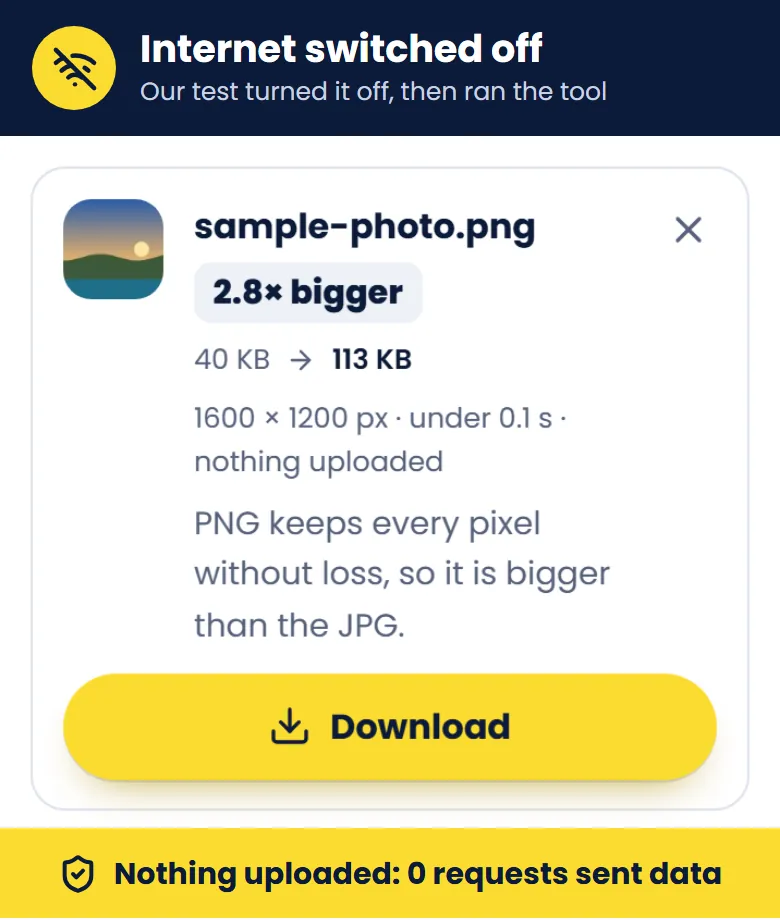
It works offline. Once the page has loaded, the converter is on your device. In our test, we switched the network off after the page had loaded, and the built-in sample photo (a 40 KB JPG) was converted to a 113 KB PNG 0.5 seconds later. So you can switch off Wi-Fi and mobile data and keep converting. Open the page once while you are online first.
Hidden details are not copied. Photos carry notes you cannot see, called EXIF: the camera's make and model, the date and time, and often the exact place where the photo was taken (GPS). This page writes the PNG from the picture's pixels only, so those notes stay behind. In our check the original photos had a GPS place, and not one saved PNG held it, or any camera, date or other hidden note. The row tells you: "Hidden details were left out, including the place it was taken (GPS), the camera and the date."
Two honest limits. You cannot choose to keep the hidden details with this tool. And the picture itself can still give things away, like a street name or a house number you can read in it. The PNG also keeps the JPG's file name, so rename it if the name says something private.
Converting many pictures at once
Add as many JPGs as you like, all together or in several goes. Each gets a row. When you press Convert, the pictures are done one after another in a background worker, so the page stays usable. The picture being converted shows its stage, and the ones in line say Waiting.
A finished row shows a small preview, the new name ending in .png, the size before and after (like 2.26 MB and 18.1 MB) with a note such as "8.0× bigger", the picture's pixels, how long it took, any notes (like "Turned upright") and a Download button. From two finished pictures, Download all as ZIP gives you one file with every PNG inside, named like jpg-to-png-13-files.zip. The ZIP stores the PNGs as they are, because a PNG is already packed, so it is about as big as the pictures together. In our check, every PNG in a ZIP was identical, byte for byte, to its single download.
Measured. We converted 13 JPGs together, 5.48 MB in all: two 12-megapixel photos, the WhatsApp-style photo, a black-and-white photo, the print file and eight small phone pictures. From pressing Convert to the end took 5.5 seconds (5.45 and 5.49 in two runs). The browser's busiest process used 378 to 408 MB, against about 200 MB with the page open and nothing converted. When we added four broken pictures and a PDF to the batch, each broken picture got its own calm note, the PDF was skipped with a message, and the 13 good pictures were still converted.
A tip for big batches. Each finished PNG stays in your browser's memory until you remove its row or close the page. Saving it to your device does not free that memory. With many large photos, convert a few at a time, save them, and remove the finished rows with their × before you add more.
Very big photos
Many phones can take photos of 48 megapixels (8000 × 6000 pixels) or more, and a PNG of a photo that big is huge. In our test, a 48-megapixel photo of 9.47 MB became a 79.0 MB PNG, 8.3 times bigger. Its row showed 6.1 seconds, and the time from pressing Convert to the end was 6.3 to 8.4 seconds. The browser's busiest process used 767 to 769 MB. That was on a laptop with 32 GB of memory, where the photo was converted at full size.
Phones and older computers have less memory, so the page limits how many pixels it trusts your device with. It asks the browser how much memory the device has:
- 2 GB or less, and every iPhone and iPad: 16 million pixels.
- 4 GB: 32 million pixels. The page assumes this when the browser does not say.
- More than 4 GB: 64 million pixels.
A 12-megapixel photo is 12 million pixels, so it is fine on all of them. A bigger picture is opened at a smaller size from the start and saved at that size, and the row says so: "This picture has 48.0 megapixels, more than this device can safely convert at full size, so it was saved at 6531 × 4898 pixels." We saw that note when we made the page believe the device had 4 GB: the 48-megapixel photo came out at 6531 × 4898, which is 32.0 megapixels. We did not test this on a real phone.
No side of a picture is made longer than 16,384 pixels. If the browser still runs out of memory, the page tries again at about half the pixels, twice at most. If that fails too, the row says "This picture is too big for this browser's memory. Close other tabs and try again, or pick a max width under Size." So for a very big photo, choose a Max width first (for an 8000-pixel-wide photo, 4000 gives 4000 × 3000), close other tabs, and on a phone convert one big photo at a time.
Problems and quick fixes
- "This file can't be opened as a picture." The file may be damaged, or may not be a picture at all, like a PDF or a text file renamed to .jpg. Open it in a viewer to check, and copy it again from where it came from.
- "This picture can't be opened: the file ends early." The JPG was cut off while it was being copied or downloaded. Try the original file again. In our tests, JPGs cut in half or cut in their header were refused with this note, and nothing was saved for them.
- A HEIC photo from an iPhone. The row says it is the iPhone's own format and that this browser cannot open it. This page does not convert HEIC. Choose Settings > Camera > Formats > Most Compatible on the iPhone, and new photos are taken as JPG.
- A TIFF picture. The row says "Save it as PNG or JPG first."
- "Some files were skipped." Only pictures work here. A PDF is not a picture, but PDF to PNG turns its pages into PNG pictures.
- The PNG is much bigger than the JPG, or a form says the picture is too big. That is normal, as PNG or JPG explains. Choose a Max width to make the PNG smaller. For a strict size limit in KB, a PNG of a photo is rarely the way: send the JPG, made smaller with fewer pixels if needed.
- The colours look a little different. This happens with print files in CMYK colours, which a browser changes to screen colours. The row says so. Other colour profiles also come out as sRGB.
- The photo is sideways, or the picture is too big for memory. See Phone photos and Very big photos.
- The Convert button is missing or grey. It appears once you have added a picture. It is grey while pictures are being converted, and when the Max width is outside 16 to 16384. When every picture is done it goes away, and if you then change the Size so that a finished picture would come out different, it comes back as Convert again.
- "The converter couldn't be downloaded." The connection was lost before the page finished loading. Reload the page while you are online.
Limits
- No background removal. A JPG made into a PNG keeps its background.
- No extra sharpness. The PNG keeps what the JPG had, blur included.
- No editing. The page does not crop, brighten or retouch. It only turns a photo upright from its camera note, and makes it smaller if you choose a max width.
- No size target. A PNG has no quality setting, so you cannot ask for "under 200 KB". Max width is the only way to make it smaller.
- No HEIC or TIFF. This page does not convert them. Save them as JPG or PNG first.
- Hidden details cannot be kept. The camera, date and GPS place are always left out.
- Colours. A PNG you add with 16 bits per colour is saved with 8, the usual for pictures. Colour profiles come out as sRGB. A moving GIF or WebP gives only its first frame.
- Browsers. We tested only in Chromium, the engine behind Chrome and Edge, with computer and phone-sized screens. We did not test on real phones, in Safari or in Firefox, so we cannot promise how they behave.
Other ways to get a PNG
This page is one way to do the job. Here are the others, and when each fits:
- The picture program that came with your computer or phone. Most can open a JPG and save a copy as PNG with "Save as" or "Export". That is fine for one picture and slow for twenty. Whether the hidden details are kept depends on the program.
- A photo editor. The right choice when you also want to crop, brighten or remove a background. Save the result as PNG at the end.
- An online converter that uploads your pictures. Many are well made and work on any device, but your picture travels to someone else's computer. For private pictures, such as ID cards and family photos, prefer a tool where the file stays on your device.
- Another format. For a smaller picture on a website, JPG to WebP is built for that. If a form wants a JPG, PNG to JPG goes the other way. For one document, JPG to PDF puts pictures into a PDF.
- A better original. If you want a sharper picture, only a better original helps: take the photo again, closer and in good light, or ask the sender for the original file.
Terms explained
- JPG or JPEG
- The usual format for photos. It keeps files small by leaving out detail the eye hardly notices. JPG, JPEG and JFIF are the same thing.
- PNG
- A format that keeps every pixel exactly. It is common for screenshots, logos and drawings, and it can have see-through parts.
- Lossless
- Saved without losing anything. Saving a PNG again changes none of its pixels.
- Lossy
- Saved by throwing some detail away to make the file smaller. A JPG is lossy, and each new save as JPG throws away a little more.
- Pixel
- One of the tiny coloured dots a picture is made of. A picture 3000 pixels wide and 4000 high has 12 million of them.
- Megapixel
- A million pixels. A 12-megapixel photo is about 4000 × 3000 pixels.
- EXIF
- Hidden notes a camera writes into a photo: make and model, settings, date, often the GPS place, and which way the phone was held.
- Transparency
- See-through parts of a picture, also called alpha. PNG and WebP can have them. A JPG cannot.
- sRGB
- The standard set of colours that screens and the web assume. The PNGs made here use it.
- CMYK
- The four inks of printing: cyan, magenta, yellow and black. Some print files are saved in CMYK, and a browser changes them to screen colours.