What JPG to WebP does, and when you need it
JPG to WebP saves each of your JPG photos again as a WebP picture, a newer format made for websites. It happens inside your browser, so your photos are never uploaded, and you get a new file for each one. Your JPG stays exactly as it was.
The reason to bother is size. At a similar look, a WebP is usually much smaller than a JPG. In our tests a 12-megapixel phone photo of 2.26 MB became a 354 KB WebP at quality 80, which is 85% smaller. Smaller pictures open faster on a slow connection, use less mobile data and take up less room on a phone, a hard disk or a website's server. People use JPG to WebP for:
- Websites and blogs. A page full of big photos is slow to open, most of all for visitors on mobile data. WebP versions of the same photos make the page lighter.
- Online shops. Product photos straight from a phone camera are far bigger than a shop page needs. Convert a whole batch at a smaller width and upload the light WebPs.
- School, college and small business sites. Some website builders and hosting plans limit the size of one upload or the total space. Lighter pictures fit more in.
- Portfolios and galleries. Photographers, designers and artists who show their work online want pictures that stay sharp and still open quickly.
- Saving space. Make WebP copies of photos you rarely open, and keep the originals in a safe place.
- Developers. Convert a folder of JPGs before you put them in a project, or see how a quality setting looks before you set it in your own build.
The converter takes other pictures too: a PNG with see-through parts becomes a WebP that keeps them. If you need the other way, from WebP back to JPG, use WebP to JPG. And WebP is not right for everything: some apps, printers and upload forms ask for JPG, as the part on websites and apps explains.
For a picture with sharp text or a logo that must stay exact, JPG to PNG keeps every pixel.
Real results from our tests
We converted test pictures with this page in headless Chromium 148, the open-source browser Chrome is built on, on a Windows laptop with an Intel Core i7-1185G7 and 32 GB of memory, on 9 October 2026. Our own script drew the pictures to look like real ones (phone photos with the camera, date and place stored inside, a screenshot, a logo); they are smoother than many real photos, so your own files may give other sizes. Sizes and times are the ones the page showed on each picture's row. We ran each test three times on a computer busy with other work, and the time from pressing Convert to the end varied (the 12-megapixel photo took 4.6 to 6.3 seconds at quality 80).
| Picture | Before | After | Time | What happened |
|---|---|---|---|---|
| Phone photo, 12 megapixels, 3000 × 4000 | 2.26 MB | 354 KB | 4.4 s | 85% smaller at quality 80 |
| The same photo at quality 70 | 2.26 MB | 119 KB | 3.4 s | 95% smaller |
| The same photo at quality 90 | 2.26 MB | 1.49 MB | 5.7 s | 34% smaller |
| Outdoor photo, 4000 × 3000 | 2.34 MB | 653 KB | 3.9 s | 73% smaller at quality 80 |
| The same photo, max width 1600 | 2.34 MB | 48 KB | 0.7 s | Saved at 1600 × 1200 pixels |
| WhatsApp photo, 1200 × 1600 | 45 KB | 16 KB | 0.5 s | 64% smaller |
| Photo with 48 megapixels, 8000 × 6000 | 9.47 MB | 2.80 MB | 16.0 s | Full size on this computer |
| The same photo, page told the device has 4 GB | 9.47 MB | 860 KB | 8.9 s | Saved at 6531 × 4898 pixels, and the row said why |
Saving WebP takes longer than opening a photo: most of each time above is the browser's WebP encoder at work. A max width makes it much quicker. All 13 pictures of our test (two 12-megapixel photos, the WhatsApp photo, a black-and-white photo, a print file and eight small phone pictures) were converted in one go in 10.5 to 12.4 seconds.
A separate program (Pillow) compared every WebP with its JPG: at quality 80 the average difference was under 3 levels out of 255 (2.31 for the phone photo), all 8 phone orientations came out upright, and no WebP held the camera, the date or the GPS place.
Memory: the browser's busiest process used about 200 MB with the page open, at most 372 MB while it converted the 12-megapixel photo and at most 870 MB for the 48-megapixel one (655 MB when it was saved smaller).
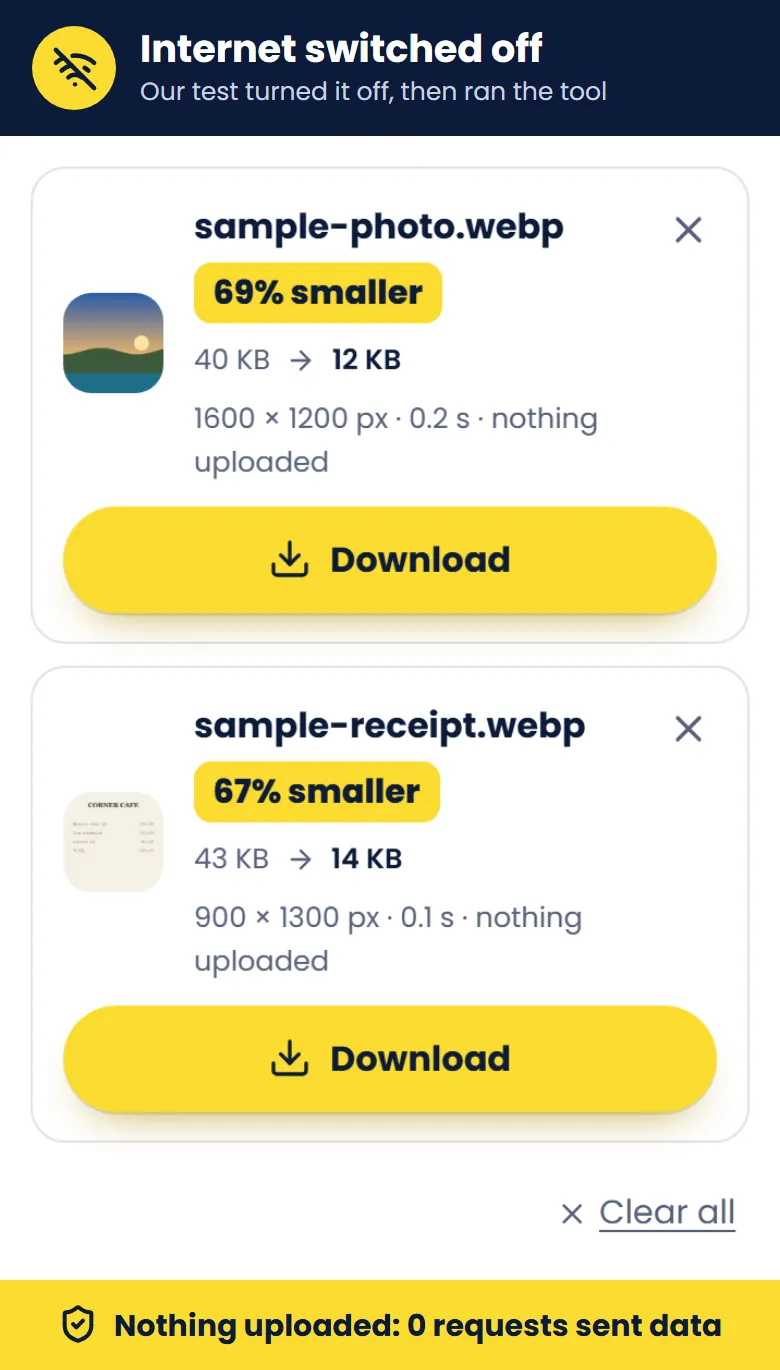
Try it yourself: press "Try with sample pictures" at the top of this page. It draws two JPGs in your browser (a landscape photo and a cafe receipt), so you can try everything without your own files.
Try the samplesStep by step: converting JPG to WebP
This is the whole way, from your JPGs to your WebPs:
- Choose your pictures. Press Choose JPG pictures and pick one or many from your phone or computer. You can also drop them anywhere on the page, or paste a copied picture. Each one gets a row with its name, its size and a × to take it out. No picture at hand? Press Try with sample pictures.
- Set the quality. The slider starts at 80, which suits sharing and websites. Move it down for smaller files or up for more detail. The line under it says what to expect. Nothing is converted yet.
- Choose the size, if you want to. Keep size leaves every picture as big as it was, in pixels. Max width, filled in with 1600, makes wider pictures smaller and leaves narrower ones alone.
- Press Convert to WebP. The button waits at the bottom of the screen and counts your pictures, like Convert 3 pictures to WebP. They are converted one at a time, each with a bar, and the one being converted has a Stop button. While it works, a line says "Working on 3 files. Nothing is uploaded."
- Download. A finished row shows a small preview, the size before and after, how much smaller it is, its size in pixels and the time it took. Press Download for that picture. From two finished pictures on, Download all as ZIP gives you one file with all of them.
- Not happy with the size? Move the slider or change the Max width. Pictures that are done are never converted again by themselves, and they keep their downloads. Each one offers a button such as Redo at quality 70 instead. With two or more, Apply to all changes them in one go.
Every row has a × at all times: while it waits, while it is converted (it stops the work) and after. From two rows on you also get Clear all.
How the conversion works, and its exact rules
Your browser does the work, and we added no extra library. For each picture the page asks the browser to open the JPG, draws it, and asks the browser's own WebP saver to write the new file at your quality. A small background script, called a worker, does this one picture at a time, so the page stays usable. Apart from two small script files of ours, nothing is downloaded for the conversion. Because the browser does the work, a picture it can't open can't be converted, and the exact result depends on the browser. We tested Chromium 148 only.
These are the rules, with a small example for each:
- Quality. The slider runs from 40 to 100 in steps of 5 and starts at 80. The WebP is a fresh, compressed copy of the picture the browser sees when it opens your JPG, so it is "lossy": a little fine detail is traded for a smaller file. Example: our 2.26 MB phone photo gave 354 KB at quality 80 and 119 KB at quality 70.
- Size. Keep size gives every picture the pixels it had. Max width takes a number from 16 to 16384 (1600 is filled in), and pictures wider than that are made smaller, keeping their shape. A picture that is not wider is left alone, and nothing is ever made bigger. Example: 4000 × 3000 pixels at a Max width of 1600 becomes 1600 × 1200. The rule looks at the width only, so a tall photo of 3000 × 4000 becomes 1600 × 2133. A number outside 16 to 16384 gets the line "Type a width from 16 to 16384 pixels." and nothing is converted until you fix it.
- Which way is up. The camera's note about how the phone was held is followed, and the WebP is saved already turned, so it needs no note. Example: our phone photo was stored as 4000 × 3000 with a note to turn it, and the WebP is 3000 × 4000.
- Hidden details. The camera's make and model, the date and the GPS place (together called EXIF), and other hidden notes such as XMP and comments, are not copied. The row says what was left out.
- Colours. A picture with another colour profile is changed to sRGB, the standard that screens assume, by the browser as it opens the picture, and the WebP carries no profile. Black-and-white photos stay grey. A print JPG (CMYK) is changed to screen colours, and its row says: "Its print colours (CMYK) were changed to screen colours by your browser, so they may look slightly different."
- See-through parts. A JPG has none. A PNG or WebP that you add keeps its see-through parts, because WebP can. That is why this page has no Background choice, unlike PNG to JPG.
- Moving pictures. An animated GIF or WebP gives only its first frame, as a still picture, and its row says so.
- Names. photo.jpg becomes photo.webp. A picture that is already a WebP gets a new copy named like photo-converted.webp, and its row says "It was already a WebP: this is a new copy at quality 80." The ZIP is named like jpg-to-webp-3-files.zip, and two pictures that would share a name in it become animated.webp and animated (2).webp.
- Always a new file. Your original is never changed.

Choosing the WebP quality
The page starts at quality 80. In our tests that gave a big saving and a picture that looked very close to the JPG. The slider runs from 40 to 100 in steps of 5, and the line under it says what to expect:
- 95 or more: "Best quality, biggest file."
- 85 to 90: "Sharp, with a much smaller file than 100."
- 70 to 80: "Smaller file, fine for sharing and websites."
- Under 70: "Smallest file: fine details may blur."
This table shows what the quality did to our two 12-megapixel photos, in the same test as the table above:
| Picture | Before | After | Time | What happened |
|---|---|---|---|---|
| Phone photo at quality 70 | 2.26 MB | 119 KB | 3.4 s | 95% smaller |
| Phone photo at quality 80 | 2.26 MB | 354 KB | 4.4 s | 85% smaller |
| Phone photo at quality 90 | 2.26 MB | 1.49 MB | 5.7 s | 34% smaller |
| Outdoor photo at quality 70 | 2.34 MB | 303 KB | 3.6 s | 87% smaller |
| Outdoor photo at quality 80 | 2.34 MB | 653 KB | 3.9 s | 73% smaller |
| Outdoor photo at quality 90 | 2.34 MB | 1.93 MB | 4.6 s | 18% smaller |
See how quickly the saving melts as the quality goes up. From 80 to 90, the phone photo's WebP grew from 354 KB to 1.49 MB, more than four times as big, and the outdoor photo's grew about three times. A small step in quality can be a big step in size, so try 70 and 80 before you try 90. We did not measure 95 or 100.
Does it still look good? At quality 80, a separate program (Pillow) compared each WebP with its JPG, pixel by pixel. On a scale of 0 to 255, the average difference was 2.31 for the phone photo, 2.68 for the outdoor photo and 0.55 for the WhatsApp photo. A black-and-white photo scored 0.72 and stayed grey. On the other common score, PSNR, where higher means closer, the pictures came to 37.4 to 47.8 dB. Those differences are small, but they are not zero. WebP is lossy, so look for yourself: convert one picture, zoom in on text, faces and edges, and compare it with the JPG.
Which quality for what. As rules of thumb: 80 for sharing and most websites; 85 to 90 for a main photo you want crisp, if you accept a much bigger file; 70 for small pictures and thumbnails where size matters most. Pictures of text, like a photographed notice or receipt, show blur first, so check them at a zoom.
When the WebP is bigger than the JPG. It can happen when the JPG was already squeezed small, or when you pick a high quality. The row then says how much bigger it is and "The new file is bigger than the original. A lower quality makes it smaller." Our WhatsApp photo was already small, 45 KB, and still came out 64% smaller (16 KB) at quality 80, so this is not the usual case. If a lower quality doesn't help, keep the JPG.
An exact size in KB. This tool saves at the quality you pick, not to a size. If a form says "under 200 KB", convert, read the size on the row, and use Redo at a lower quality or a smaller max width until the size fits. The quality moves in steps of 5, so a few tries get you there.
Smaller in pixels for websites
Quality is not the only way to make a file smaller. A pixel is one dot of a picture, and a phone photo has far more of them than a web page ever shows: a 12-megapixel photo has 12 million, about 4000 across. A page rarely shows a photo wider than the page itself, so most of those dots make the file big without anyone seeing them.
Max width fixes that. You find it under Size, with 1600 filled in as soon as you pick it, and you can type any number from 16 to 16384. In our test the outdoor photo of 2.34 MB became:
- 653 KB at quality 80 and its full 4000 × 3000 pixels (73% smaller), in 3.9 s;
- 48 KB at quality 80 and a Max width of 1600, saved at 1600 × 1200 pixels (98% smaller), in 0.7 s.
The phone photo, which stands upright at 3000 × 4000, became a 1600 × 2133 WebP of 24 KB with the same Max width. The saving is not only in size. With fewer pixels to save, the work is much quicker: 0.7 s against 3.9 s for the outdoor photo. At this size, the same Pillow check as above gave an average difference of 1.52 for the phone photo and 1.99 for the outdoor photo, each compared with its JPG made the same size.
Which width? Think of the widest place the picture will show on your page, in pixels. Screens that pack more pixels into the same space, like many phone screens, look sharper with a picture about twice that wide, so a picture shown 800 wide can be saved 1600 wide. If you don't know, 1600 is a safe start, and your site builder or developer can tell you the real number.
A Max width never makes a picture bigger: a picture only 1200 pixels wide stays as it is. If you change the Max width after converting, only the finished pictures that are wider than the new number offer a button like Redo at 800 px wide. To go back, choose Keep size and press Redo at full size.
Using WebP on websites and apps
Web browsers have shown WebP pictures for years, so on a website a WebP works like any other picture: you upload the file and use it where the JPG would go. We tested the converting here, in Chromium, not how every browser or app shows the files, so try your own pages. Some tips:
- Pick the width first. A WebP of the right width saves far more than a WebP of a huge photo. See the part above on size in pixels.
- Keep your originals. A WebP made here is a lossy copy. If you need another size later, start again from the JPG, not from the WebP.
- Check where you upload. A site builder, shop or content system may or may not take .webp files. Its upload page lists what it accepts; try one picture.
- For developers. To be safe, use the picture element: it offers the WebP to browsers that can show it and the JPG to the rest. Give every picture its width and height so the page doesn't jump while it loads, and write alt text.
When to keep the JPG. Not every app, printer or upload form takes WebP. If one asks for JPG, JPEG or PDF, give it that. Exam, job and government portals are the usual case: they list the file types they accept, often with a size in KB, and a WebP may be refused. Some photo editors and print shops may not open WebP either. If you have only the WebP and need a JPG, WebP to JPG converts it back, though detail that was already lost doesn't come back.
Test one first. Before you convert a whole folder, convert one picture and try to open it where you need it: the app, the form or the printer's program. It takes a minute and saves doing the folder twice.
Phone photos: upright, and converting on a phone
They come out the right way up. A phone saves a photo the way its sensor sees it and adds a hidden note about how you held it. Most viewers follow the note and turn the picture; some programs ignore it, and then the photo shows sideways. This page follows the note itself and saves the turned picture, so the WebP stands upright everywhere. We tested all 8 orientations a camera can record, with small pictures that have a red corner at the top left, a green one at the top right and blue along the bottom: every WebP came out upright. The row tells you when it turned a photo: "Turned upright, the way the camera recorded it."
Converting on your phone. Open this page in your phone's browser. There is nothing to install. Tap Choose JPG pictures, pick your photos from the gallery or the files app (you can pick several), tap Convert, and then Download. The file is saved the way your browser saves any download, usually in a Downloads folder. The Convert button stays at the bottom of the screen, so you don't have to scroll to find it.
What we tested. We used a phone-sized screen, 390 × 844 pixels with touch turned on, in Chromium on a computer. That imitates a phone. It is not one. On that screen the 12-megapixel photo became 354 KB in 4.1 s, the same size as on the computer screen, and the browser's busiest process used 310 to 314 MB. We have not tested real phones, Safari or Firefox. A real phone may be slower and has less memory to spare, so keep the page open and in front until the photos are done, and close other tabs for big photos.
iPhone photos (HEIC). An iPhone saves photos as HEIC unless you tell it otherwise. Chromium, the browser we tested, can't open HEIC, and the row says so: "This is a HEIC photo, the iPhone's own format, and this browser can't open it." To make your iPhone take JPG photos, choose Settings, Camera, Formats, and then Most Compatible. Some other browsers can open HEIC; we have not tested them.
Privacy and hidden photo details
Photos are often private: your family, your home, your papers. The converter has no upload step, so it never sends your photos anywhere. Your browser opens each JPG, saves the WebP on your own device, and the new file goes straight to your downloads.
To be exact, this page also loads Google's ad code, which pays for the free tools. The page's Content Security Policy, a security rule, lets it contact only this site and Google's ad service, and our code never gives your files to the ad code. There is no account to create and nothing to sign in to.
You can check it. On a computer, press F12 in Chrome or Edge, open the Network tab and convert a picture: you will see the page's own files and the ads, and your picture goes nowhere. In our tests, with Google's ad code left out, the only requests while converting were for the converter's own two small files from this site, and none carried a picture. We also switched the network off once the page had loaded and converted the built-in sample photo: it still worked, and the 40 KB sample became a 12 KB WebP (69% smaller) in 0.4 s. Our proof page shows how to check any tool on this site.
Hidden details are left out. A photo carries notes you can't see: the camera's make and model, the date and often the exact place where it was taken (GPS). A WebP made here copies none of them, nor other hidden notes such as XMP and comments. A separate program looked at every picture we saved in our tests and found no EXIF (so no GPS place), no XMP, no text notes and no colour profile. The row also tells you: "Hidden details were left out, including the place it was taken (GPS), the camera and the date." The picture itself still shows whatever is in it, like a face or a house number, and that check can only see the hidden notes.
On a shared computer. Finished WebPs wait in the browser's memory until you remove their rows or close the page. Downloading a WebP does not clear it from memory. Closing or reloading the page clears them. Downloads are saved as ordinary files, so delete them when you are done if other people use the device. Our privacy policy has the rest.
Converting many pictures at once
Choose or drop as many JPGs as you like. Each gets a row, and Convert works through them one at a time, in the order they were added. A background script does the work, so the page stays usable, and a picture that fails doesn't stop the others. You can Stop the picture being converted, take any row out with its ×, or empty the list with Clear all.
How long it takes. All 13 pictures of our test, 5.48 MB in all, were converted in 10.5 and 12.4 seconds in two runs, counted from pressing Convert. Plan on about 4 seconds for every 12-megapixel photo, which is what the rows showed on our computer (3.9 to 4.4 seconds at quality 80). A phone may need longer. A Max width makes each picture much quicker.
Mixed batches. Something that is not a picture, like a PDF, is skipped with the note "Some files were skipped: only pictures, like JPG, PNG and WebP, work here." A picture that can't be opened shows a calm note on its own row. In one test we added five good pictures, three files that could not be opened (a JPG cut in half, a text file named .jpg and an iPhone HEIC photo) and a PDF. The five good pictures were all converted, in 13.6 seconds on a computer screen and 11.2 seconds on a phone-sized screen, on a busy computer. Each of the three had its own note, and the PDF was skipped.
The ZIP. From two finished pictures on, Download all as ZIP gives you one file. It holds the WebPs as they are, without squeezing them again, so it is about as big as the pictures together. We compared the files in the ZIPs we made with the single downloads, and they were the same, byte for byte.
A tip for big folders. Download before you close or reload the page, because the finished WebPs live only in the browser's memory, and downloading them does not free it. We converted 13 pictures at a time. For hundreds, work in rounds of a few dozen, download each round, and clear the list with Clear all before the next.
Very big photos
Many phones can take photos of 48 megapixels (8000 × 6000 pixels) or more. They are heavy for a browser: opening one means holding 48 million pixels in memory, and saving it as WebP takes a while. We tested a 9.47 MB photo of that size. At full size on our computer it became a 2.80 MB WebP (70% smaller) in 16.0 seconds, and the browser's busiest process used 869 to 870 MB while it worked.
The page looks after devices that can't spare that much. Before it opens a picture, it works out how many pixels the device is trusted with, from what the browser says about the device's memory. If the browser doesn't say, the page assumes 4 GB.
- 2 GB of memory or less, or any iPhone or iPad: 16 million pixels. Safari on iPhone and iPad can draw at most about 16.7 million pixels at once, a known limit that we have not tested.
- 4 GB: 32 million pixels.
- More than 4 GB: 64 million pixels. Our test computer says it has more, so it treated the 48-megapixel photo as safe.
A picture with more pixels than that is opened smaller right away, saved at the smaller size, and its row says so. We made the page believe the device had 4 GB, and the same photo was saved at 6531 × 4898 pixels (32 megapixels) as an 860 KB WebP (91% smaller) in 8.9 seconds, with the busiest process at 653 to 655 MB. The row said: "This picture has 48.0 megapixels, more than this device can safely convert at full size, so it was saved at 6531 × 4898 pixels." No picture is saved with a side longer than 16,384 pixels, the most some browsers allow on one canvas.
If the browser still runs out of memory, the page tries again at half the pixels, up to two more times, and the row says it was saved smaller. If that fails too, the row says "This picture is too big for this browser's memory. Close other tabs and try again, or pick a max width under Size." Changing an option gives that picture another go.
What helps. For a huge photo that you don't need at full size, pick a Max width first. It is quicker and lighter on memory: our 12-megapixel outdoor photo used 374 to 403 MB at full size and 288 to 292 MB at a Max width of 1600.
Problems and quick fixes
- "This file can't be opened as a picture." The file may be damaged, or not a picture at all, like a text or PDF file renamed to .jpg. Open it in a photo app to see. If it opens there, save it as a JPG again and add that.
- "This picture can't be opened: the file ends early..." The JPG was cut off while it was copied or downloaded. Chromium opened nothing of a JPG cut in half in our test, so nothing is saved for it. Copy or download the original again.
- "This is a HEIC photo, the iPhone's own format..." The Chromium browser we tested can't open iPhone HEIC photos. Make the iPhone take JPG photos (Settings, Camera, Formats, Most Compatible) or add the photo as a JPG. A TIFF picture gets a similar note: save it as PNG or JPG first.
- "This picture is too big for this browser's memory." Pick a Max width under Size, close other tabs and try again. Very big photos has the details.
- "This browser can't save WebP pictures." The browser has no WebP saver. Update it, or open this page in an up-to-date Chrome or Edge.
- "The converter couldn't be downloaded." The connection went away before the page had finished loading. Connect to the internet and open the page again.
- The WebP is bigger than the JPG. Press Redo at a lower quality, or pick a Max width. If it stays bigger, keep the JPG. See Choosing the WebP quality.
- The WebP looks soft or blotchy. Either the quality was low or the JPG was soft already. Press Redo at quality 90 and compare. Always convert from the original JPG, not from a copy of a copy, because each lossy save loses a little more.
- An app, form or printer won't take the WebP. Send the JPG instead, or turn the WebP back with WebP to JPG.
- A photo is sideways. This page follows the camera's note about how the phone was held. If another app removed that note, the JPG was already sideways, and the WebP is too. Turn it in a photo app first, as this page has no turn button.
- The Convert button is missing or grey. It appears once you have added a picture. It is grey while pictures are being converted and when the Max width is outside 16 to 16384. When every picture is done it goes away, and if you change the quality or the size it comes back as Convert again.
- It is slow. A 12-megapixel photo took about 4 seconds on our computer and a 48-megapixel one 16 seconds, and your device may be slower. A Max width makes it much quicker. Press Stop to stop the picture under way, or × to take a row out.
Limits
- It is a lossy copy. A WebP made here gives up a little fine detail. Convert from the original JPG, never back and forth, and keep the originals.
- It saves at a quality, not to a size. There is no way to ask for "exactly 200 KB". You pick a quality or a Max width and read the size on the row.
- Hidden details can't be kept. There is no choice to keep the camera, the date, the GPS place or a copyright note. Colour profiles become sRGB. If you need these kept, use a photo program.
- Still pictures only. It does not make moving WebPs. An animated GIF gives its first frame.
- HEIC and TIFF. The Chromium browser we tested can't open them. See the fixes above.
- Not every app takes WebP. Keep the JPG for apps, forms and printers that ask for it.
- One setting for each round. The quality and size you set apply to every picture converted in one go. For different settings on different pictures, convert them in separate rounds.
- No editing. It does not crop, turn, brighten, remove backgrounds or add watermarks.
- Big photos on small devices. They are saved smaller, and the row says so. Saving WebP takes seconds for a 12-megapixel photo.
- Gallery dates. Because the date is left out, a gallery app may file the WebP under the day you made it, not the day you took the photo.
- What we tested. Chromium 148, the engine behind Chrome and Edge, on a Windows laptop, with a computer-sized screen and a phone-sized one. Not real phones, not Safari and not Firefox, where sizes and times may differ.
Other ways to make WebP pictures
There is more than one way to get WebP pictures, and each suits a different job. In general terms:
- Photo editors and gallery apps. Many photo programs on computers and phones can save or export a picture as WebP. They suit a few pictures that you also want to edit. Look under Save as, Export or Save for web.
- Scripts and command-line tools. Developers who convert hundreds of pictures, again and again, often use a program or a build step that does it automatically, with settings for each folder. That takes some technical knowledge.
- Automatic conversion by your website. Some website builders, shop platforms and image services convert pictures when you upload them and serve WebP to browsers that can show it. If yours does, you may not need to convert by hand. Check its settings.
- Online converters that upload. They work from any device, but your pictures travel to somebody else's server. Here is how that compares with doing the work on your own device:
| PDFGuild | An upload-based converter | |
|---|---|---|
| Where your pictures go | Stay on your device | Uploaded to the company's servers |
| Hidden location | Left out of the WebP | Depends on the tool |
| Waiting | No upload or download wait | Upload and download time on top |
| Works offline | Yes, once the page has loaded | No |
| Sign-up and watermark | Never | Sometimes, on free plans |
| Number of pictures | No limit set | May be limited on free plans |
| Control | One quality and one max width for each round | Depends on the tool |
Many upload-based tools are well made, and some promise to delete your files after a while. A picture that is never uploaded needs no such promise. This page is the quick choice for pictures you have now and want to keep private. If you need to edit pictures too, or convert hundreds regularly, one of the other ways may suit you better.
Terms explained
- WebP
- A picture format made for websites. At a similar look it is usually much smaller than a JPG. Its files end in .webp.
- JPG or JPEG
- The usual format for photos. It keeps files small by leaving out detail the eye hardly notices. JPG, JPEG and JFIF are the same thing.
- Quality
- The number on the slider, from 40 to 100. A higher number keeps more detail and makes a bigger file.
- Lossy and lossless
- Lossy saving leaves out some fine detail to make a smaller file. Lossless saving, as PNG does, keeps every pixel. The WebPs made here are lossy.
- Pixel and megapixel
- A pixel is one dot of a picture. A megapixel is a million of them. A 4000 × 3000 photo has 12 megapixels.
- Max width
- The widest a picture may be, in pixels. Wider pictures are made smaller, and narrower ones are left alone.
- EXIF
- Hidden notes a camera writes into a photo: its make and model, the settings, the date, often the GPS place, and how the phone was held.
- sRGB
- The standard way of showing colours that screens and web pages assume. Pictures with another colour profile are changed to it.
- HEIC
- The format an iPhone uses for photos unless you tell it otherwise. The Chromium browser we tested can't open it.
- PSNR
- A score of how close a copy is to its original, in dB. Higher means closer.
- ZIP
- One file that holds several files. Your phone or computer can open it.