What the discount calculator does, and when you need it
A discount takes a percentage off a price. “30% off ₹2,499” means you save 30 rupees in every hundred, ₹749.70, and pay ₹1,749.30. The sum is easy to get slightly wrong in a shop, and harder still when a sale stacks two discounts or a coupon on top.
Type the price and the discount in percent, and this calculator shows the price after the discount, what you save, and the original price, with the working. It all happens in your browser: nothing you type is uploaded or kept.
When it helps:
- In a sale, online or in a shop, to see what you really pay.
- Comparing offers, such as 40% off one item against ₹1,000 off another.
- Pricing as a seller, to see what a discount leaves you.
- Homework, with the working shown step by step.
Step by step
- Type the price in rupees, such as 2,499. Commas the Indian or the international way and Hindi digits are read.
- Type the discount in percent, such as 30. A % sign is fine to type.
- Read the answer: the price after the discount in large type, then what you save and the original price.
- Open “How this was worked out” for the sums with your numbers, and use Copy result for a one-line summary.
Try an example fills in ₹2,499 with 30% off, and Clear empties the boxes. A discount above 100% gets a calm line under its box.
What the page does, exactly
These are the calculator's rules in full, and the same rules are checked by our tests.
| Part | The rule | Example |
|---|---|---|
| What you can type | Digits, also those of Hindi and other scripts, a dot for decimals, and commas the Indian or the international way | 2,499 and 2499 are the same |
| The boxes' limits | A price of 0 or more, a discount from 0% to 100% | A discount of 120 gets a message under its box |
| You save | Price × discount ÷ 100 | ₹2,499 × 30 ÷ 100 = ₹749.70 |
| Price after discount | The price minus what you save | ₹1,749.30 |
| Rounding | Every sum is worked out exactly, in whole numbers and fractions rather than the computer's binary approximations; amounts are rounded to the paisa, half a paisa up, only when they are written, in the Indian way | ₹999 with 12.5% off: ₹874.13, saving ₹124.87 |
What the rules don't decide: the calculator takes one discount at a time; two in a row, a flat amount off, or a coupon on top are worked out step by step, as shown below. Each amount is rounded on its own, so in an exact half-paisa case such as ₹999 with 12.5% off, the price and the saving can add up to a paisa more than the original.
Real results from our tests
We tested the Discount Calculator with headless Chromium 148, the open-source browser Chrome is built on, on a Windows laptop with an Intel Core i7-1185G7 and 32 GB of memory, on 1 November 2026. Other work was running on the laptop at the same time, so times vary a little from run to run: each time below is the middle one of 3 runs.
Checked against a second program. Python's decimal numbers, with 120 digits and none of the page's code, worked out 25,000 random discounts on prices of ₹0 to ₹5 crore, with and without paise, of 0% to 100%, and the page's code gave the same 75,000 amounts every time, to the paisa: the price to pay, the saving and the price before the discount of each. The boxes were typed as people type them, with Indian and international commas, in Hindi, Bengali and Gujarati digits, and with a % sign after the discount. 311 of the prices sat exactly on half a paisa, such as 12.5% off ₹999, which is ₹874.125, and every one was rounded up, as it should be.
The answer is drawn at once. The page drew the answer to a typed amount in 0.07 milliseconds (the middle of 3 runs of 200 amounts typed in a row), not counting the moment the browser takes to paint the screen.
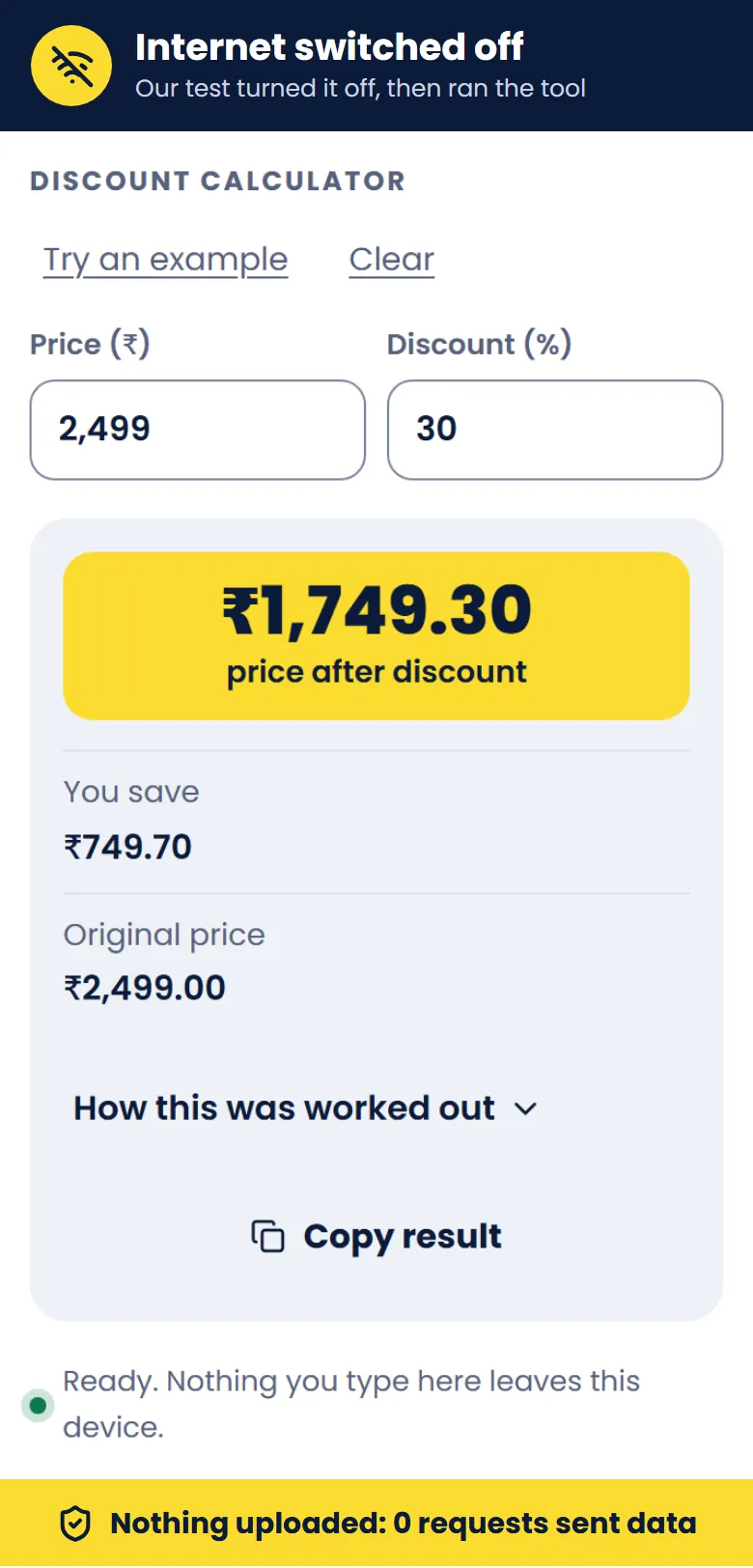
Size and offline. On a first visit the page downloads about 0.1 MB for the tool: the page, its styles, its scripts and the fonts, with Google's ad code not counted. In our test we switched the network off after the page had loaded and pressed Try an example: the price showed 0.1 seconds later or less in each of 15 runs.
Phone-sized screen. We also ran the tests on a phone-sized screen in Chromium (390 × 844 pixels, with touch). That is not a real phone. Every button and box was 44 pixels high or more, and the page did not scroll sideways.
Try it yourself: press "Try an example" at the top of this page. It puts 2,499 and 30 in the boxes and the price after the discount is ₹1,749.30. Then type 999 and 12.5: you pay ₹874.13 and save ₹124.87.

The formula, by hand
Two steps, or one:
- What you save: price × discount ÷ 100. ₹2,499 × 30 ÷ 100 = ₹749.70.
- What you pay: price − saving = ₹2,499 − ₹749.70 = ₹1,749.30.
Or in one step: price × (100 − discount) ÷ 100. With 30% off you pay 70% of the price: ₹2,499 × 0.70 = ₹1,749.30. That one-step form is the easiest to do in your head: 25% off is three quarters of the price, 40% off is six tenths.
Two discounts in a row
“Extra 10% off on the sale price” is a second discount on an already lower price, so two discounts don't add up. 40% off and then an extra 10% is not 50% off: on ₹4,999, 40% off gives ₹2,999.40, and 10% off that gives ₹2,699.46, a total saving of ₹2,299.54, which is 46% of the original.
To work it out here, take the first discount, then type the price after it as the new price with the second discount. The order doesn't change the result: 10% then 40% ends at the same ₹2,699.46. Our post on 50% plus an extra 20% off decodes common sale banners, from 50% twice to three discounts in a row.
Percentage or flat discount
Offers come as a percentage (“20% off”) or a flat amount (“₹500 off”). To compare them, turn one into the other. On a ₹3,500 item, ₹500 off is 500 × 100 ÷ 3,500, about 14.3%, so 15% off (₹525) is slightly better. On a ₹2,000 item the same ₹500 off is 25%, better than 15%. Flat amounts favour cheaper items; percentages favour costlier ones.
Finding the discount
When a tag shows the old and new prices but not the percentage, the discount is (old − new) ÷ old × 100. A shirt marked down from ₹1,999 to ₹1,299 is 700 ÷ 1,999 × 100, about 35% off. Type 35 here with ₹1,999 to check: the price comes to ₹1,299.35, so the real discount is a shade over 35%. The Percentage Calculator works out the exact percentage change between two prices.
Finding the original price
If you know the price after a discount and the percentage, divide: original = price paid ÷ (100 − discount) × 100. You paid ₹2,975 after 15% off, so the original was 2,975 ÷ 85 × 100 = ₹3,500. Type 3,500 and 15 here to check: the price after discount is ₹2,975.
Discounts and GST
Shop prices and MRPs in India include GST, so a discount on the tag price is a discount on the tax too, and the calculator's answer is what you pay. For a business price quoted before GST, a discount shown on the invoice comes off first and GST is worked out on what is left: ₹10,000 with 10% off is ₹9,000, and 18% GST on that makes ₹10,620. The GST Calculator adds or takes out the GST.
Reading a sale
- “Up to 70% off” means some items, not all; check the one you want.
- “Buy 1 get 1 free” is 50% off each item only if you wanted two.
- Cashback is money returned later, often as points, not a lower price today.
- A struck-out price is the seller's own figure; compare the price you pay with other shops, not the discount.
- No-cost EMI offers are a discount spread over months; the EMI Calculator shows what an EMI costs.
For sellers
A discount comes straight out of your margin. If an item costs you ₹700 and sells for ₹1,000, your margin is ₹300; a 20% discount takes ₹200 of it, so two thirds of the profit is gone, though the price fell by only a fifth. Before a sale, work out the price after discount here, then what is left after your cost with the Profit Margin Calculator. A smaller discount on more items, or a flat amount on a bigger order, often keeps more of the margin.
Worked examples
- ₹1,999 with 50% off: ₹999.50, saving ₹999.50.
- ₹10,000 with 10% off: ₹9,000, saving ₹1,000.
- ₹4,999 with 40% off: ₹2,999.40, saving ₹1,999.60.
- ₹3,500 with 15% off: ₹2,975, saving ₹525.
- ₹999 with 12.5% off: ₹874.13, saving ₹124.87. The exact price is ₹874.125, half a paisa, rounded up to ₹874.13, and the saving is ₹999 minus that, so the two add up to ₹999.
Caps, coupons and minimum orders
Many offers have small print that changes the sum. “20% off, up to ₹200” on a ₹1,500 order saves ₹200, not the ₹300 that 20% would give, so the real discount is 200 ÷ 1,500 × 100, about 13.3%. A coupon that needs a minimum order, such as ₹150 off above ₹999, is worth it only if you were going to spend that much anyway. Work out the percentage first with this calculator, then apply the cap: whichever saving is smaller is the one you get.
Bank offers and cashback
Online sales often add a bank offer: “10% instant discount up to ₹1,500 with a card”. On a ₹20,000 phone, 10% would be ₹2,000, but the cap makes it ₹1,500, an effective 7.5%. An instant discount lowers the price you pay at once; cashback comes back later, sometimes as points with their own rules and expiry, so treat it as worth less than the same amount off the price. When an offer needs a no-cost EMI, compare the total you pay with the price paid in full.
Bigger packs and price per unit
A bigger pack with a discount isn't always cheaper per gram. Divide each pack's price by its quantity: a 1 kg pack at ₹450 is ₹0.45 a gram, while a 500 g pack at ₹240 with 10% off is ₹216, or ₹0.432 a gram, so the smaller pack wins here. Many packs now also print a unit sale price, the price per kilogram or litre, for this reason; it is the fairest number to compare. For packs weighed in ounces or pounds, the Weight Converter turns them into grams first.
Discounts in exams
School and competitive exams ask discounts in a few standard forms:
- Successive discounts of a% and b% equal a single discount of a + b − a × b ÷ 100. 40% and 10% make 40 + 10 − 4 = 46%, as worked out above.
- Marked price and selling price: the selling price is the marked price after the discount; the profit is the selling price minus the cost price.
- “What discount gives a 20% profit?” Work out the selling price from the cost first, then the discount from the marked price, as in the section on finding the discount.
“Buy more, save more”
Tiered offers give a bigger percentage for more items: 10% off on two, 20% off on three. Work out each tier's total with the calculator and divide by the number of items to see the price of each. Three shirts at ₹1,000 with 20% off cost ₹2,400, ₹800 each; two with 10% off cost ₹1,800, ₹900 each. The third shirt really costs ₹600, the difference between ₹2,400 and ₹1,800, which is the number to weigh if you didn't need it.
Was the price raised before the sale?
A discount is only as good as the price it starts from. Some listings raise the struck-out price shortly before a sale, so 50% off a doubled price is no saving at all. Before a big purchase, note the price a few weeks earlier, or check it at two or three other shops, and compare what you would pay, not the size of the discount. The calculator tells you exactly what a discount is worth; whether the starting price is fair is for you to check.
Prices ending in 99, and paise
Prices like ₹999 and ₹2,499 are set just under a round number because they feel smaller, and a discount on them lands on paise: 10% off ₹999 is ₹899.10. The calculator keeps the paise exactly, and rounds an exact half paisa up, so 12.5% off ₹999 is ₹874.13. At the till, shops usually round the bill to the nearest rupee, so the paise you see here may not be the paise you pay; the rupees will be. When comparing two prices, use the calculator's figures, which are exact, and ignore the rounding.
Small discounts on things you buy often
A small discount on something you buy every month can be worth more than a big one-off sale. 5% off a monthly grocery bill of ₹3,000 saves ₹150 a month, ₹1,800 a year; the same 5% off a ₹20,000 phone saves ₹1,000, once. When a shop or an app offers a lasting discount on regular buys, work out the year’s saving before you compare it with a one-time offer.
Private: your numbers stay on your device
Your prices and discounts never leave your device. The calculator runs inside your browser and has no upload step: it never sends the numbers you type anywhere, and it doesn't save them, so closing the page forgets them. The page's Content Security Policy lets it contact only this site and Google's ad service, which pays for the site; our code never gives your numbers to the ad code. You can check it yourself in your browser's network panel (F12 on a computer): working out a discount adds no request that carries your numbers.
Read our privacy policy and how we prove your files are never uploaded.
Tips
- Think in what you pay: 30% off is 70% of the price.
- Stack discounts one at a time, never by adding the percentages.
- Compare flat and percentage offers by turning one into the other.
- Check the price you pay against other shops, not just the discount.
Limits
- One percentage discount at a time; work out stacked discounts in turn.
- No flat amounts, coupons or cashback are added for you.
- No tax is added; MRPs already include GST.
- Browsers. We tested only in Chromium, the engine behind Chrome and Edge, with computer and phone-sized screens. We did not test on real phones, in Safari or in Firefox, so we cannot promise how they behave.
Terms explained
- Discount
- A reduction in price, given as a percentage or an amount.
- MRP
- Maximum retail price: the most a seller may charge, with all taxes included.
- Flat discount
- A fixed amount off, such as ₹500, whatever the price.
- Stacked discounts
- Two discounts in a row, the second on the already lower price.
- Margin
- What a seller keeps: the price minus the cost.
- Cashback
- Money or points returned after a purchase, not a lower price at the time.