What the lumpsum calculator does, and when you need it
A lumpsum is money invested all at once rather than bit by bit: a bonus, the proceeds of a sale, a maturing deposit or an inheritance put into a mutual fund, or any investment left alone to grow. Whatever it earns is earned on everything already in it, so it grows by compounding.
Type the amount, the yearly return you expect and the number of years, and this calculator shows what it could be worth at the end, how much of that you put in, and the estimated gain, with the working. It all happens in your browser: nothing you type is uploaded or kept.
When it helps:
- Deciding what to do with a large sum, by seeing what it could become in 5, 10 or 20 years.
- Comparing a lumpsum with a SIP of the same total.
- Testing your expectations: what if the return is 8% instead of 12%?
- Planning a goal years away, such as a child's education.
Step by step
- Type the amount invested in rupees, such as 1,00,000. Commas the Indian or the international way and Hindi digits are read.
- Type the expected return as a yearly percentage, such as 12. Use a figure you think is realistic, after the fund's costs.
- Type the time in years. Part of a year works: 10.5 years is ten and a half.
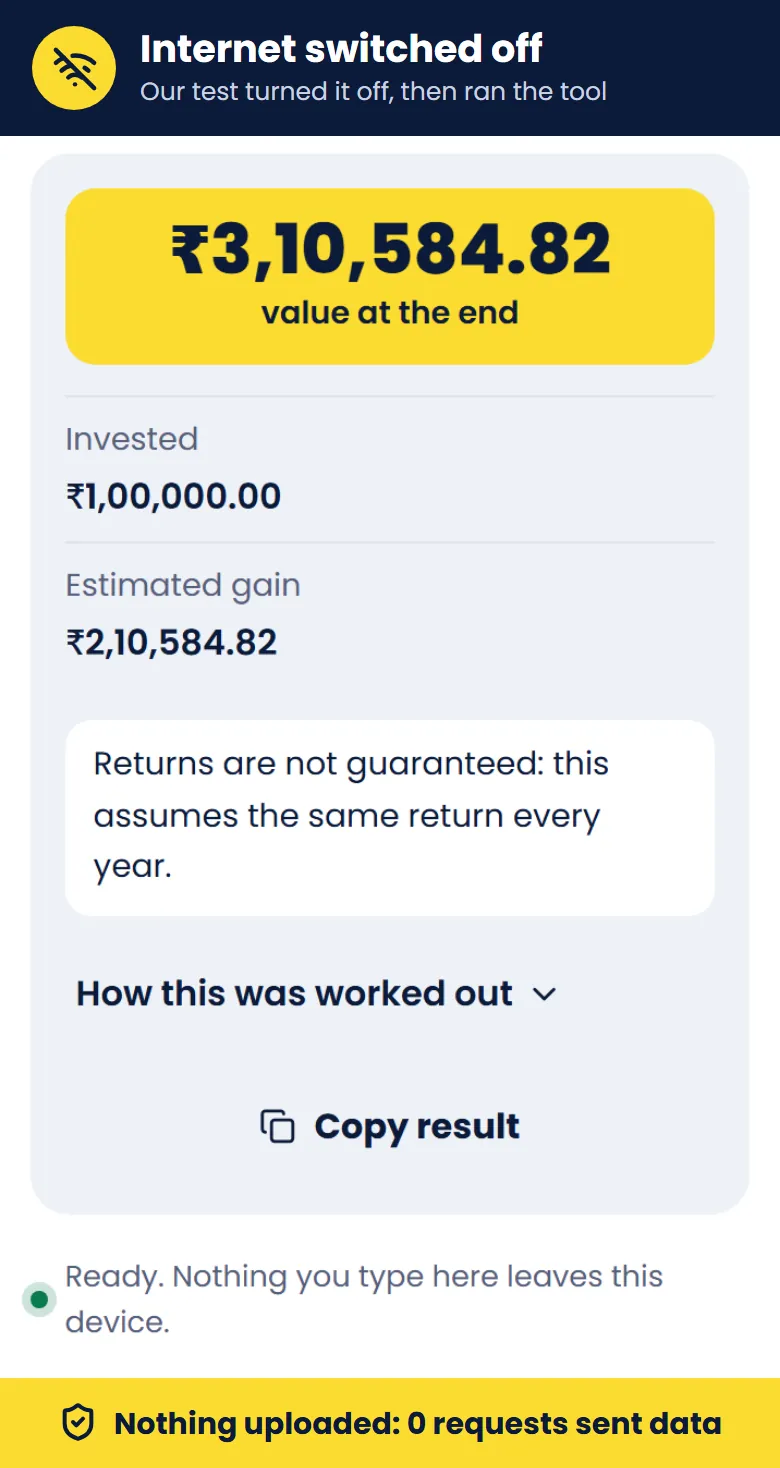
- Read the answer: the value at the end in large type, then the amount invested and the estimated gain.
- Open “How this was worked out” for the formula with your numbers, and use Copy result for a one-line summary.
Try an example fills in ₹1,00,000 at 12% for 10 years, and Clear empties the boxes. A number that doesn't fit, such as a return above 50%, gets a calm line under its box.
What the page does, exactly
These are the calculator's rules in full, and the same rules are checked by our tests.
| Part | The rule | Example |
|---|---|---|
| What you can type | Digits, also those of Hindi and other scripts, a dot for decimals, and commas the Indian or the international way | 1,00,000 and 100000 are the same |
| The boxes' limits | At least ₹1, a return from 0% to 50% a year, a time from 0.1 to 60 years | A return of 60 gets a message under its box |
| The value | P × (1 + r ÷ 100)years: the return added once a year | ₹1,00,000 at 12% for 10 years is ₹3,10,584.82 |
| Estimated gain | The value minus the amount invested | ₹2,10,584.82 |
| Rounding | Whole years are worked out exactly, in whole numbers and fractions; a part of a year needs a root, worked out to 60 decimal places. Amounts are rounded to the paisa, half a paisa up, only when they are written, in the Indian way | ₹3,28,692.08 for 10.5 years |
What the rules don't decide: the calculator assumes the same return every year, which no fund delivers, and it doesn't take off exit loads, stamp duty or tax. Its answer shows what a steady return would give, not a forecast.
Real results from our tests
We tested the Lumpsum Calculator with headless Chromium 148, the open-source browser Chrome is built on, on a Windows laptop with an Intel Core i7-1185G7 and 32 GB of memory, on 1 November 2026. Other work was running on the laptop at the same time, so times vary a little from run to run: each time below is the middle one of 3 runs.
Checked against a second program. Python's decimal numbers, with 120 digits and none of the page's code, worked out 25,000 random investments of ₹1 to ₹5 crore, at returns from 0% to 50% and for 0.1 to 60 years, and the page's code gave the same 75,000 amounts every time, to the paisa: the value at the end, the amount invested and the estimated gain of each. The boxes were typed as people type them, with Indian and international commas, in Hindi, Bengali and Gujarati digits, and with a % sign after the rate. 18 of the amounts sat exactly on half a paisa, and every one was rounded up, as it should be.
The answer is drawn at once. The page drew the answer to a typed amount in 0.17 milliseconds (the middle of 3 runs of 200 amounts typed in a row), not counting the moment the browser takes to paint the screen. Even 59.99 years at a return typed to 40 digits, the longest sum the page does, was drawn in 1.2 milliseconds.
Size and offline. On a first visit the page downloads about 0.1 MB for the tool: the page, its styles, its scripts and the fonts, with Google's ad code not counted. In our test we switched the network off after the page had loaded and pressed Try an example: the value showed 0.1 seconds later or less in each of 15 runs.
Phone-sized screen. We also ran the tests on a phone-sized screen in Chromium (390 × 844 pixels, with touch). That is not a real phone. Every button and box was 44 pixels high or more, and the page did not scroll sideways.
Try it yourself: press "Try an example" at the top of this page. It puts 1,00,000, 12 and 10 in the boxes and the value is ₹3,10,584.82. Then change the time to 20: it is ₹9,64,629.31.

The formula, by hand
Each year multiplies the amount by (1 + r), so after n years it is P × (1 + r)n. For the example, ₹1,00,000 at 12% for 10 years:
- The growth for one year: 1 + 12 ÷ 100 = 1.12.
- For 10 years: 1.12 multiplied by itself 10 times, about 3.1058.
- Multiply by the amount: ₹1,00,000 × 3.1058, about ₹3,10,580; with every decimal kept, the calculator works out exactly ₹3,10,584.82.
A spreadsheet gives the same with =100000*(1+12%)^10. For 10.5 years the power is 10.5, a square root and ten whole years, and the value is ₹3,28,692.08.
Why time matters most
₹1,00,000 at 12% a year:
| Time | Value at the end | Estimated gain |
|---|---|---|
| 10 years | ₹3,10,584.82 | ₹2,10,584.82 |
| 20 years | ₹9,64,629.31 | ₹8,64,629.31 |
| 30 years | ₹29,95,992.21 | ₹28,95,992.21 |
Each extra 10 years roughly triples the value, because the growth itself grows. Thirty years turns ₹1 lakh into nearly ₹30 lakh at a steady 12%. Money that can stay invested longest gains the most from it.
What the return changes
₹1,00,000 for 10 years:
- At 8%: ₹2,15,892.50.
- At 10%: ₹2,59,374.25.
- At 12%: ₹3,10,584.82.
- At 14%: ₹3,70,722.13.
The return is the number nobody can know in advance, so try a careful figure, a middle one and a hopeful one. If a plan only works at the hopeful return, invest more or for longer. The gap between two returns also widens with time: over 20 years, ₹1,00,000 becomes ₹9,64,629.31 at 12% but ₹6,72,749.99 at 10%, nearly ₹3 lakh apart.
Lumpsum or SIP?
With the same return, money invested earlier grows longer. ₹6,00,000 invested at once at 12% for 10 years becomes ₹18,63,508.93; the same ₹6,00,000 spread as ₹5,000 a month over those 10 years becomes ₹11,61,695.38 in the SIP Calculator, because most of it is invested later: on average, each rupee of the SIP is invested for only about half of the 10 years.
But that comparison assumes a steady return. Real markets rise and fall, and a lumpsum put in just before a fall loses more than instalments spread over the same months. That is why many people invest a large sum in parts, or through a SIP from a liquid fund, when markets feel high: it gives up a little of the expected return to avoid the worst timing. If the money is already yours today and you will leave it for many years, investing it sooner has usually done better.
Returns are not promised
A mutual fund's value rises and falls with the markets it invests in, so a fund that averaged 12% a year may lose money in some years and gain much more in others. The calculator assumes one steady return, which no fund gives; its answer shows what that steady return would add up to. Past returns are a guide to how a fund has behaved, not a promise. For money you will need soon, or must not lose, a fixed deposit gives a known rate: the FD Calculator shows what one earns.
Costs, and which return to type
Every fund takes a yearly fee, its expense ratio, out of its assets, so returns a fund reports are already after it; direct plans cost less than regular plans of the same fund. If you work from a market's return instead, type a figure after costs. One percentage point matters: ₹1,00,000 for 10 years is ₹3,10,584.82 at 12% but ₹2,59,374.25 at 10%. Exit loads, stamp duty and tax on gains are not taken off here.
What the money will buy
A rupee in ten years buys less than a rupee today. To see a result in today's money, type the return minus inflation: 12% with prices rising 6% a year is about 6% in today's rupees, and ₹1,00,000 for 10 years at 6% is ₹1,79,084.77. So the ₹3.1 lakh at the end would buy about what ₹1.8 lakh buys now. For long goals, plan in today's money and add inflation to the goal, not just to the hope.
Working back from a goal
To find the lumpsum a goal needs, work out what ₹1 grows to and divide the goal by it. Type 1 as the amount with your return and years: at 12% for 15 years, ₹1 grows to about ₹5.47. A goal of ₹10,00,000 in 15 years then needs about ₹10,00,000 ÷ 5.47, roughly ₹1,83,000 today. Check by typing it back: ₹1,83,000 at 12% for 15 years gives ₹10,01,662.53, just over the goal. For a goal reached by monthly saving instead, see how much SIP for ₹1 crore.
Before you invest a large sum
A lumpsum often arrives once: a bonus, a sale, a maturing deposit. Before it goes into anything that rises and falls, two checks are worth making. First, an emergency fund: a few months of expenses kept where you can reach them at once, such as a savings account or a liquid fund. Second, debts: a credit card or personal loan at 14% to 40% a year costs more than almost any investment earns, so paying it off is a certain return. A third is cover: health insurance, so that a hospital bill never has to be paid by selling an investment at a bad time. Whatever is left, and won't be needed for several years, is what this calculator is for.
Investing a lumpsum in parts
If putting everything in on one day feels risky, many fund houses offer a systematic transfer plan, an STP: the lumpsum goes into a low-risk fund such as a liquid fund, and a fixed amount moves each month into the fund you chose, over 6 to 12 months or longer. It is a SIP funded from your own lumpsum. The calculator works out the lumpsum part as if it were invested on the first day; for the monthly part, use the SIP Calculator with the amount moved each month. The reverse, a fixed amount taken out each month while the rest stays invested, is a systematic withdrawal plan, an SWP: the SWP Calculator shows how long the money lasts.
Worked examples
- A maturing FD of ₹3,00,000, reinvested at 8% for 5 years: ₹4,40,798.42.
- A bonus of ₹2,00,000 at 11% for 7 years: ₹4,15,232.03, a little more than double.
- ₹5,00,000 for a child's education in 15 years at 12%: ₹27,36,782.88, before tax and inflation.
- ₹1,00,000 for ten and a half years at 12%: ₹3,28,692.08, with the half year worked out by the same formula.
Reading a fund's past returns
Fund factsheets quote returns over 1, 3, 5 and 10 years as a CAGR, a compound annual growth rate: the steady yearly return that would turn the starting value into the ending one. That is exactly the kind of return this calculator uses, so a 10-year CAGR of 12% means ₹1,00,000 became about ₹3,10,585. But it hides the path: a fund can reach 12% a year with years of 30% and years of −10%. Use past CAGRs to choose a careful return to type, not as a promise of the next ten years. To work out the CAGR of an investment you hold, from what you paid and what it is worth now, use the CAGR Calculator.
Tax
The calculator shows the value before tax. Gains on mutual fund units are taxed when you sell them, and how much depends on the kind of fund, how long you held the units and the law of the year you sell. Check the current rules, or ask a tax professional, before planning around a figure after tax.
Not only mutual funds
The same formula fits any single amount that grows at a yearly rate: a bond or a deposit whose interest is added once a year, gold or property you expect to rise by some percentage, or simply money left alone. Where interest is added more often, as in most bank deposits, the FD Calculator and the Compound Interest Calculator take the quarterly or monthly adding into account. And some homes for a lumpsum have limits of their own: PPF, for instance, takes at most ₹1,50,000 in a financial year, so a larger sum can't all go there at once; the PPF Calculator works out yearly deposits.
Private: your numbers stay on your device
Your amounts, returns and years never leave your device. The calculator runs inside your browser and has no upload step: it never sends the numbers you type anywhere, and it doesn't save them, so closing the page forgets them. The page's Content Security Policy lets it contact only this site and Google's ad service, which pays for the site; our code never gives your numbers to the ad code. You can check it yourself in your browser's network panel (F12 on a computer): working out a value adds no request that carries your numbers.
Read our privacy policy and how we prove your files are never uploaded.
Tips
- Try three returns, and plan on the careful one.
- Think in today's money for goals years away.
- Keep a record of what you invested and when, so you can compare the real result with this estimate later.
- Investing every month instead? The SIP Calculator works out a monthly investment.
- For interest added more often, such as a deposit's quarterly interest, use the Compound Interest Calculator.
Limits
- One steady return, added once a year.
- One amount, nothing added or taken out.
- No costs or tax taken off, except through the return you type.
- Not advice. It works out the numbers; which investment suits you is for you, and a registered adviser if you have one.
- Browsers. We tested only in Chromium, the engine behind Chrome and Edge, with computer and phone-sized screens. We did not test on real phones, in Safari or in Firefox, so we cannot promise how they behave.
Terms explained
- Lumpsum
- Money invested all at once, rather than in instalments.
- Return
- What an investment earns in a year, as a percentage.
- Compounding
- Earning a return on earlier returns as well as on the money put in.
- CAGR
- Compound annual growth rate: the steady yearly return that gives the same growth.
- Expense ratio
- A fund's yearly fee, taken out of its assets.
- SIP
- Systematic investment plan: a fixed amount invested every month.