The quick answer
The monthly SIP that reaches ₹1 crore depends mostly on how many years you have, then on the return, and only then on anything else. At a steady return of 12% a year, with each instalment invested at the start of its month:
| Years to go | SIP a month | You pay in |
|---|---|---|
| 30 years | ₹2,832.93 | ₹10,19,854.94 |
| 25 years | ₹5,269.72 | ₹15,80,915.11 |
| 20 years | ₹10,008.53 | ₹24,02,046.74 |
| 15 years | ₹19,818.62 | ₹35,67,351.60 |
| 10 years | ₹43,040.54 | ₹51,64,865.16 |
Every figure was worked out exactly with the Goal SIP Calculator, which works backwards from a goal and a date to the monthly SIP. Type your own goal, years and return to see yours. The calculator assumes the same return every month and the same SIP every month, which makes the numbers easy to compare; real investments move around that path, as explained below.
Time does most of the work
Look at the last column of the table. With 30 years to go, you put in about ₹10.2 lakh of your own money and growth supplies the other ₹89.8 lakh. With 10 years to go, you put in about ₹51.6 lakh, more than half the crore, yourself, and the monthly amount is more than fifteen times the 30-year SIP. Each five years of waiting roughly doubles the monthly SIP.
That is the power of compounding: money invested early earns returns, and those returns earn returns of their own, for longer. A small SIP started today usually beats a large one started later, and the first years count the most. Starting at 25 instead of 35 can mean paying ₹5,269.72 a month instead of ₹19,818.62 for the same crore at 50, if the return holds.
Starting small still adds up
A crore may feel far off, but small SIPs started early go a long way. ₹2,000 a month for 30 years at 12% grows to ₹70,59,827.55, from ₹7,20,000 paid in. ₹5,000 a month for 25 years grows to ₹94,88,175.46, from ₹15,00,000 paid in. Neither quite reaches a crore, but each gets most of the way with an amount many families can set aside, and a yearly step-up closes the rest.
The hardest part is usually the first month. Pick an amount you can keep paying when money is tight, since a SIP that stops in a bad year loses the years that matter most. An automatic monthly debit on the day after your salary arrives makes it easy to keep going.
What the return you assume changes
The return you plan on changes the SIP a lot. For ₹1 crore in 20 years:
- At 8% a year: ₹16,864.91 a month, with ₹40,47,577.80 paid in.
- At 10% a year: ₹13,060.00 a month, with ₹31,34,399.49 paid in.
- At 12% a year: ₹10,008.53 a month, with ₹24,02,046.74 paid in.
Planning on a careful return and doing better leaves you ahead; planning on a hopeful one and doing worse leaves you short of the goal, often when it is too late to catch up. Many people plan with a return a little below what they hope for, and check every year. A 2% difference in the return, from 10% to 12%, changes the SIP for the same crore by more than ₹3,000 a month over 20 years.
What ₹10,000 a month becomes
Working forwards gives the same picture. ₹10,000 a month for 20 years at 12% grows to ₹99,91,479.19, just short of a crore, from ₹24,00,000 paid in; the SIP Calculator shows it. That is why the goal SIP for a crore in 20 years is a little over ₹10,000: ₹10,008.53 closes the small gap.
If ₹10,000 a month is more than you can manage today, start with what you can and raise it as your income grows, as below. The order of the numbers is worth noticing: over 20 years, growth supplies about three quarters of the crore, so missing a few early months costs far more than missing a few late ones.
A crore in 20 years is worth less than a crore today
Prices rise, so a crore in the future buys less than a crore does now. If prices rise 6% a year, ₹1 crore in 20 years will buy only what ₹31,18,047.27 buys today; the Inflation Calculator works it out. To have the buying power of today's crore in 20 years, you would need ₹3,20,71,354.72, and the SIP for that at 12% is ₹32,098.71 a month.
That isn't meant to discourage you. It is a reason to price a goal in future rupees first, then work out the SIP for that figure, so the plan is honest from the start. Nobody knows what inflation will be over 20 years, so many people try two or three rates, such as 5%, 6% and 7%, and plan for the middle one.
If the SIP is more than you can invest
There are four levers, and most plans use more than one:
- More years: the table shows how much each extra five years helps.
- A step-up SIP: start lower and raise the SIP each year as your pay rises. The Goal SIP Calculator works out a level SIP; the Step-up SIP Calculator shows what one that rises each year grows to.
- A lump sum now: money you already have, such as a bonus, grows alongside the SIP. Work out what it will grow to with the Lumpsum Calculator, take that from the goal, and work out the SIP for the rest.
- A smaller or later goal: ₹75 lakh, or the crore in 25 years instead of 20.
Raising the SIP by even a small amount each year makes a large difference over 20 years, because the extra money in the early years has the longest time to grow.
Returns aren't promised
Every figure here assumes the same return every month for the whole time, which no fund gives. Equity funds rise and fall with the markets, sometimes sharply, so a real SIP's value will wander above and below the steady path. The calculator shows what a steady return would need from you; it can't promise the goal.
Over 20 years there will probably be several bad years; what matters is staying invested through them, since stopping the SIP after a fall means buying less when prices are low. Many people move money from riskier funds to safer ones as the goal gets close, so that a fall in the market in the last year or two can't undo years of saving. For a goal only a few years away, a lower return, or a safer investment, is the wiser assumption. Funds' past returns are often quoted as a yearly CAGR; they help in choosing a careful figure, but they are not a promise of the next 20 years.
Costs and tax
A fund's yearly costs, its expense ratio, come out of its returns, so type the return you expect after costs: a fund that earns 12% before a 1% expense ratio gives you about 11%. Tax on mutual fund gains is charged when you sell, and how much depends on the kind of fund and how long you held it. Tax rules change with budgets, so leave some room in the goal for tax, and check the current rules on the Income Tax Department's website or with a tax adviser before you plan around them. Direct plans of mutual funds have lower expense ratios than regular plans of the same fund, which over 20 years can make a noticeable difference to the final amount.
Check the plan every year
Once a year, compare what your investment is worth with where the plan says it should be. If you are ahead, you can keep the SIP as it is. If you are behind, grow what you have to the goal date with the Lumpsum Calculator, take it from the goal, and work out a new SIP for the rest over the years left. Small corrections each year are far easier than one large one near the end. Good years count too: if the fund did better than planned, you may be able to keep the SIP as it is and still reach the goal early.
Writing the goal down, with its amount, its date and the return you assumed, makes the yearly check quick, and keeps one goal from quietly eating into another. A pay rise is a good moment to raise the SIP, before the extra money gets spent.
When a crore is one of several goals
Few families save for one thing only. A down payment in 3 years, a child's degree in 10 and retirement in 20 each need their own SIP, worked out with a return that suits its time: a careful one for the near goal, a higher one for the far goals. Add the SIPs up to see the monthly total, and when the near goal is reached, its SIP can move to the others. The Goal SIP Calculator's guide works through such a plan. Keeping each goal in its own SIP, or at least its own folio, makes it easy to see which goal is on track and which needs more.
Try it: type your goal, the years and a careful return to see the monthly SIP that gets you there.
Open the Goal SIP Calculator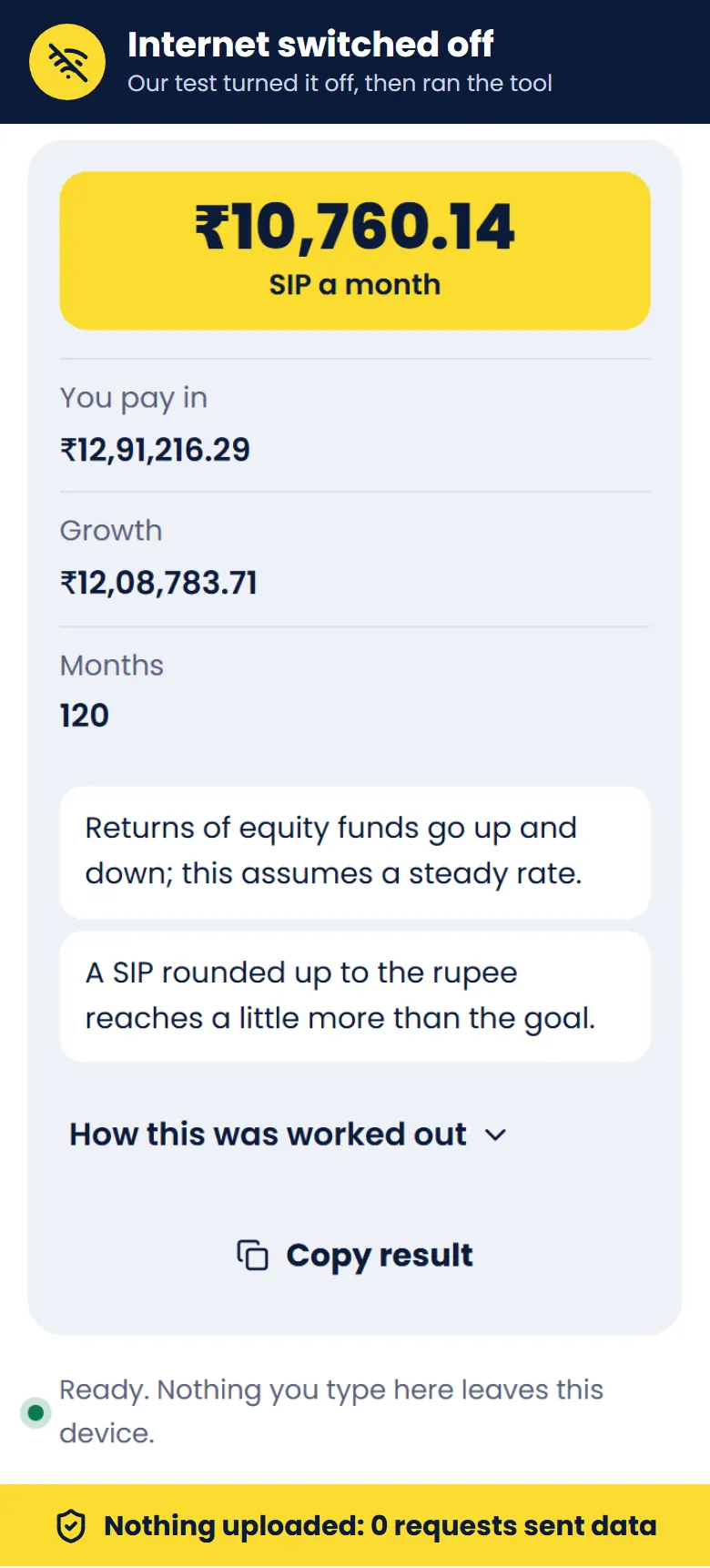
Goal SIP Calculator, free and private: work out the monthly SIP that reaches a goal amount in the years you have.
Open Goal SIP Calculator