The quick answer
Percentage of marks = marks obtained ÷ maximum marks × 100. If you scored 432 out of 500, divide 432 by 500 to get 0.864, then multiply by 100 to get 86.4%. That is the whole formula, and it works for any total: five subjects, six subjects, a board exam, a semester or a single test.
The slips come later: adding up several subjects, subjects with different maximum marks, working out the marks you still need, comparing two exams, and rounding. This page takes each one in turn, with small examples you can check by hand. Every mark and every student in the examples is invented.
Three rules to carry through every example:
- Add first, divide once. Add the marks of all the subjects, add their maximums, and divide the first total by the second.
- Use the paper's maximum. The number at the bottom is what the paper was set out of, not the pass mark and not the highest score in the class.
- Round last. Keep every digit until the end, and round only the way your board, college or form says.
If you would rather not do the sum by hand, Percentage Calculator does it: choose “Part as a percentage of a whole”, type the marks and the maximum, and it shows the percentage with its working. It runs in your browser and has no upload step, so the marks you type are never sent anywhere. The five formulas in its guide include this one.
Percentage of 5 subjects: add, then divide
Say a student has these marks, each subject out of 100:
| Subject | Marks | Out of |
|---|---|---|
| Hindi | 78 | 100 |
| English | 85 | 100 |
| Mathematics | 72 | 100 |
| Science | 91 | 100 |
| Social Science | 66 | 100 |
| Total | 392 | 500 |
The five marks add up to 392 (78 + 85 + 72 + 91 + 66) and the five maximums to 500. Then 392 ÷ 500 = 0.784, and 0.784 × 100 = 78.4%.
Because every subject here is out of 100, there is a shortcut: the average of the five marks is the percentage. 392 ÷ 5 = 78.4. That shortcut works only when every subject has the same maximum. Two sections down you will see what goes wrong when they don't.
In the Percentage Calculator, add the five marks yourself, then type 392 as the part and 500 as the whole. It answers 78.4% and lists each step in plain words. To check the result the other way, choose “A percentage of a number” and type 78.4 and 500: it gives 392 back.
Totals of 500, 600 and 1,200
The sum never changes; only the maximum does. Five papers of 100 give a total of 500, six papers of 100 give 600, and six papers of 200 give 1,200. Four examples, with invented marks:
| Maximum | Marks | Working | Percentage |
|---|---|---|---|
| 500 | 432 | 432 ÷ 500 × 100 | 86.4% |
| 500 | 389 | 389 ÷ 500 × 100 | 77.8% |
| 600 | 449 | 449 ÷ 600 × 100 | 74.83% |
| 1,200 | 846 | 846 ÷ 1,200 × 100 | 70.5% |
There is a quick way to do these in your head. When the maximum ends in two zeros, cross out the two zeros and divide the marks by what is left. Out of 500, divide by 5: 432 ÷ 5 = 86.4. Out of 600, divide by 6: 449 ÷ 6 is about 74.83. Out of 1,200, divide by 12: 846 ÷ 12 = 70.5. It works because a percentage is the marks per 100 of the maximum.
449 ÷ 6 never ends: it is 74.8333 and so on. So the page writes 74.83% to two decimal places, and its Exact value row gives 449/6% with a note that the decimal never ends. That is normal for sums like this one. The rounding section below says what to write on a form.
Subjects with different maximum marks
Not every subject is out of 100. A practical may be out of 50, a project out of 20, a language paper out of 80. The rule stays the same: add all the marks, add all the maximums, divide once. Say a student has these three:
| Subject | Marks | Out of | On its own |
|---|---|---|---|
| Mathematics | 85 | 100 | 85% |
| Computer practical | 38 | 50 | 76% |
| Project | 9 | 20 | 45% |
| All together | 132 | 170 | 77.65% |
The marks add up to 85 + 38 + 9 = 132, and the maximums to 100 + 50 + 20 = 170. Then 132 ÷ 170 × 100 = 77.65%, to two decimal places. The exact value is 1320/17%, which never ends.
Why not average the three percentages?
Some people work out each subject's percentage and average them: (85 + 76 + 45) ÷ 3 = 68.67%. That is 8.98 percentage points lower than 77.65%, and it is not what “percentage of total marks” means. Averaging the percentages gives the 20-mark project the same weight as the 100-mark paper, though the project holds only 20 of the 170 marks. Adding the marks counts every mark once.
The two methods agree only when every subject has the same maximum, as in the five-subject example. If your board or college says to weight the subjects in some other way, its own rule is the one to follow. Also check how your marksheet or notice treats an additional or optional subject: if it is left out of the total, leave it out of both the marks and the maximums.
The marks you need for a target percentage
Often the question is the other way round: how many marks do I need? The marks needed in total are the target percentage divided by 100, times the maximum. Some round targets:
| Target | Out of 500 | Out of 600 | Out of 1,200 |
|---|---|---|---|
| 50% | 250 | 300 | 600 |
| 60% | 300 | 360 | 720 |
| 75% | 375 | 450 | 900 |
| 90% | 450 | 540 | 1,080 |
In the Percentage Calculator, choose “A percentage of a number” and type the target and the maximum: 60% of 500 is 300.
The marks you still need in the last paper
Take the marks you need in total and subtract the marks you already have.
- Four papers done, one to go. A student has 228 out of 400, which is 57%. To reach 60% out of 500 she needs 300 in total, so 300 − 228 = 72 out of 100 in the last paper.
- Five of six done. A student has 350 out of 500 so far, which is 70%. For 72% out of 600 the total must be 432, so the last paper needs 432 − 350 = 82 out of 100.
Then check that the target is still possible. If the marks you need are more than the last paper's maximum, it is out of reach. In the second example, 80% of 600 is 480, and 480 − 350 = 130, but the last paper is only out of 100. The highest possible finish is (350 + 100) ÷ 600 = 75%. It is kinder to know this early, so you can aim at a target that is within reach.
Some courses also ask for a minimum in each subject, as well as in total. Your notice or marksheet says. These sums cover only the overall percentage.
A change between two exams: percent or percentage points?
Two results can be compared in two ways, and they give different numbers. Say a student scored 360 out of 500 (72%) in the first unit test and 405 out of 500 (81%) in the second.
- In percentage points: 81 − 72 = 9 percentage points. This is the plain difference between the two percentages.
- As a percent change: 9 ÷ 72 × 100 = 12.5%. This measures the change against the first result.
Both are true. They answer different questions. “Up 9 points” says how far the percentage moved. “Up 12.5%” says how big the move is compared with where the student started. When you report a change, say which one you mean: “up 9 percentage points” cannot be mistaken for “up 9%”.
The percent change also depends on which result you start from. From 72 to 81 is +12.5%, but from 81 back down to 72 is -11.11%, because the same 9 points are now measured against the larger number. In the Percentage Calculator, choose “Percentage change” and type the old percentage in the first box and the new one in the second. Its list of common mistakes has the same warning about percent and percentage points.
When the two exams have different totals
Compare the percentages, not the raw marks. Say the first exam was 72 out of 100 (72%) and the second 130 out of 150 (86.67%). The raw marks rose from 72 to 130, which the page calls an increase of 80.56%, but that is not the improvement: the second exam was simply out of more marks. The percentage rose by about 14.67 percentage points, which is the fair comparison.
Rounding: why 59.6% is not 60%
298 out of 500 is exactly 59.6%. It is tempting to write 60%, but 59.6 is below 60, by two marks out of 500: 300 out of 500 is 60%. Whether a result such as 59.6% counts as 60% for a cut-off, a scholarship or a job form is the rule of that board, college or employer. It is not a rule of arithmetic. Notices differ, so read the sentence about rounding in yours, and if there is none, ask the office that issued it.
On a form, give the percentage printed on your marksheet if it has one. If you have to work it out yourself, write the exact figure to as many decimal places as the form allows, and do not round up to the next whole number on your own.
The Decimal places box
The Percentage Calculator starts with 2 decimal places, so 298 out of 500 shows as 59.6%. If you set Decimal places to 0, the page rounds half away from zero and shows 60%, and its Exact value row still says 59.6%. Choose 0 only when the form wants whole numbers and says to round. Here is 449 out of 600 at four settings:
| Decimal places | The page shows |
|---|---|
| 0 | 75% |
| 1 | 74.8% |
| 2 | 74.83% |
| 4 | 74.8333% |
A half rounds outwards: 375 out of 600 is exactly 62.5%, which is 63% at 0 places. The guide's section on rounding explains the rule and the Exact value row.
Common slips with marks
- Dividing the wrong way round. The marks go on top and the maximum underneath. 500 ÷ 432 gives 1.157 and so on, which is not a percentage of anything.
- Forgetting the × 100. 432 ÷ 500 is 0.864. That is the fraction; the percentage is 86.4%.
- Using the wrong maximum. Use what the paper was set out of, not the pass mark and not the topper's score.
- Averaging percentages across subjects with different maximums. Add the marks and the maximums instead, as in the section above.
- Rounding each subject first. Small roundings add up. Keep the full marks until the very end.
- Mixing up percent and percentage points when comparing two results.
- Using one formula for every CGPA. A CGPA turns into a percentage by the formula of your own board or university, so a rule you heard from a friend may not be yours.
Checking your answer, and CGPA
Three quick checks catch most mistakes. Half the maximum is always 50%, so if you got more than half the marks the answer must be above 50%. Going back should return the marks: 78.4% of 500 is 392. And a percentage over 100 means the marks are bigger than the maximum, so one of the two numbers was typed wrongly; the page points this out when it happens.
If your result is a CGPA rather than marks, that is a different sum. A CGPA is an average of grade points, and each board or university publishes its own formula for turning it into a percentage. CGPA to Percentage applies the formula you choose, and its guide explains why the formula of your own institution is the one that counts, and that a college or form may ask for a certificate.
Try it: type your marks as the part and the maximum as the whole, and read the percentage with its working.
Open the Percentage Calculator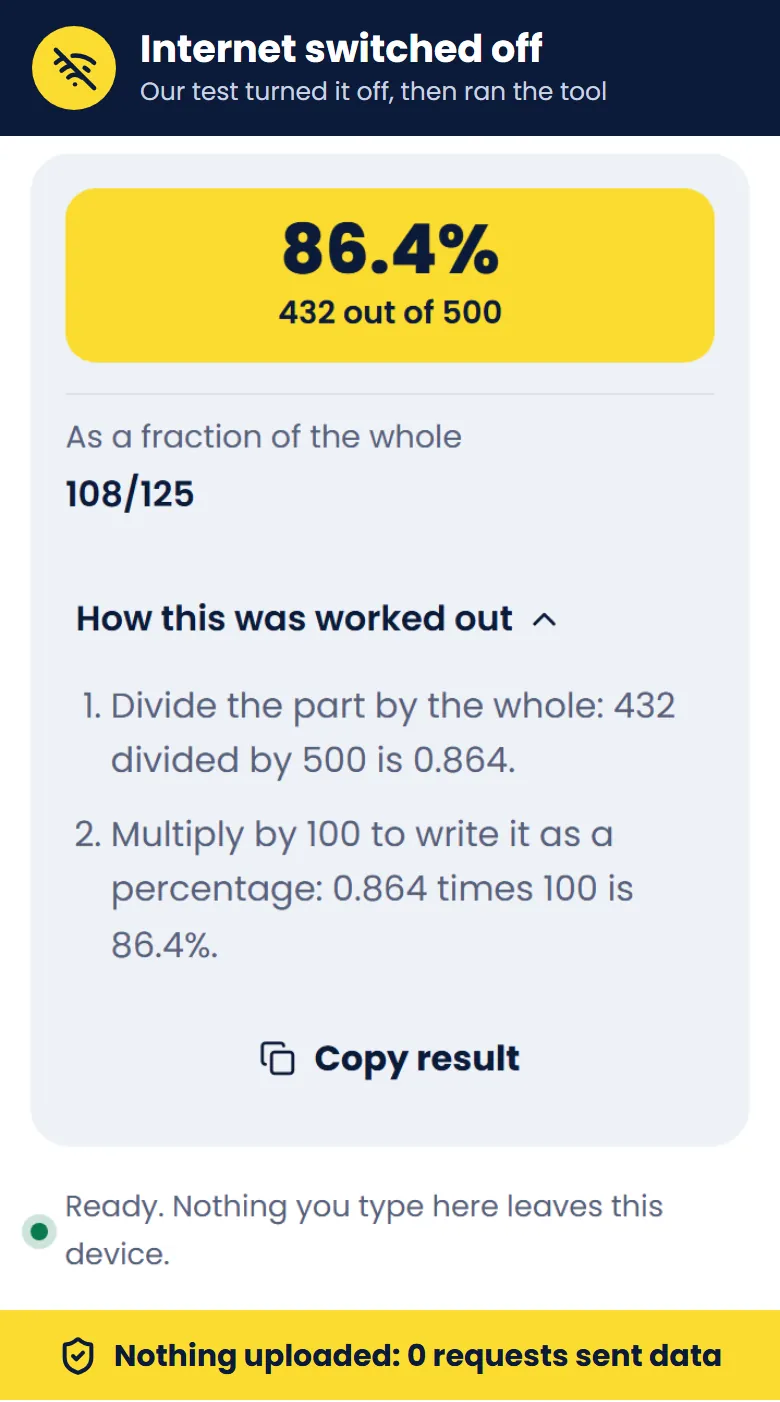
Percentage Calculator, free and private: work out a percentage of a number, a percentage change, or add, subtract and undo a percentage, with the working shown.
Open Percentage Calculator