The quick answer
On an Indian cheque, the amount in words follows a simple pattern: the word Rupees, the amount in words using lakh and crore, the paise if there are any, and the word Only at the end. For ₹25,000 you write Rupees Twenty-Five Thousand Only. For ₹1,50,000 you write Rupees One Lakh Fifty Thousand Only. For ₹1,234.56 you write Rupees One Thousand Two Hundred Thirty-Four and Fifty-Six Paise Only.
Many cheques already print the word Rupees at the start of the line; then you begin straight after it. In the box, write the same amount in figures, close to the ₹ sign, such as 25,000/- or 25,000.00.
If you would rather not work out the words yourself, Number to Words writes them for you in this exact form: type the amount, choose “In rupees, for a cheque”, and copy the words. It runs in your browser and has no upload step, so the amount you type is never sent anywhere.
The rest of this page explains each part, the mistakes that most often get a cheque returned, and the same rules for drafts, slips and receipts, so you can write any amount with confidence even without the converter at hand.
Reading the amount the Indian way
Indian amounts are grouped with commas after the first three digits from the right, then every two digits: 1,00,000 is one lakh and 1,00,00,000 is one crore. The commas tell you the words. Read each group with its name, from the left:
- 12,34,567: 12 lakh, 34 thousand, 567. In words: Twelve Lakh Thirty-Four Thousand Five Hundred Sixty-Seven.
- 1,01,000: 1 lakh and 1 thousand: One Lakh One Thousand. Don't drop the second “One”.
- 1,00,500: 1 lakh, no thousands, 500: One Lakh Five Hundred.
- 1,50,00,000: 1 crore and 50 lakh: One Crore Fifty Lakh.
A group that is zero is simply left out: there is no “zero thousand” in 1,00,500. Above 99 crore, crore simply repeats: 1,00,000 crore is One Lakh Crore. If the commas aren't there yet, put them in first, three digits from the right and then pairs, and the words follow. The guide's section on lakh and crore explains the system in more depth, with the international names beside them.
Writing paise
When the amount has paise, add them after the rupees with the word “and”, then end with Only: Rupees Four Hundred Fifty and Seventy-Five Paise Only for ₹450.75. A single digit after the point means tens of paise, so ₹45.5 is forty-five rupees and fifty paise, not five paise. The paise are written as a number in words, Seventy-Five, not as two separate digits.
Many people avoid paise on cheques altogether and pay a round amount, which keeps both lines short and leaves less room for mistakes. When the amount must be exact, such as a bill or a fee, write the paise as above, and in the box write the figures with two decimal places: 450.75.
Number to Words rounds to the paisa before writing the words, half a paisa up, so 999.999 becomes Rupees One Thousand Only. That matters when an amount comes from a calculation, such as a share of a bill: work out the exact rupees and paise first, and write those.
Where to write each part
- Start right after Rupees, at the very beginning of the line, with no gap, so that no word can be squeezed in front of yours.
- Write the words in one go, clearly, without large spaces between them.
- End with Only, then draw a line through any space left on the line, up to the box.
- In the box, write the figures right next to the ₹ sign, and end them with /- or with the paise, so no digit can be added after them.
- Read both lines once more before you sign, and check that they say the same amount.
Use a pen with ink that doesn't smudge or erase, and keep within the printed area. A cheque is read by a machine and by a person, so neat writing speeds it through.
The figures in the box
The box takes the same amount in figures. Write it close to the ₹ sign, with commas the Indian way, such as 1,50,000, and close it off so nothing can be added: 1,50,000/- for whole rupees, or 1,50,000.00. With paise, write both decimal places, 450.75. Keep the figures inside the box and don't let them touch its edges, since the cheque is read by a machine as well as a person.
If you aren't sure where the commas go, type the amount into Number to Words: it shows the figures with the commas in the right places under the words.
When the words and the figures differ
Section 18 of the Negotiable Instruments Act, 1881, covers an amount stated differently in figures and in words: the amount in words is the amount to be paid. In practice, banks often return a cheque whose two amounts don't match, so a mismatch usually means a returned cheque, a delay and sometimes a charge. The safe rule is simple: make them say exactly the same thing. If a cheque does come back, the bank's return memo gives the reason; write a fresh cheque with matching amounts rather than correcting the old one.
The words are there in the first place because they are much harder to change than figures. One stroke turns a 1 into a 7, and a zero can be added after a number; Twenty-Five Thousand can't become Seventy-Five Thousand without the change showing.
Mistakes to avoid
- Leaving out Only, which leaves room for more words after the amount.
- Skipping a group: One Lakh Thousand for 1,01,000 is wrong; it is One Lakh One Thousand.
- Mixing the systems: “Ten Lakh Million” means nothing. On Indian cheques, use lakh and crore.
- Spelling: forty has no u, and ninety keeps its e.
- Plurals: after a number, formal writing says Five Lakh and Two Crore; Lakhs and Crores are common in speech but best avoided on a cheque.
- Correcting a mistake on the cheque: most banks won't accept a cheque with a correction, even a signed one, so write a fresh cheque and cancel the spoiled one by writing CANCELLED across it.
- Leaving gaps before, inside or after the words.
And, hyphens and capital letters
Small differences in style are all accepted, as long as the amount is clear:
- “And” inside the number: British English often writes Five Hundred and Sixty-Seven; Indian cheques usually leave it out, Five Hundred Sixty-Seven, and keep “and” only before the paise.
- Hyphens: Twenty-One with a hyphen is the standard spelling; Twenty One without it is also common and understood.
- Capitals: writing every word with a capital letter makes each one stand out, which is why many people write cheques that way.
Number to Words uses capitals and hyphens, and no “and” inside the number, the most common form on Indian cheques. The guide explains the choices.
Post-dated cheques for EMIs and rent
Lenders and landlords sometimes ask for a set of post-dated cheques, one for each EMI or month's rent. Write each one exactly as above, with the date it is due, and keep a list of the cheque numbers, dates and amounts. A cheque is valid for three months from the date written on it, so a cheque dated far in the past can't be paid. The EMI Calculator shows a loan's EMI, so you can check the amount before writing a dozen cheques.
Keeping a cheque safe
- Cross it with two parallel lines across the top left corner and the words A/C Payee between them, so it can be paid only into the payee's bank account, not cashed over the counter.
- Write the payee's name in full, as it appears on their bank account, and draw a line after it.
- Never sign a blank cheque, and never leave the amount for someone else to fill in.
- Note the details in your cheque book's counterfoil: the date, the payee and the amount.
Ready examples
| In figures | In words |
|---|---|
| ₹5,000 | Rupees Five Thousand Only |
| ₹25,000 | Rupees Twenty-Five Thousand Only |
| ₹1,00,000 | Rupees One Lakh Only |
| ₹1,01,000 | Rupees One Lakh One Thousand Only |
| ₹2,50,000 | Rupees Two Lakh Fifty Thousand Only |
| ₹5,00,000 | Rupees Five Lakh Only |
| ₹12,34,567.50 | Rupees Twelve Lakh Thirty-Four Thousand Five Hundred Sixty-Seven and Fifty Paise Only |
| ₹1,50,00,000 | Rupees One Crore Fifty Lakh Only |
For any other amount, type it into Number to Words: it gives the words and the figures with the commas in the right places, ready to copy.
Demand drafts, slips and receipts
The same rules apply wherever an amount is written in words: demand draft forms, deposit and withdrawal slips, rent receipts, agreements and salary letters. Start right after the printed word, end with Only, and keep the figures the same. When you fill in a form for someone else, read the words back to them: a missed lakh is easy to overlook in a long line. Older relatives often ask for help with exactly this, and a printed or copied line of words, checked against the figures, takes the guesswork out of it.
For an invoice that needs GST, work out the total with the GST Calculator first, then write the total in words. For a shared bill, the Split Bill Calculator gives each person's exact share.
Try it: type your amount and choose “In rupees, for a cheque” to get the words, ready to copy.
Open Number to Words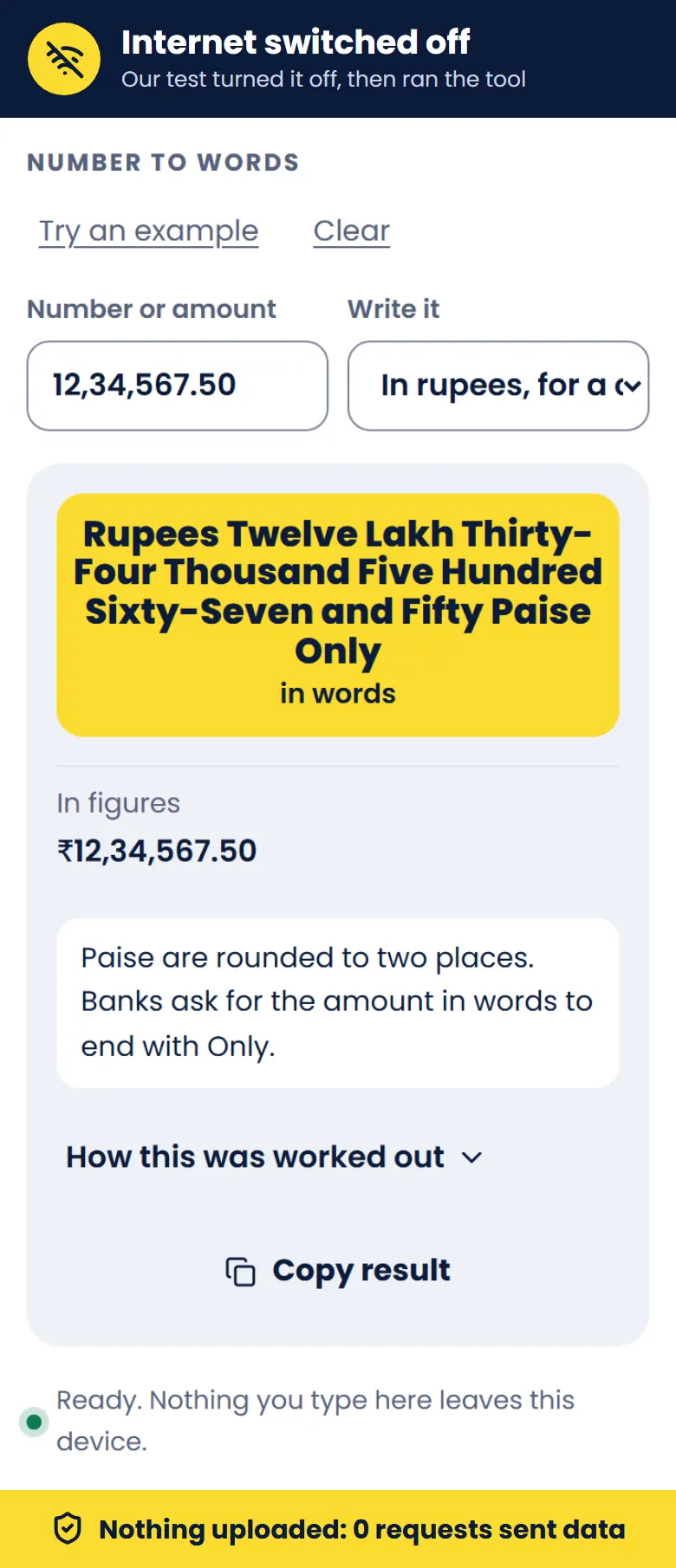
Number to Words, free and private: write a number or an amount in words: in rupees and paise for a cheque, or the Indian or international way.
Open Number to Words