The quick answer
If you pay the maximum, ₹1,50,000, into a Sukanya Samriddhi account at the start of each financial year for the 15 years deposits are allowed, and the rate stays at 8.2%, the account holds ₹71,82,119.17 when it matures, 21 years after it was opened. You pay in ₹22,50,000; the other ₹49,32,119.17 is interest.
The figure comes from the Sukanya Samriddhi Calculator, which works the sum out exactly, with interest compounded once a year as the scheme does. It assumes one rate for all 21 years; the real rate is set by the government every quarter, so treat the answer as a guide, and check it again when the rate changes. It works in your browser, so nothing you type is uploaded or kept. Below: how the balance builds up year by year, what smaller deposits give, what a different rate does, and the rules on withdrawals and tax.
How the money grows: 15 years in, 6 to grow
A Sukanya Samriddhi account has two parts. For the first 15 years from opening, you pay in. For the last 6, you pay nothing and the balance keeps earning interest. With ₹1,50,000 a year at 8.2%, the balance is ₹44,75,989.33 when the deposits stop, and the six years of interest alone take it to ₹71,82,119.17: more than ₹27 lakh of growth without another rupee from you.
The dates follow the account, not her age. Opened when she is 2, the deposits end when she is 17 and the account matures when she is 23; opened when she is a baby, it matures when she is 21.
The early deposits do the most. The first ₹1,50,000 grows for 21 years, to ₹7,84,989.30; the last grows for 7 years, to ₹2,60,424.65. A deposit made in April earns interest for the whole year, which is why the calculator takes each deposit as paid at the start of the year; paying later in the year, or in parts through the year, earns a little less.
The balance, year by year
Here is how ₹1,50,000 a year at 8.2% builds up, with each deposit paid at the start of its year and the balance taken at the end of the year:
| End of year | Paid in so far | Balance |
|---|---|---|
| Year 1 | ₹1,50,000 | ₹1,62,300.00 |
| Year 3 | ₹4,50,000 | ₹5,27,917.11 |
| Year 5 | ₹7,50,000 | ₹9,55,953.83 |
| Year 10 | ₹15,00,000 | ₹23,73,617.52 |
| Year 15, the last deposit | ₹22,50,000 | ₹44,75,989.33 |
| Year 18 | ₹22,50,000 | ₹56,69,840.28 |
| Year 21, maturity | ₹22,50,000 | ₹71,82,119.17 |
In the first five years, interest adds about ₹2 lakh to the ₹7.5 lakh paid in. By year 15 it has added more than ₹22 lakh, almost as much as the deposits themselves, and in the last six years it adds another ₹27 lakh. The calculator shows the amount at maturity; the balances in between were worked out the same way, with every decimal kept.
To check the figures in a spreadsheet, =FV(8.2%, 15, -150000, 0, 1) gives the balance after 15 years, about ₹44,75,989.33, and multiplying it by 1.082 to the power 6 gives the amount at maturity.
If you can't pay the full ₹1.5 lakh
Any amount from ₹250 to ₹1,50,000 a year can go in. At 8.2%, every rupee paid in each year for 15 years becomes about ₹47.88 after 21 years:
| Deposit a year | You pay in | At 21 years |
|---|---|---|
| ₹250, the minimum | ₹3,750 | ₹11,970.20 |
| ₹12,000, ₹1,000 a month | ₹1,80,000 | ₹5,74,569.53 |
| ₹50,000 | ₹7,50,000 | ₹23,94,039.72 |
| ₹1,00,000 | ₹15,00,000 | ₹47,88,079.45 |
| ₹1,50,000 | ₹22,50,000 | ₹71,82,119.17 |
If you save ₹1,000 a month, paying the year's ₹12,000 in April rather than in twelve parts earns the most interest, since each deposit then earns for the whole year. In real life the deposit can change from year to year within the limits; the calculator uses one amount for all 15 years, so try a low and a high figure to see the range.
If the rate changes
The rate has been 8.2% since 1 January 2024, and the Department of Posts kept it for October to December 2026. Since the scheme began in December 2014 it has moved between 7.6% and 9.2%, and a new rate applies to the whole balance, not only to new deposits. For ₹1,50,000 a year:
- At 7.6%, the lowest so far: ₹65,93,071.43.
- At 8%: ₹69,80,092.77.
- At 8.2%, today's rate: ₹71,82,119.17.
- At 9.2%, the highest so far: ₹82,84,210.09.
Over 21 years the rate will change several times, so the true amount will fall somewhere around these figures. Check the rate each quarter and type the new one into the calculator to keep the plan honest. The calculator's guide lists every rate since the start.
The main rules, briefly
- Who: a parent or guardian opens the account for a girl under 10; each girl can have one account, and a family can open accounts for two girls, with more for twins or triplets.
- Where: a post office or an authorised bank, and the account can be moved anywhere in India.
- How much: at least ₹250 and at most ₹1,50,000 in a financial year.
- How long: deposits for 15 years from opening; the account matures at 21 years, and earns no interest after that.
Rules change from time to time, so confirm the current terms at your post office or bank when you open the account. The guide's summary of the rules gives more detail.
Taking money out before 21
For higher education, up to half of the balance at the end of the previous financial year can be taken out once the girl turns 18 or passes Class 10, whichever comes first, against an offer of admission or a fee slip. The account can be closed early for her marriage once she is 18, from a month before the wedding to three months after it, and in hardship such as serious illness. Ask the post office or bank that holds the account for the form.
Any withdrawal lowers the balance that earns interest, so the amount at 21 will be less than the figures above. If you expect to take money out for a degree at 18, the calculator's figure is the most the account could reach, not what will be left. What stays in the account keeps earning interest until it matures.
Tax
The National Savings Institute's page says deposits qualify for a deduction under Section 80C of the Income Tax Act, and that the interest is free of income tax under Section 10. The 80C deduction is available only to those who choose the old tax regime. Tax law changes, so check the current rules for your year on the Income Tax Department's website or with a tax adviser before counting on them.
Sukanya Samriddhi or PPF?
Both are government schemes with a ₹1,50,000 yearly limit. Sukanya Samriddhi pays 8.2% today, is only for a girl under 10, and runs for 21 years. The Public Provident Fund pays 7.1%, is open to any resident Indian, and runs for 15 years, with extensions of 5 years at a time: ₹1,50,000 a year in PPF grows to ₹40,68,209.22 after 15 years, as the PPF Calculator shows, worked out the same way, with each deposit at the start of its year. The periods differ, so compare the rates rather than the end amounts. Many parents with a daughter use both: Sukanya Samriddhi for her, PPF for the family.
Keeping the account on track
If a year's minimum isn't paid, the account goes into default. It can be brought back by paying the missed minimum with a small penalty for each year missed. The calculator assumes every deposit is made, so a missed year means a lower amount at 21 than it shows. ₹250, the minimum, keeps the account out of default, so even in a tight year pay at least that, and set a reminder for April each year, or a standing instruction where your bank offers one.
Check the passbook, or the bank's statement, each year. The published rules credit each year's interest rounded to the rupee, while the calculator works to the paisa, so the two can differ by a few rupees; a bigger gap is worth asking about at the post office or bank.
When the account matures, close it and take the money: the balance earns no interest after 21 years, so leaving it there only lets rising prices eat into it.
Planning a goal with it
Twenty-one years is a long time for prices. A degree that costs ₹10,00,000 today would cost ₹23,96,558.19 in 15 years if prices rise 6% a year; the Inflation Calculator works out the future cost of any goal. Compare it with what the account will hold, and if it falls short, the Goal SIP Calculator shows the monthly SIP that could fill the gap.
Rising prices shrink the maturity amount too. If prices rise 6% a year, ₹71,82,119.17 in 21 years will buy what ₹21,12,659.16 buys today; type it into the Inflation Calculator with 6% and 21 years to see it. Since 8.2% is more than 6%, the account still grows faster than prices in that example; with a lower rate or faster-rising prices, the margin shrinks.
Sukanya Samriddhi gives a rate set by the government; an equity SIP may earn more over long periods but can also fall, so many families use both.
Try it: type the yearly deposit you plan and the current rate to see the amount at 21.
Open the Sukanya Samriddhi Calculator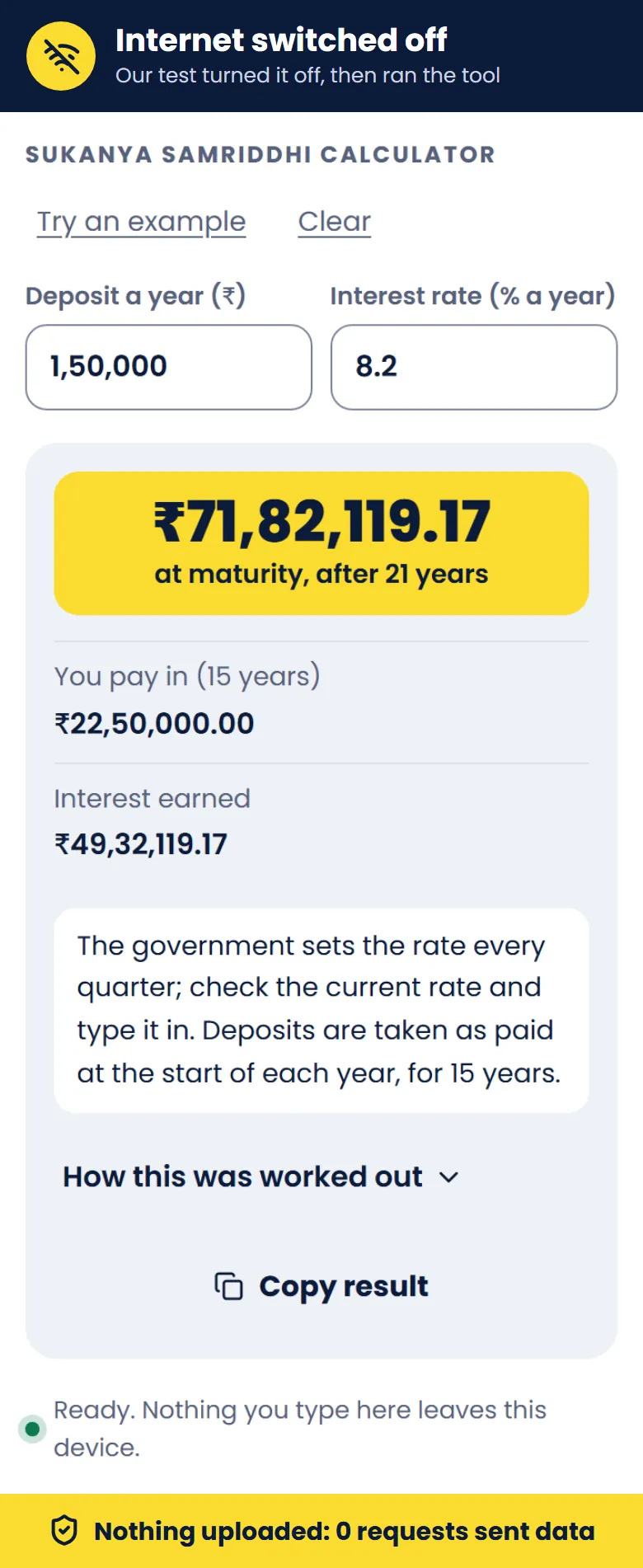
Sukanya Samriddhi Calculator, free and private: work out what a Sukanya Samriddhi account will pay out after 21 years, from the yearly deposit.
Open Sukanya Samriddhi Calculator