What the PPF calculator does, and when you need it
The Public Provident Fund, PPF, is a long-term savings scheme of the Government of India, opened at a post office or an authorised bank. You deposit up to ₹1,50,000 each financial year for at least 15 years, the government sets the interest rate every quarter, and the interest is added once a year, so it compounds. The deposits can reduce your income tax under the old tax regime, and the interest is free of income tax.
Type what you deposit each year, the interest rate and the number of years, and this calculator shows the maturity amount, what you deposited and the interest earned, with the working. It all happens in your browser: nothing you type is uploaded or kept.
When it helps:
- Before you open an account, to see what ₹1.5 lakh, ₹50,000 or ₹12,000 a year becomes in 15 years.
- Deciding whether to extend after 15 years, by working out 20 or 25 years.
- Comparing PPF with a fixed deposit, an RD or a SIP for a long goal.
Step by step
- Type the deposit every year, from ₹500 to ₹1,50,000, the scheme's limits. Commas the Indian or the international way and Hindi digits are read.
- Type the interest rate, 7.1 for the rate in force since April 2020, or another to see what a change would do.
- Type the years, 15 for the first term, or 20, 25 and on for an extended account.
- Read the answer: the maturity amount in large type, then the deposits and the interest.
- Open “How this was worked out” for the formula with your numbers, and use Copy result for a one-line summary.
Try an example fills in ₹1,50,000 a year at 7.1% for 15 years, and Clear empties the boxes.
What the page does, exactly
These are the calculator's rules in full, and the same rules are checked by our tests.
| Part | The rule | Example |
|---|---|---|
| What you can type | Digits, also those of Hindi and other scripts, a dot for decimals, and commas the Indian or the international way | 1,50,000 and 150000 are the same |
| The boxes' limits | A deposit of ₹500 to ₹1,50,000 a year, a rate from 0% to 20%, and 15 to 50 whole years | A deposit of ₹2,00,000 gets a message under its box |
| When deposits are made | At the start of each year, so each earns interest for the whole year, as a deposit made by 5 April does | 15 deposits, the last earning for one year |
| The maturity amount | P × ((1 + r)n − 1) ÷ r × (1 + r), with interest added once a year | ₹1,50,000 at 7.1% for 15 years is ₹40,68,209.22 |
| Rounding | Every sum is worked out exactly, in whole numbers and fractions rather than the computer's binary approximations; amounts are rounded to the paisa, half a paisa up, only when they are written, in the Indian way | ₹18,18,209.22 of interest |
What the rules don't decide: the calculator keeps one rate for all the years, though the government can change it every quarter, and it assumes the same deposit each year, made on time. Deposits made later in the year earn less, as explained below.
Real results from our tests
We tested the PPF Calculator with headless Chromium 148, the open-source browser Chrome is built on, on a Windows laptop with an Intel Core i7-1185G7 and 32 GB of memory, on 1 November 2026. Other work was running on the laptop at the same time, so times vary a little from run to run: each time below is the middle one of 3 runs.
Checked against a second program. Python's decimal numbers, with 120 digits and none of the page's code, worked out 25,000 random PPF accounts of ₹500 to ₹1,50,000 a year, at rates from 0% to 20% and for 15 to 50 years, and the page's code gave the same 75,000 amounts every time, to the paisa: the maturity amount, the deposits and the interest of each. The boxes were typed as people type them, with Indian and international commas, in Hindi, Bengali and Gujarati digits, and with a % sign after the rate.
The answer is drawn at once. The page drew the answer to a typed amount in 0.10 milliseconds (the middle of 3 runs of 200 amounts typed in a row), not counting the moment the browser takes to paint the screen. Even 50 years at a rate typed to 40 digits, the longest sum the page does, was drawn in 0.9 milliseconds.
Size and offline. On a first visit the page downloads about 0.1 MB for the tool: the page, its styles, its scripts and the fonts, with Google's ad code not counted. In our test we switched the network off after the page had loaded and pressed Try an example: the maturity amount showed 0.1 seconds later or less in each of 15 runs.
Phone-sized screen. We also ran the tests on a phone-sized screen in Chromium (390 × 844 pixels, with touch). That is not a real phone. Every button and box was 44 pixels high or more, and the page did not scroll sideways.
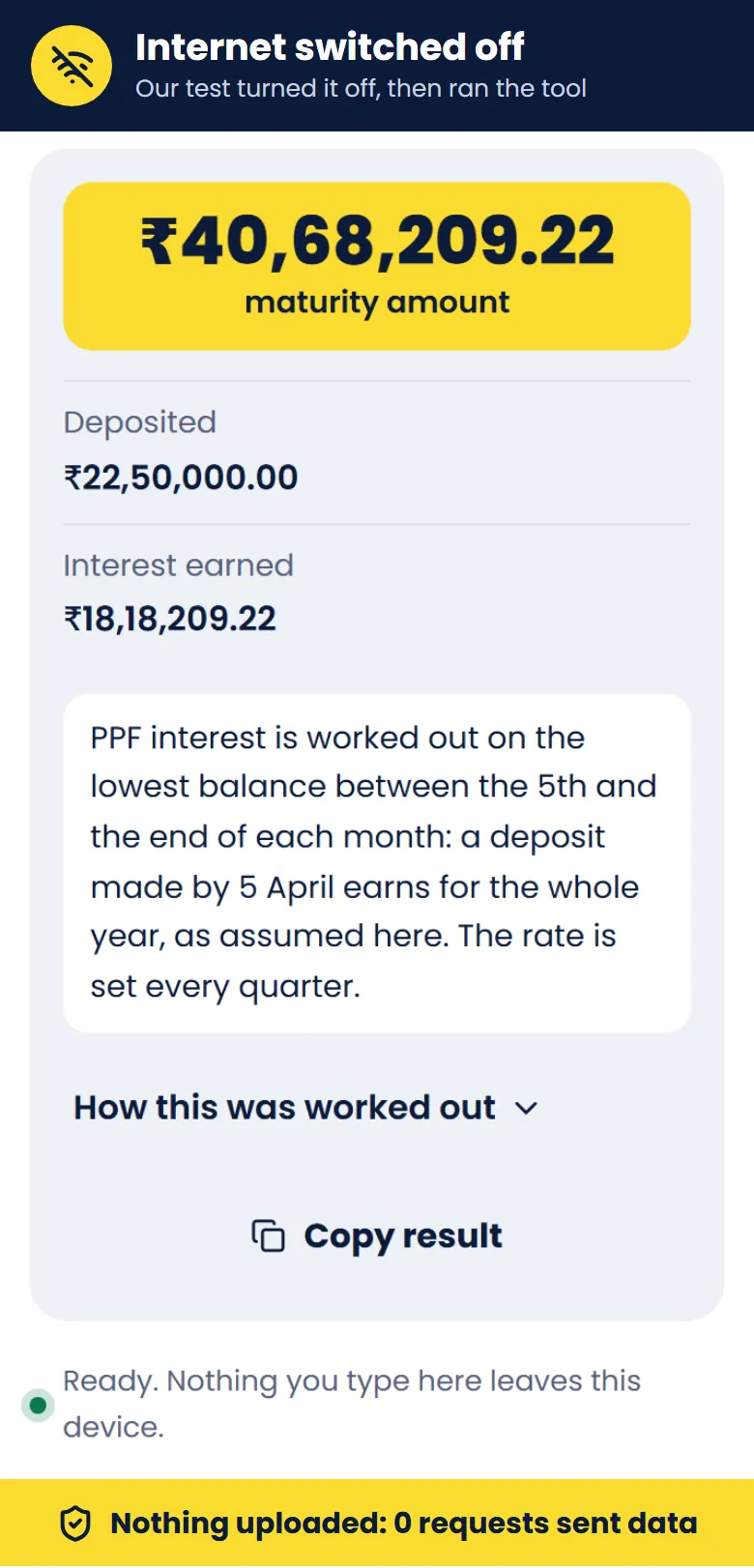
Try it yourself: press "Try an example" at the top of this page. It puts 1,50,000, 7.1 and 15 in the boxes and the maturity amount is ₹40,68,209.22. Then change the years to 25: it is ₹1,03,08,014.97.

The PPF rules, from the scheme itself
PPF runs under the Public Provident Fund Scheme, 2019, notified on 12 December 2019. The National Savings Institute of the Ministry of Finance publishes the scheme and a summary (NSI, read on 1 November 2026). The main rules:
- Deposits: at least ₹500 and at most ₹1,50,000 in a financial year, in multiples of ₹50. The limit includes deposits in an account you hold for a minor.
- Maturity: the account matures on completion of fifteen complete financial years from the end of the year in which it was opened.
- Interest: worked out each month on the lowest balance between the close of the fifth day and the end of the month, and added to the account at the end of each year.
- Loans are allowed from the 3rd financial year up to the 6th, and withdrawals every year from the 7th.
- After maturity, the account can be extended in blocks of 5 years with further deposits, or kept without deposits at the rate then in force.
The interest rate
The government sets the PPF rate every quarter, with the other small savings schemes. It has been 7.1% a year since 1 April 2020: the National Savings Institute's table lists 7.1% from 01.04.2020 to 30.09.2026 (NSI), and the Department of Posts' order of 30 September 2026 keeps the rates unchanged for October to December 2026 (SB Order 12/2026), both read on 1 November 2026. It has been higher before: 8.0% from October 2018 to June 2019, and 12% from 1986-87 until January 2000.
Because the rate can change, any figure for 15 years ahead is an estimate. Try a lower rate too: ₹1,50,000 a year for 15 years gives ₹40,68,209.22 at 7.1% and ₹43,98,642.46 at 8%, so each percentage point moves the result by lakhs.
Deposit by the 5th
Interest for each month is worked out on the lowest balance between the close of the 5th and the end of the month. So a deposit made by 5 April earns interest for all twelve months of the financial year, while the same deposit made on 6 April earns for only eleven, and one made in March for none in that year. The calculator assumes deposits by 5 April, the best case. If you deposit in parts through the year, each part earns from the month after its 5th, and the result is a little lower than shown. The simplest habit is one deposit each year by 5 April, or monthly deposits each made by the 5th.
The formula, by hand
Each year's deposit grows for the years left: the first for 15 years, the last for one. Added up, that is P × ((1 + r)n − 1) ÷ r × (1 + r). For ₹1,50,000 at 7.1% for 15 years:
- 1.071 multiplied by itself 15 times is about 2.7983.
- Take away 1 and divide by 0.071: about 25.323, what ₹1 a year paid at the end of each year grows to.
- Multiply by 1.071, since deposits are made at the start of each year: about 27.121.
- Multiply by ₹1,50,000: about ₹40,68,150; with every decimal kept, the calculator works out exactly ₹40,68,209.22.
Of that, ₹22,50,000 is what you put in and ₹18,18,209.22 is interest, all of it tax-free.
Extending after 15 years
At maturity you can close the account, keep it without deposits, or extend it with deposits for blocks of 5 years, applying within a year of maturity. Extending is where compounding shows most. ₹1,50,000 a year at 7.1%:
| Years | Deposited | Maturity amount | Interest |
|---|---|---|---|
| 15 | ₹22,50,000 | ₹40,68,209.22 | ₹18,18,209.22 |
| 20 | ₹30,00,000 | ₹66,58,288.17 | ₹36,58,288.17 |
| 25 | ₹37,50,000 | ₹1,03,08,014.97 | ₹65,58,014.97 |
Two extensions take the account past ₹1 crore, with interest larger than all the deposits together. The calculator's years box works for any number of years up to 50.
Smaller deposits
PPF works at any size within its limits. At 7.1% for 15 years:
- ₹50,000 a year: ₹13,56,069.74, from ₹7,50,000 deposited.
- ₹12,000 a year, ₹1,000 a month: ₹3,25,456.74, from ₹1,80,000.
- ₹500 a year, the minimum that keeps the account active: ₹13,560.70.
A year with no deposit makes the account discontinued; the scheme lets you revive it by paying the missed minimum deposits with a small fee, so even the minimum each year is worth keeping up.
Loans and withdrawals
PPF money isn't locked away completely, though the rules are strict. From the 3rd financial year up to the 6th you can take a loan of up to 25% of the balance at the end of the second year before the one you apply in, one loan at a time. From the 7th year you can withdraw once a year, up to 50% of the lower of the balance at the end of the fourth year before, or at the end of the year before. Any loan must be repaid first. The calculator assumes nothing is taken out; a withdrawal lowers the maturity amount by more than its size, because that money stops compounding.
Tax
The National Savings Institute's summary says deposits qualify for deduction under Section 80C of the Income Tax Act and that the interest is free of income tax under Section 10. The 80C deduction is available only if you choose the old tax regime; the interest stays tax-free either way. Because there is no tax on the interest, PPF's 7.1% is worth more than the same rate on a fixed deposit, whose interest is taxed at your slab rate.
PPF and other savings
- Fixed deposits are shorter and can be broken more easily, but their interest is taxed; the FD Calculator works them out.
- Recurring deposits take a fixed amount every month for a few years; see the RD Calculator.
- Sukanya Samriddhi, for a girl under 10, has paid 8.2% a year since 1 January 2024, against PPF's 7.1%, and runs for 21 years; see the Sukanya Samriddhi Calculator and our post on what ₹1.5 lakh a year in it becomes.
- A lumpsum invested once, such as a bonus, can't all go into PPF beyond ₹1,50,000 a year; the Lumpsum Calculator works out what one amount becomes elsewhere.
- Equity SIPs can grow faster over long periods, but their returns aren't fixed or guaranteed; see the SIP Calculator.
Many families use PPF as the safe, tax-free part of a long-term plan, alongside riskier investments. Its long term is the main thing to weigh: money in PPF is meant to stay for 15 years, with only loans and part-withdrawals before that, so keep money you may need soon somewhere easier to reach.
An account for a child
A parent or guardian can open a PPF account for a minor. The ₹1,50,000 limit is shared: the scheme counts the deposits in your own account and in the account you hold for the minor together. So a parent depositing ₹1,00,000 in their own account can put at most ₹50,000 in the child's in the same year. Started at a child's birth, a 15-year account matures in their teens, and two extensions carry it to 25, close to when money for higher studies or a first home is needed. Work out each account with the calculator, using its own yearly deposit.
Opening an account and depositing
A PPF account is opened at a post office or at an authorised bank, and many banks let their customers open one and deposit online through net banking. One person can hold only one PPF account in their own name. Deposits can be made in one go or in parts during the year, as long as the year's total stays between ₹500 and ₹1,50,000; for the most interest, make them by the 5th of a month, and the whole year's deposit by 5 April. Keep the passbook or statement: it shows the interest added each year, which you can compare with this calculator's figure.
Private: your numbers stay on your device
Your deposits, rates and years never leave your device. The calculator runs inside your browser and has no upload step: it never sends the numbers you type anywhere, and it doesn't save them, so closing the page forgets them. The page's Content Security Policy lets it contact only this site and Google's ad service, which pays for the site; our code never gives your numbers to the ad code. You can check it yourself in your browser's network panel (F12 on a computer): working out a maturity amount adds no request that carries your numbers.
Read our privacy policy and how we prove your files are never uploaded.
Tips
- Deposit by 5 April for a full year's interest.
- Keep up at least ₹500 a year so the account stays active.
- Decide on extension within a year of maturity, or deposits are refused.
- Try a lower rate as well, since the rate can change every quarter.
Limits
- One rate for all the years; the real rate can change every quarter.
- One deposit a year, by 5 April, the same each year.
- No loans, withdrawals or missed years.
- Not advice. It works out the numbers; the post office or bank has the account's own figures.
- Browsers. We tested only in Chromium, the engine behind Chrome and Edge, with computer and phone-sized screens. We did not test on real phones, in Safari or in Firefox, so we cannot promise how they behave.
Terms explained
- PPF
- Public Provident Fund: the government's long-term savings scheme, run under the PPF Scheme, 2019.
- Financial year
- 1 April to 31 March, the year PPF's limits and interest follow.
- Maturity
- The end of the account's 15 complete financial years after the year it was opened.
- Extension
- Keeping the account open for a further block of 5 years, with or without deposits.
- Section 80C
- The part of the Income Tax Act that lets some savings reduce taxable income, under the old regime.
- Compounding
- Interest added to the balance so that it earns interest itself.