What the compound interest calculator does, and when you need it
Compound interest is interest on interest. Each time interest is added to the principal, the next round of interest is worked out on the bigger amount, so money grows faster and faster. Fixed deposits, savings accounts, PPF, loans on a reducing balance and unpaid credit card bills all compound; the only question is how often.
Type the principal, the yearly rate, the time in years and how often interest is added, and this calculator shows the compound interest, the amount at the end, and the simple interest at the same rate for comparison, with the working. It all happens in your browser: nothing you type is uploaded or kept.
When it helps:
- Homework and exams: checking a compound interest answer, with the working shown.
- Seeing what a rate really does over 10, 20 or 30 years.
- Comparing two offers that add interest monthly and quarterly.
- Understanding a debt whose unpaid interest is being added to it.
Step by step
- Type the principal in rupees, such as 50,000. Commas the Indian or the international way and Hindi digits are read.
- Type the rate as a yearly percentage, such as 8.
- Type the time in years. Part of a year works: 3 years 6 months is 3.5.
- Choose how often interest is added: every year, half year, quarter or month.
- Read the answer: the compound interest in large type, then the amount, the principal, and the simple interest for comparison.
- Open “How this was worked out” for the formula with your numbers, and use Copy result for a one-line summary.
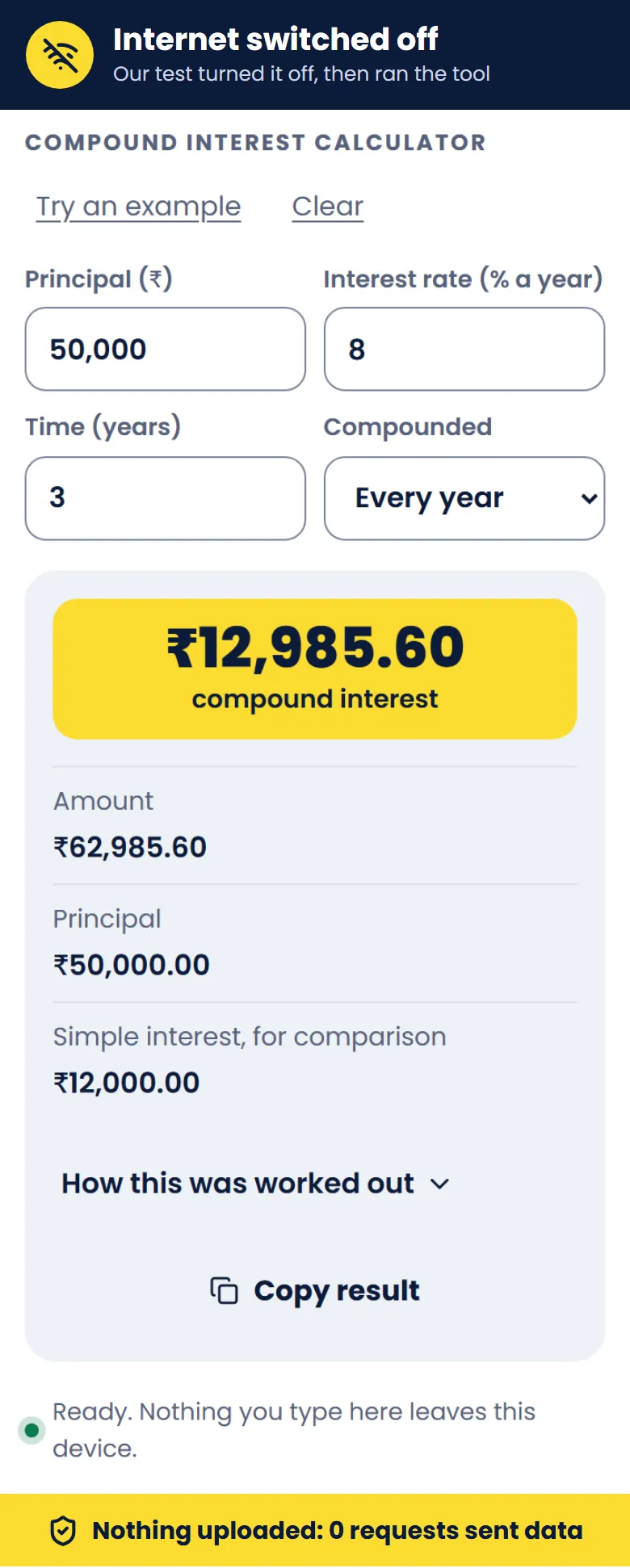
Try an example fills in ₹50,000 at 8% for 3 years, added every year, and Clear empties the boxes.
What the page does, exactly
These are the calculator's rules in full, and the same rules are checked by our tests.
| Part | The rule | Example |
|---|---|---|
| What you can type | Digits, also those of Hindi and other scripts, a dot for decimals, and commas the Indian or the international way | 50,000 and 50000 are the same |
| The boxes' limits | A principal of 0 or more, a rate from 0% to 100% a year, a time from 0 to 100 years | A rate of 120 gets a message under its box |
| The amount | A = P × (1 + r ÷ (100 × k))k × t, where k is how many times a year interest is added | ₹50,000 at 8% for 3 years, every year: ₹62,985.60 |
| Compound interest | The amount minus the principal | ₹12,985.60 |
| Simple interest | P × r × t ÷ 100, for comparison | ₹12,000 |
| Rounding | A whole number of times the interest is added is worked out exactly, in whole numbers and fractions; a part of a time left over needs a root, worked out to 60 decimal places. Amounts are rounded to the paisa, half a paisa up, only when they are written, in the Indian way | ₹63,511.85 |
What the rules don't decide: the calculator assumes the rate stays the same, nothing is added or taken out, and a part of a year grows by the same formula, which is not how every exam or bank treats it, as explained below.
Real results from our tests
We tested the Compound Interest Calculator with headless Chromium 148, the open-source browser Chrome is built on, on a Windows laptop with an Intel Core i7-1185G7 and 32 GB of memory, on 1 November 2026. Other work was running on the laptop at the same time, so times vary a little from run to run: each time below is the middle one of 3 runs.
Checked against a second program. Python's decimal numbers, with 120 digits and none of the page's code, worked out 25,000 random sums of ₹0 to ₹5 crore, at rates from 0% to 40%, for 0.1 to 40 years, with interest added every month, quarter, half year or year, and the page's code gave the same 100,000 amounts every time, to the paisa: the compound interest, the amount, the principal and the simple interest of each. The boxes were typed as people type them, with Indian and international commas, in Hindi, Bengali and Gujarati digits, and with a % sign after the rate. 1,114 of the amounts sat exactly on half a paisa, and every one was rounded up, as it should be.
The answer is drawn at once. The page drew the answer to a typed amount in 0.17 milliseconds (the middle of 3 runs of 200 amounts typed in a row), not counting the moment the browser takes to paint the screen. Even 99.99 years with interest added every month, at a rate typed to 40 digits, was drawn in 14.4 milliseconds.
Size and offline. On a first visit the page downloads about 0.1 MB for the tool: the page, its styles, its scripts and the fonts, with Google's ad code not counted. In our test we switched the network off after the page had loaded and pressed Try an example: the compound interest showed 0.1 seconds later or less in each of 15 runs.
Phone-sized screen. We also ran the tests on a phone-sized screen in Chromium (390 × 844 pixels, with touch). That is not a real phone. Every button and box was 44 pixels high or more, and the page did not scroll sideways.
Try it yourself: press "Try an example" at the top of this page. It puts 50,000, 8 and 3 in the boxes, added every year, and the compound interest is ₹12,985.60. Then choose "Every month": it is ₹13,511.85.

The formula, by hand
Take the example, ₹50,000 at 8% for 3 years, with interest added once a year. Each year multiplies the amount by 1.08:
- After year 1: ₹50,000 × 1.08 = ₹54,000. The interest, ₹4,000, is the same as simple interest.
- After year 2: ₹54,000 × 1.08 = ₹58,320. This year's interest is ₹4,320: ₹320 of it is interest on the first year's interest.
- After year 3: ₹58,320 × 1.08 = ₹62,985.60, so the compound interest is ₹12,985.60.
That is A = P × (1 + r)n: 50,000 × 1.083. With interest added k times a year, the rate for each time is r ÷ k, and it is added k × t times. A spreadsheet gives the same with =50000*(1+8%)^3.
How often interest is added
The more often interest is added, the sooner it starts earning interest itself. ₹50,000 at 8% for 3 years:
| Interest added | Compound interest | Amount |
|---|---|---|
| Every year | ₹12,985.60 | ₹62,985.60 |
| Every half year | ₹13,265.95 | ₹63,265.95 |
| Every quarter | ₹13,412.09 | ₹63,412.09 |
| Every month | ₹13,511.85 | ₹63,511.85 |
The gap between yearly and monthly is ₹526.25 here: real, but small next to the effect of the rate and the time. Bank deposits in India usually add interest every quarter; loans charge it monthly. For a borrower the table works the other way: at the same rate, interest added monthly costs more than interest added once a year.
The effective rate
Because of compounding, a rate added often is worth more than it says. 12% a year added every month turns ₹1,00,000 into ₹1,12,682.50 in one year, the same as 12.68% added once; added every quarter, it gives ₹1,12,550.88, or 12.55%. That yearly equivalent is the effective rate, or annual percentage yield.
Use it to compare offers that add interest at different times, and remember that it works against you on a loan: a credit card's 3.5% a month is about 51% a year once unpaid interest compounds, not 42%.
Why time matters most
Compounding is slow at first and fast later. ₹1,00,000 at 6% a year, added yearly:
- After 10 years: ₹1,79,084.77, against ₹1,60,000 with simple interest.
- After 20 years: ₹3,20,713.55, against ₹2,20,000.
- After 30 years: ₹5,74,349.12, against ₹2,80,000.
The last 10 years add more than the first 20 together, because the growth itself is growing. That is the case for saving early, and for paying off debts that compound as soon as you can.
The rule of 72
A quick way to see how long money takes to double: divide 72 by the yearly rate. The calculator shows how close it comes, for ₹1,00,000 added yearly:
- At 6%, 72 ÷ 6 = 12 years: ₹2,01,219.65.
- At 8%, 9 years: ₹1,99,900.46.
- At 10%, 7.2 years: ₹1,98,621.99.
- At 12%, 6 years: ₹1,97,382.27.
Each is within about 1.5% of doubling. The same rule works for prices: at 6% inflation, prices double in about 12 years. The CAGR Calculator works the formula the other way round, from a start and an end value to the yearly rate.
Part of a year
For a time like 3.5 years with interest added yearly, the calculator uses the formula as it is, 1.083.5: ₹50,000 grows to ₹65,456.56. Many textbooks and some lenders treat the half year differently, as simple interest on the amount after 3 whole years: ₹62,985.60 × 1.04 = ₹65,505.02. Both are used; check which one your question or contract means.
The same difference makes compound interest for less than one period smaller than simple interest with the formula: half a year at 8%, added yearly, gives ₹1,961.52 on ₹50,000, against ₹2,000 simple. To get the simple-interest way here, work out the whole years with this calculator and the part with the Simple Interest Calculator.
Compound against simple interest
Simple interest is worked out only on the principal, so it grows by the same amount every year; compound interest grows by more each year. The calculator shows both, so the difference is always in front of you. For a saver compound is better, for a borrower simple is cheaper, and over one period with interest added once, they are the same. Most deposits and bank loans in India compound; the Simple Interest Calculator covers the cases that don't, such as payout deposits and flat-rate loans, and the Flat to Reducing Rate Calculator shows the reducing rate a flat-rate loan really is.
Compound interest in exams
- The difference between CI and SI for 2 years is P × (r ÷ 100)2: on ₹50,000 at 8%, ₹50,000 × 0.0064 = ₹320, as the calculator shows (₹8,320 against ₹8,000).
- “Find CI on ₹10,000 at 10% for 2 years”: ₹12,100 − ₹10,000 = ₹2,100.
- “Compounded half-yearly” means half the rate, twice the times: choose Every half year.
- Mixed years such as 2½ years: see the section on part of a year for the two ways it is done.
When you are the borrower
Compounding is just as strong on a debt. A credit card balance left unpaid has interest added every month, and then interest on that interest; a loan in moratorium adds its unpaid interest to the amount owed. Use the calculator with the monthly option to see what an unpaid balance becomes, and pay off the debts with the highest rate first. For a loan repaid in instalments, the EMI Calculator shows the monthly payment and the total interest. Our post on how an EMI is calculated shows that same compounding turned into equal monthly payments.
Comparing two offers
Two deposits quote 7% added every quarter and 7.1% added once a year. Which pays more? Turn both into effective rates: 7% every quarter is 1.0175 multiplied by itself 4 times, about 7.19% a year, so it beats 7.1% once a year. Or simply type both into the calculator with the same principal and time and compare the amounts at the end, which also shows what the difference is worth in rupees.
For loans, do the opposite: the lower effective rate is the better offer, and fees, which the calculator doesn't add, can change the answer.
Inflation compounds too
Prices rise by compounding as well. At 6% inflation a year, something that costs ₹1,00,000 today costs about ₹1,79,085 in 10 years, the same figure the calculator gives for ₹1,00,000 growing at 6%. Turned around, ₹1,00,000 in 10 years will buy only what about ₹55,839 buys now.
So a deposit earning 7% while prices rise 6% grows your buying power by only about 1% a year, and less after tax. When you plan for a goal years away, raise its cost by inflation first, with the Inflation Calculator, then work out what you need to save for it.
Where you meet compound interest in India
- Fixed deposits usually add interest every quarter; the FD Calculator works them out.
- Recurring deposits add it every quarter to each month's deposit; see the RD Calculator.
- PPF adds interest once a year, at the end of the financial year; see the PPF Calculator.
- Home and personal loans charge interest monthly on the reducing balance; their EMIs follow from it.
- Credit cards add interest monthly on what is left unpaid, at rates far above any deposit.
A worked example: a gift at birth
Grandparents put ₹1,00,000 in a deposit for a newborn, at 7% a year with interest added every quarter, to be used at 18. The calculator gives ₹3,48,720.99 at the end: ₹2,48,720.99 of compound interest, nearly twice the ₹1,26,000 that simple interest would have paid. Added once a year instead, it would be ₹3,37,993.23, ₹10,727.76 less, which shows that how often interest is added matters more as the years pile up. Tax on the interest, and rates that change when a deposit is renewed, would change these figures; the calculator shows what steady compounding alone does.
Private: your numbers stay on your device
Your amounts, rates and times never leave your device. The calculator runs inside your browser and has no upload step: it never sends the numbers you type anywhere, and it doesn't save them, so closing the page forgets them. The page's Content Security Policy lets it contact only this site and Google's ad service, which pays for the site; our code never gives your numbers to the ad code. You can check it yourself in your browser's network panel (F12 on a computer): working out the interest adds no request that carries your numbers.
Read our privacy policy and how we prove your files are never uploaded.
Tips
- Compare offers by the effective rate, or by the amount at the end, not by the quoted rate alone.
- Start early: time does more than the rate or how often interest is added.
- Check how a part year is treated before comparing with a textbook or a bank.
- For a fixed deposit, the FD Calculator adds the bank's details; for one amount invested at a steady return, the Lumpsum Calculator.
Limits
- One rate, nothing added or taken out during the time.
- A part of a period uses the formula's power, not simple interest for the part.
- No continuous compounding and no daily option; monthly is the most often it adds interest.
- No tax on the interest is taken off.
- Browsers. We tested only in Chromium, the engine behind Chrome and Edge, with computer and phone-sized screens. We did not test on real phones, in Safari or in Firefox, so we cannot promise how they behave.
Terms explained
- Compound interest
- Interest worked out on the principal and on the interest already added to it.
- Compounding frequency
- How often interest is added: yearly, half-yearly, quarterly or monthly.
- Amount
- The principal plus all the interest at the end.
- Effective rate
- The yearly rate that, added once, gives the same as a rate added more often.
- Rule of 72
- 72 divided by the yearly rate: roughly the years it takes money to double.
- Simple interest
- Interest on the principal only, the same every year.