What the volume converter does, and when you need it
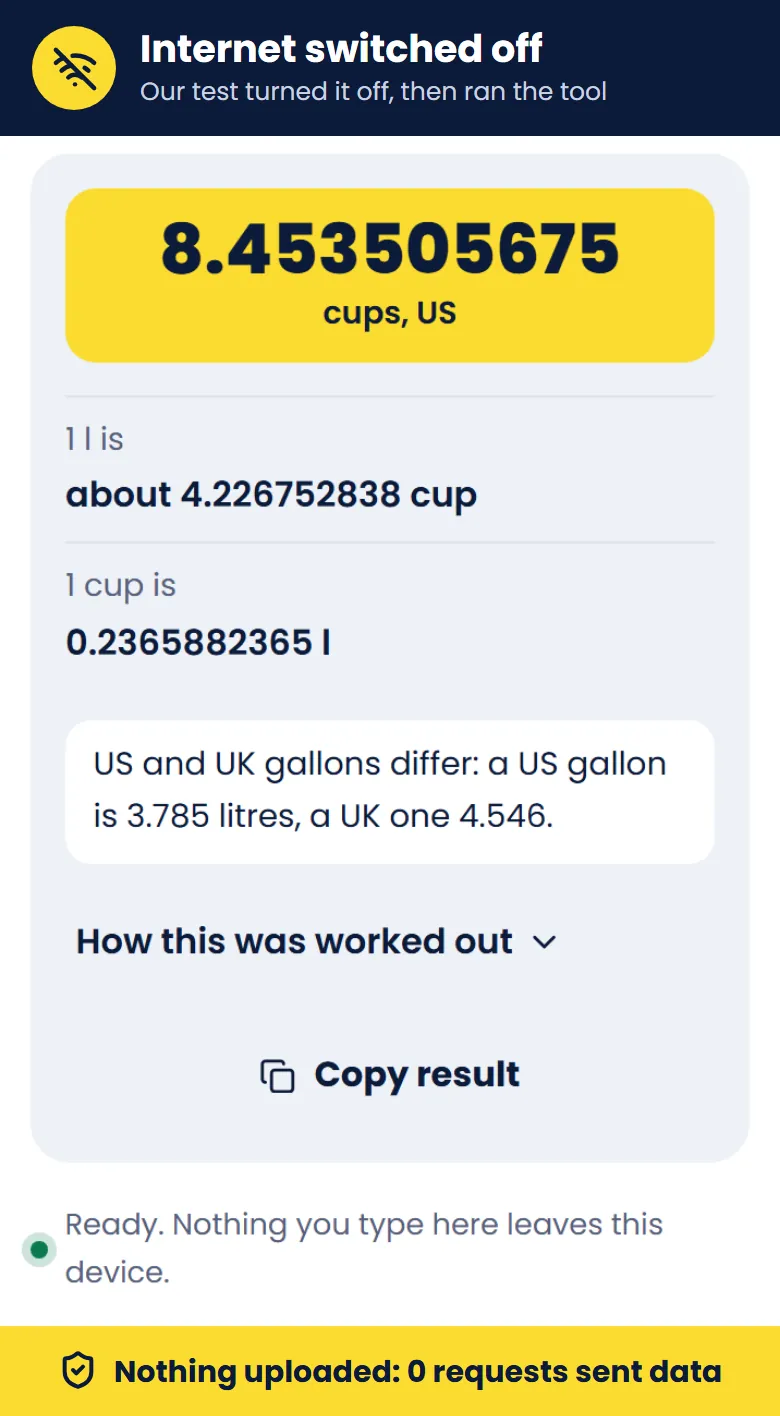
Type a volume, choose its unit and the unit you want, and this converter gives the answer at once, with both one-unit rates and the working. 2 litres is 8.453505675 US cups; a US gallon is exactly 3.785411784 litres and a UK gallon exactly 4.54609. It converts between millilitres, litres, cubic metres, US teaspoons, tablespoons, cups and fluid ounces, US and UK gallons, and cubic feet, working from each unit's exact definition.
It all happens in your browser: nothing you type is uploaded or kept.
When it helps:
- Recipes from America or Britain, in cups, spoons and fluid ounces.
- Water tanks and plumbing, in litres, cubic metres or cubic feet.
- Fuel and oil measured in gallons abroad.
- Bottles and cans labelled in fluid ounces.
- Science lessons, where volumes are in millilitres, litres and cubic metres.
The Weight, Data Storage and Speed converters work the same way, from exact definitions.
Step by step
- Type the volume, such as 2. Commas the Indian or the international way and Hindi digits are read, and decimals are fine.
- Choose the unit it is in, such as litres, and the unit you want, such as US cups.
- Read the answer in large type, with what one of each unit is in the other.
- Open “How this was worked out” for the definitions and the sum, and use Copy result for a one-line summary.
Try an example fills in 2 litres to US cups, and Clear empties the box.
What the page does, exactly
These are the converter's rules in full, and the same rules are checked by our tests.
| Part | The rule | Example |
|---|---|---|
| What you can type | Digits, also those of Hindi and other scripts, a dot for decimals, and commas the Indian or the international way | 1,000 and 1000 are the same |
| The units | ml, litres, m³, US tsp, tbsp, cup and fl oz, US and UK gallons and ft³, each as an exact number of litres | 1 US gal = 3.785411784 l |
| The sum | The volume × the first unit in litres ÷ the second unit in litres, worked out exactly in fractions | 2 × 1 ÷ 0.2365882365 cup |
| How it is written | To 10 significant digits, half away from zero, without trailing zeros, with lakh-style commas | 8.453505675 cups; 2,000 ml |
| Exact or rounded | The working says “exactly” when nothing was rounded, and the one-unit rates say “about” when they were | 1 cup is 0.2365882365 l; 1 l is about 4.226752838 cups |
Real results from our tests
We tested the Volume Converter with headless Chromium 148, the open-source browser Chrome is built on, on a Windows laptop with an Intel Core i7-1185G7 and 32 GB of memory, on 1 November 2026. Other work was running on the laptop at the same time, so times vary a little from run to run: each time below is the middle one of 3 runs.
Checked against a second program. Python's exact fractions, with none of the page's code, converted 25,000 random volumes from 10-12 to 1015, with and without decimals, between every pair of the ten units, and the page's code gave the same 75,000 values every time: the answer and the two one-unit rates of each, to 10 significant digits. The boxes were typed as people type them, with Indian and international commas, and in Hindi, Bengali and Gujarati digits. 304 of the answers sat exactly on half of their tenth digit, and every one was rounded away from zero, as it should be.
The answer is drawn at once. The page drew the answer to a typed volume in 0.34 milliseconds (the middle of 3 runs of 200 volumes typed in a row), not counting the moment the browser takes to paint the screen.
Size and offline. On a first visit the page downloads about 0.1 MB for the tool: the page, its styles, its scripts and the fonts, with Google's ad code not counted. In our test we switched the network off after the page had loaded and pressed Try an example: the answer showed 0.1 seconds later or less in each of 15 runs.
Phone-sized screen. We also ran the tests on a phone-sized screen in Chromium (390 × 844 pixels, with touch). That is not a real phone. Every button and box was 44 pixels high or more, and the page did not scroll sideways.
Try it yourself: press "Try an example" at the top of this page. It puts 2 in the box, from litres to US cups, and the answer is 8.453505675 cups. Then choose millilitres: 2,000.

Where the numbers come from
The litre is a cubic decimetre, a thousandth of a cubic metre, and a millilitre is a cubic centimetre. The US gallon is defined as 231 cubic inches, and since the inch is exactly 2.54 cm, the US gallon is exactly 3.785411784 litres. The US fluid ounce is a 128th of it, exactly 29.5735295625 ml; the US cup is 8 fluid ounces, the tablespoon half a fluid ounce and the teaspoon a sixth. The UK, or imperial, gallon is a separate unit, exactly 4.54609 litres, which the US National Institute of Standards and Technology lists as exact. A cubic foot is 0.3048 m cubed, exactly 28.316846592 litres.
Which cup?
“A cup” means different amounts in different places. The cup in this converter is the US customary cup, exactly 236.5882365 ml. The metric cup used in many recipes from Australia and elsewhere is 250 ml, and US nutrition labels use a rounded cup of 240 ml. Indian recipes often use a standard 240 ml or 250 ml measuring cup, or simply a household cup. For most cooking the difference doesn't matter; for baking, use the cup the recipe was written with, or better, weigh the ingredients.
Spoons
A US tablespoon is about 14.79 ml and a US teaspoon about 4.93 ml; three teaspoons make a tablespoon. Metric measuring spoons are 15 ml and 5 ml, close enough to swap in any recipe. A spoon from the cutlery drawer can hold quite a different amount, so for medicines always use the measure that comes with the bottle, never a kitchen spoon.
US and UK gallons
The US and UK gallons differ by about a fifth: a UK gallon is 1.200949926 US gallons. American fuel, milk and paint come in US gallons of 3.785411784 litres; older British and Commonwealth figures use the imperial gallon of 4.54609 litres. A car's fuel economy in miles per gallon therefore depends on which gallon is meant: a UK figure in mpg looks better than a US one for the same car.
Fluid ounces
Drinks from America are labelled in US fluid ounces: a 12 fl oz can is about 355 ml, and a 16.9 fl oz bottle is about 500 ml. One litre is 33.8140227 US fluid ounces, and 500 ml is 16.90701135. A fluid ounce measures volume; the ounce on a kitchen scale measures weight, which the Weight Converter handles. British labels may use the UK fluid ounce, exactly 28.4130625 ml, a little smaller than the US one.
Water tanks and cubic metres
Water bills and large tanks are measured in cubic metres or kilolitres: 1 cubic metre is exactly 1,000 litres, also called a kilolitre. A rectangular tank's volume is its length times breadth times height: a tank 2 m by 1.5 m by 1 m holds 3 cubic metres, 3,000 litres. Plumbing and pump specifications from abroad may use cubic feet: 1 ft³ is 28.31684659 litres. Sump and overhead tanks in India are usually sold by their capacity in litres; a 1,000-litre tank holds as much as a cube 1 metre on each side.
Fuel and engines
Fuel in India is sold by the litre. An American car's tank or a generator's manual may give capacity in gallons: 20 litres is 5.283441047 US gallons. Engine sizes are in cubic centimetres, the same as millilitres: a 1,500 cc engine is 1.5 litres. For the cost of a trip's fuel, the Fuel Cost Calculator works it out from the distance, the mileage and the price.
Volume is not weight
A litre of water weighs almost exactly a kilogram, but a litre of oil weighs less and a litre of honey more. So a cup of flour and a cup of sugar weigh different amounts, and a recipe in cups can't be turned into grams with a single number. For water and drinks, millilitres and grams are close enough to swap; for everything else, weigh it, or look up the weight of a cup of that ingredient.
Rain and roofs
Rainfall is measured in millimetres, and 1 mm of rain on 1 square metre is exactly 1 litre of water. So a roof of 100 square metres collects 1,000 litres, one cubic metre, in 10 mm of rain, before losses. That simple rule is the starting point for sizing a rainwater harvesting tank; the Area Converter turns a roof measured in square feet into square metres first.
Pints and quarts
Pints and quarts aren't in this converter's list, but they are easy from the units that are. A US pint is 2 US cups, 473.176473 ml, and a US quart 2 pints. A UK pint is an eighth of a UK gallon, exactly 568.26125 ml, bigger than the US pint, so a pint of milk in Britain is not a US pint.
Milk, oil and bottles
Milk is sold in 500 ml and 1 litre packets, and drinking water in bottles of 500 ml, 1 litre and 2 litres and in 20 litre jars, about 5.28 US gallons. Edible oil is sold by volume or by weight, and a litre of oil weighs less than a kilogram, so a 1 litre pouch and a 1 kg pouch are not the same amount. Compare packs by the price for a litre, or for a kilogram, whichever the labels both show.
In science
In the laboratory, a millilitre is a cubic centimetre, cm³, and a litre a cubic decimetre, dm³. Measuring cylinders and burettes read in millilitres, and the SI unit of volume is the cubic metre, a thousand litres. Volumes in a formula are usually in cubic metres, so divide litres by 1,000 first.
Round tanks and drums
A round tank's volume is π × the radius squared × the height, with the radius half the width across. A tank 1.2 m across and 1.5 m high has a radius of 0.6 m, so it holds about 3.1416 × 0.36 × 1.5 = 1.696 cubic metres, about 1,696 litres. Measure the inside, not the outside, and remember that a tank is rarely filled to the very top.
Scaling a recipe
To make a recipe for more or fewer people, multiply every amount by the same number before converting: for one and a half times a recipe, 2 cups become 3 cups, which is 709.7647095 ml. Convert at the end, once, rather than converting and then rounding each amount, so the proportions stay right.
Paint and other liquids
Paint, garden sprays and cleaning liquids are sold by the litre in India and often by the gallon or quart abroad. A paint tin from America marked 1 gallon holds 3.785411784 litres, and its coverage, the area a litre paints, is printed per gallon too: convert both before comparing tins.
Ten significant digits
Most conversions between US and metric units don't come out even, so the converter writes ten significant digits, rounding the last one half away from zero, and says so in the working: 1 litre is 4.226752838 US cups. When the result is exact, such as 2 cups to 473.176473 ml, it is written in full and the working says “exactly”. No kitchen jug measures anywhere near ten digits, so round the answer to what your measure shows.
Converting by hand
Turn the volume into litres, then into the unit you want. For 2 litres in US cups: 2 ÷ 0.2365882365 = 8.453505675 cups. For gallons to litres, multiply: 3 US gallons is 3 × 3.785411784 = 11.35623535 litres. Within the metric system, move the decimal point: 1 litre is 1,000 ml, and 1 cubic metre is 1,000 litres.
Quick table
| Unit | In millilitres |
|---|---|
| 1 US teaspoon | 4.92892159375 exactly |
| 1 US tablespoon | 14.78676478125 exactly |
| 1 US fluid ounce | 29.5735295625 exactly |
| 1 US cup | 236.5882365 exactly |
| 1 US gallon | 3,785.411784 exactly |
| 1 UK gallon | 4,546.09 exactly |
The converter writes these to ten significant digits, such as 4.928921594 ml for a teaspoon; the table gives every digit of the exact values.
Common mistakes
- Mixing up US and UK gallons, which differ by about 20%.
- Assuming every cup is 250 ml, or that every one is the US cup.
- Treating fluid ounces as ounces of weight.
- Converting cups of flour or sugar into grams as if they were water.
Worked examples
- 1 US cup in millilitres: 236.5882365 ml, exactly.
- 1 UK gallon in litres: 4.54609 l, exactly.
- 1 litre in US fluid ounces: 33.8140227 fl oz.
- 1 cubic foot in litres: 28.31684659 l.
- 20 litres in US gallons: 5.283441047 US gal.
- 1,000 litres in cubic metres: 1 m³, exactly.
- 3 US gallons in litres: 11.35623535 l.
- 2 US cups in millilitres: 473.176473 ml, exactly.
Private: your numbers stay on your device
The volumes you type never leave your device. The converter runs inside your browser and has no upload step: it never sends the numbers you type anywhere, and it doesn't save them, so closing the page forgets them. The page's Content Security Policy lets it contact only this site and Google's ad service, which pays for the site; our code never gives your numbers to the ad code. You can check it yourself in your browser's network panel (F12 on a computer): converting a volume adds no request that carries your numbers.
Read our privacy policy and how we prove your files are never uploaded.
Tips
- Ask which cup or gallon a recipe or a manual means.
- Weigh dry ingredients when a recipe needs to be exact.
- Use the bottle's own measure for medicines.
- Remember 1,000: millilitres in a litre, and litres in a cubic metre.
- Measure tanks inside, and work out their volume before converting it.
Limits
- US spoons, cups and fluid ounces only: the UK fluid ounce and pint, and the metric cup of 250 ml, aren't in the list.
- Volume only: it doesn't turn cups of an ingredient into grams.
- Not a dosing tool: for medicines, follow the label and its own measure.
- Browsers. We tested only in Chromium, the engine behind Chrome and Edge, with computer and phone-sized screens. We did not test on real phones, in Safari or in Firefox, so we cannot promise how they behave.
Terms explained
- Litre
- A cubic decimetre, 1,000 millilitres.
- Cubic metre
- 1,000 litres, also called a kilolitre.
- US gallon
- 231 cubic inches, exactly 3.785411784 litres.
- UK gallon
- The imperial gallon, exactly 4.54609 litres.
- US fluid ounce
- A 128th of a US gallon, about 29.57 ml.
- US cup
- 8 US fluid ounces, exactly 236.5882365 ml.