What the length converter does, and when you need it
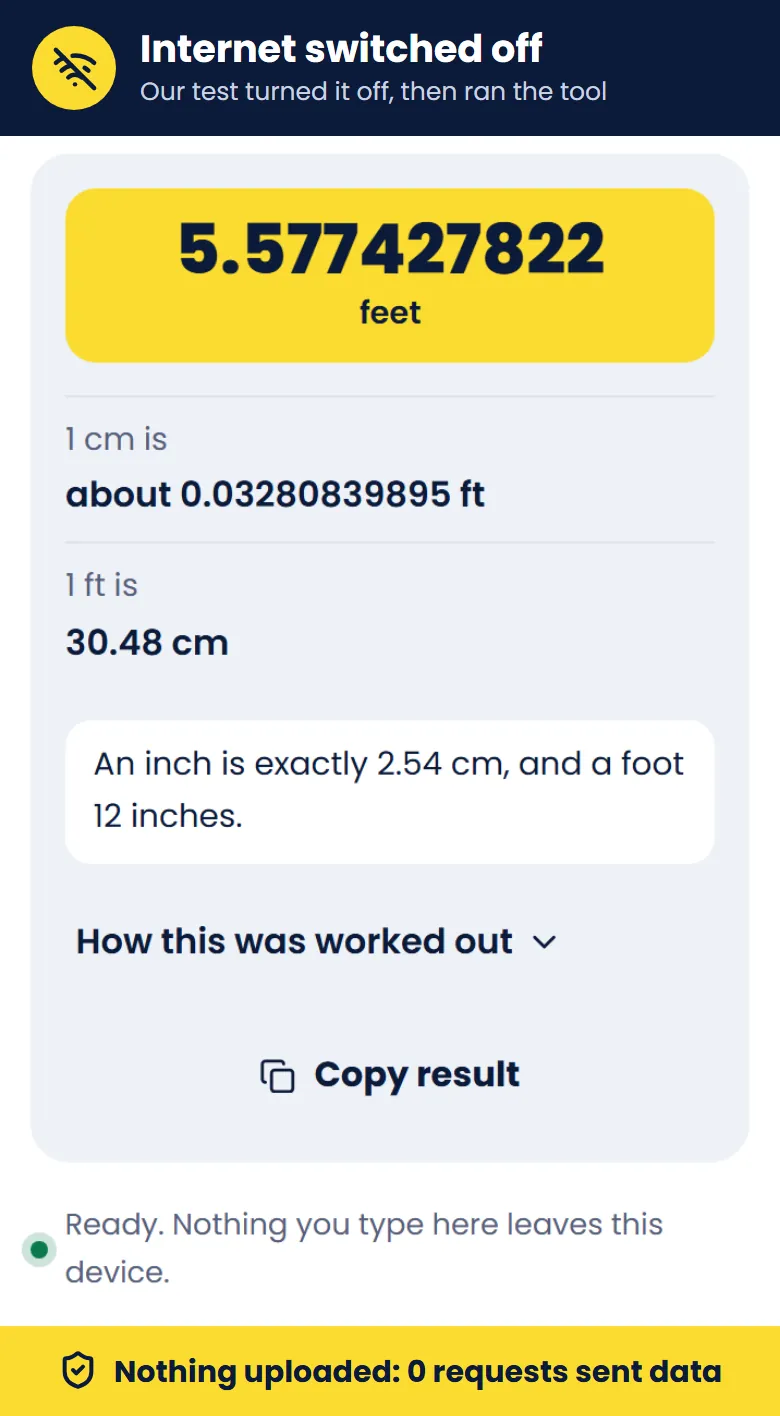
Type a length, choose the unit it is in and the unit you want, and this converter gives the answer at once, with both one-unit rates and the working. 170 cm is 5.577427822 feet, or 66.92913386 inches; 1 mile is exactly 1.609344 km. It converts between millimetres, centimetres, metres, kilometres, inches, feet, yards and miles, working from each unit's exact definition, so the digits it shows are right.
It all happens in your browser: nothing you type is uploaded or kept.
When it helps:
- Heights on forms, in feet and inches or in centimetres.
- Sizes of screens, furniture, paper and fabric.
- Distances in kilometres or miles, for running, travel or maps.
- Shopping from abroad, where sizes are often given in inches or feet.
- Homework and exams, where unit conversions come up all the time.
The Weight Converter, Temperature Converter and Area Converter work the same way, from exact definitions.
Step by step
- Type the length, such as 170. Commas the Indian or the international way and Hindi digits are read, and decimals are fine.
- Choose the unit it is in, such as centimetres, and the unit you want, such as feet.
- Read the answer in large type, with what one of each unit is in the other.
- Open “How this was worked out” for the definitions and the sum, and use Copy result for a one-line summary.
Try an example fills in 170 cm to feet, and Clear empties the box.
What the page does, exactly
These are the converter's rules in full, and the same rules are checked by our tests.
| Part | The rule | Example |
|---|---|---|
| What you can type | Digits, also those of Hindi and other scripts, a dot for decimals, commas the Indian or the international way, and a minus sign | 1,200 and 1200 are the same |
| The units | mm, cm, m, km, inches, feet, yards and miles, each as an exact number of metres | 1 in = 0.0254 m |
| The sum | The length × the first unit in metres ÷ the second unit in metres, worked out exactly in fractions | 170 × 0.01 ÷ 0.3048 ft |
| How it is written | To 10 significant digits, half away from zero, without trailing zeros, with lakh-style commas | 5.577427822 ft; 3,280.839895 ft |
| Very large or small | From 1015 up, or below 0.000001, with a power of ten | 1 × 10-12 km |
| Exact or rounded | The working says “exactly” when nothing was rounded, and the one-unit rates say “about” when they were | 1 in is 2.54 cm; 1 cm is about 0.3937007874 in |
Real results from our tests
We tested the Length Converter with headless Chromium 148, the open-source browser Chrome is built on, on a Windows laptop with an Intel Core i7-1185G7 and 32 GB of memory, on 1 November 2026. Other work was running on the laptop at the same time, so times vary a little from run to run: each time below is the middle one of 3 runs.
Checked against a second program. Python's exact fractions, with none of the page's code, converted 25,000 random lengths from 10-12 to 1015, with and without decimals and some below zero, between every pair of the eight units, and the page's code gave the same 75,000 values every time: the answer and the two one-unit rates of each, to 10 significant digits. The boxes were typed as people type them, with Indian and international commas, and in Hindi, Bengali and Gujarati digits. One of the answers sat exactly on half of its tenth digit, and it was rounded away from zero, as it should be.
The answer is drawn at once. The page drew the answer to a typed length in 0.52 milliseconds (the middle of 3 runs of 200 lengths typed in a row), not counting the moment the browser takes to paint the screen.
Size and offline. On a first visit the page downloads about 0.1 MB for the tool: the page, its styles, its scripts and the fonts, with Google's ad code not counted. In our test we switched the network off after the page had loaded and pressed Try an example: the answer showed 0.1 seconds later or less in each of 15 runs.
Phone-sized screen. We also ran the tests on a phone-sized screen in Chromium (390 × 844 pixels, with touch). That is not a real phone. Every button and box was 44 pixels high or more, and the page did not scroll sideways.
Try it yourself: press "Try an example" at the top of this page. It puts 170 in the box, from centimetres to feet, and the answer is 5.577427822 feet. Then choose inches: 66.92913386.

Where the numbers come from
The inch, foot, yard and mile used to differ slightly from country to country. In 1958 the English-speaking countries agreed to unify their standards of length and mass, and from 1 July 1959 the yard became exactly 0.9144 metre. Everything else follows from it: the inch, a thirty-sixth of a yard, is exactly 2.54 cm, as the US National Institute of Standards and Technology (NIST) puts it, “exactly equivalent to 25.4 mm”; the foot, 12 inches, is exactly 0.3048 m; and the mile, 1,760 yards, is exactly 1,609.344 m.
Because these are exact, the converter can work in exact fractions and never collect rounding errors. The metre itself is defined from the speed of light, and the units of the metric system are tenths, hundredths and thousandths of it, so every conversion here comes down to multiplying and dividing exact numbers.
Converting by hand
Turn the length into metres, then into the unit you want. For 170 cm in feet:
- Into metres: 170 cm × 0.01 = 1.7 m.
- Into feet: 1.7 ÷ 0.3048 = 5.5774278… ft.
Or use a single rate: there are 2.54 cm in an inch and 30.48 cm in a foot, so 170 cm ÷ 30.48 = 5.577427822 ft. Dividing by the exact rate is safer than multiplying by a rounded one: 170 × 0.0328 gives 5.576, already a thousandth of a foot out.
Height in feet and inches
Heights are often asked in feet and inches, such as 5 ft 7 in, while the converter gives a single unit. To turn centimetres into feet and inches:
- Convert to inches: 170 cm is 66.92913386 in.
- Take out the whole feet: 66.93 ÷ 12 = 5 feet, which is 60 inches.
- The rest is inches: 66.93 − 60 = 6.93, so 170 cm is about 5 ft 6.9 in, or 5 ft 7 in rounded.
The other way round, 5 ft 8 in is 5 × 12 + 8 = 68 inches, and 68 in is exactly 172.72 cm. 6 ft is exactly 182.88 cm. Forms that ask for height in centimetres usually want a whole number, so 172.72 cm is written as 173 cm unless the form says otherwise.
Quick table
| Unit | In metric | The other way |
|---|---|---|
| 1 inch | 2.54 cm exactly | 1 cm is about 0.3937 in |
| 1 foot | 30.48 cm exactly | 1 m is about 3.2808 ft |
| 1 yard | 0.9144 m exactly | 1 m is about 1.0936 yd |
| 1 mile | 1.609344 km exactly | 1 km is about 0.6214 mi |
The left-hand column is exact; the right-hand one is rounded to four decimal places here, and the converter gives it to ten significant digits.
Paper, screens and sizes
- A4 paper is 210 × 297 mm, which is 8.267716535 × 11.69291339 inches, about 8.27 × 11.69 in, while US Letter paper is 8.5 × 11 inches; A4 vs Letter explains the difference, and Resize PDF changes a PDF's page size.
- Screens are sold by their diagonal in inches: a 55-inch TV is 139.7 cm across the diagonal, exactly.
- Furniture and rooms are often in feet: a 6-foot bed is 182.88 cm long.
- Cloth is sold in metres in most shops, and in yards in some: 1 yard is 0.9144 m, so 5 yards is 4.572 m.
Kilometres and miles
India measures roads in kilometres, while maps and apps from some countries use miles. A mile is exactly 1.609344 km, and a kilometre about 0.6214 miles. A 10 km run is 6.213711922 miles, and a marathon of 42.195 km is 26.21875746 miles, the “26.2 miles” runners quote. For speeds, the Speed Converter turns km/h into miles an hour; for the fuel a trip needs, the Fuel Cost Calculator works it out from the distance.
Ten significant digits
Most conversions don't come out even: 1 cm is 0.3937007874015748… inches, and the digits go on. The converter writes ten significant digits, counted from the first one that isn't zero, rounding the last one half away from zero: 0.3937007874. Ten digits are far more than any ruler can measure, so the answer is as precise as anything you will use it for. When the result is exact, such as 6 ft = 182.88 cm, it is written in full and the working says “exactly”.
Very large and very small results are written with a power of ten, so 10-12 km is clearer than a long row of zeros.
Inside the metric system
Metric units step by tens, so converting between them only moves the decimal point. 1 km is 1,000 m, 1 m is 100 cm, and 1 cm is 10 mm, so 1 m is 1,000 mm and 1 km is 10,00,000 mm. 2.35 m is 235 cm or 2,350 mm; 750 m is 0.75 km. The converter does these too, and they always come out exact.
Mixed units in school sums
School questions often mix two units, such as 3 km 250 m or 2 m 35 cm. Turn the smaller unit into a decimal of the larger, or the larger into the smaller, before you add or convert: 3 km 250 m is 3.25 km or 3,250 m, and 2 m 35 cm is 2.35 m or 235 cm. Then type the single number here. The same works for feet and inches: 4 ft 6 in is 4.5 ft, or 54 in.
The international foot and the survey foot
In the United States, land surveys long used an older “survey foot”, defined as 1,200 ÷ 3,937 metre. It is about two parts in a million longer than the international foot of exactly 0.3048 m, which makes a difference only over very long survey distances. This converter uses the international foot, the one in every everyday use, and its inch, yard and mile.
Measuring well
A conversion is only as good as the measurement. Hold a tape straight and flat, read it with your eye level with the mark, and measure twice. For a height, stand against a wall without shoes, with a book flat on your head, and mark the wall under it. Write the measurement down with its unit, so 66 doesn't become 66 cm when you meant inches.
From lengths to areas
Plots and rooms are measured by their sides, and their area is length times breadth. A plot 30 ft by 40 ft is 1,200 sq ft. Convert the area, not each side and then multiply rounded numbers: the Area Converter turns 1,200 sq ft into exactly 111.483648 sq m, and into guntha, cents or acres for farmland.
The nautical mile
Ships and aircraft use the nautical mile, exactly 1,852 metres, about 1.15 ordinary miles. It isn't in this converter's list, since it is rarely used on land, but a speed in knots, nautical miles an hour, is: the Speed Converter turns knots into km/h.
Pixels are not lengths
A pixel has no fixed size: a photo's size in centimetres depends on how many pixels are printed or shown per inch. Printed at 300 pixels per inch, a photo 1,800 pixels wide is 6 inches, 15.24 cm, wide; at 150 pixels per inch it is twice as wide. So to turn pixels into centimetres, first divide by the pixels per inch, then convert the inches here.
Fractions of an inch
Tapes and rulers marked in inches show halves, quarters, eighths and sixteenths. Turn the fraction into a decimal before you type it: 3/8 inch is 0.375 in, which is exactly 0.9525 cm, and 1/16 inch is 0.0625 in, exactly 0.15875 cm. A spanner or a drill bit sold as 1/4 inch is 6.35 mm.
Common mistakes
- Reading 5.5 feet as 5 ft 5 in. 5.5 feet is 5 ft 6 in, since half a foot is 6 inches.
- Mixing up the factor: to go from centimetres to inches, divide by 2.54; to go from inches to centimetres, multiply.
- Rounding too early: keep all the digits until the end, then round once.
- Confusing square and plain units: a square foot is not a foot; for areas, use the Area Converter.
Worked examples
- 100 m in feet: 328.0839895 ft.
- 1 km in feet: 3,280.839895 ft.
- 1 foot in centimetres: 30.48 cm, exactly.
- 1 yard in metres: 0.9144 m, exactly.
- 210 mm in inches: 8.267716535 in.
- 42.195 km in miles: 26.21875746 mi.
- 5 ft 8 in, which is 68 in, in centimetres: 172.72 cm, exactly.
- A 55-inch screen in centimetres: 139.7 cm, exactly.
- 10 km in miles: 6.213711922 mi.
Private: your numbers stay on your device
The lengths you type never leave your device. The converter runs inside your browser and has no upload step: it never sends the numbers you type anywhere, and it doesn't save them, so closing the page forgets them. The page's Content Security Policy lets it contact only this site and Google's ad service, which pays for the site; our code never gives your numbers to the ad code. You can check it yourself in your browser's network panel (F12 on a computer): converting a length adds no request that carries your numbers.
Read our privacy policy and how we prove your files are never uploaded.
Tips
- Round only at the end, to the precision your form or project needs.
- Remember 2.54: inches and centimetres are linked by it exactly.
- For heights, convert to inches first, then split off the feet.
- Copy the result instead of retyping a long number.
- Check which foot or mile is meant in an old document or a survey map from abroad.
Limits
- One unit at a time: feet and inches together need the two steps above.
- No old or local units such as the hath or the gaz; the yard here is the international yard.
- Up to 1015 in the box, with or without a minus sign.
- Browsers. We tested only in Chromium, the engine behind Chrome and Edge, with computer and phone-sized screens. We did not test on real phones, in Safari or in Firefox, so we cannot promise how they behave.
Terms explained
- Metre
- The SI unit of length; a centimetre is a hundredth of it and a kilometre a thousand.
- Inch
- Exactly 2.54 centimetres.
- Foot
- 12 inches, exactly 30.48 centimetres.
- Yard
- 3 feet, exactly 0.9144 metre since 1959.
- Mile
- 1,760 yards, exactly 1,609.344 metres.
- Significant digits
- The digits of a number from its first non-zero digit on.