What the SWP calculator does
A systematic withdrawal plan, or SWP, takes a fixed amount out of an investment every month, while what is left stays invested and keeps earning. It is how many people turn a lump sum, such as retirement savings, into a monthly income. This calculator shows where such a plan leads: the money left after the time you choose, the total withdrawn, the returns earned, and, if the withdrawals are larger than the returns can carry, the month the money runs out.
Type the amount invested, the withdrawal every month, the expected return and the time, and the answer appears at once, exact to the paisa, with the working and a year-by-year table. It all happens in your browser: nothing you type is uploaded or kept.
When it helps:
- Before retiring, to see whether a corpus can pay a monthly income for 20 or 30 years.
- Choosing the withdrawal: trying ₹10,000, ₹15,000 and ₹20,000 a month from the same amount.
- Checking a plan a fund house or an adviser shows you, with the same return.
- Seeing the effect of the return: the same plan at 6%, 8% and 10% a year.
Step by step
- Type the amount invested, such as
10,00,000. Commas the Indian or the international way and Hindi digits are read. - Type the withdrawal every month, such as
10,000. - Type the expected return as a yearly percentage, up to 50%, and the time in years, up to 60 (2.5 is two and a half years).
- Read the answer: the money left in large type, and, if it runs out, a second answer with the month. Below are the total withdrawn, the returns earned and how long the money lasts.
- Open "How this was worked out" for the formula with your numbers, and the year-by-year table under it. Copy result gives a one-line summary.
Try an example fills in ₹10,00,000, ₹10,000 a month, 10% and 10 years, and Clear empties the boxes.
The rules, in full
These are the calculator's rules, and the same rules are checked by our tests.
| Part | The rule | Example |
|---|---|---|
| Monthly rate | The yearly return ÷ 12 ÷ 100, added once a month | 10% a year: 10 ÷ 12 ÷ 100 a month |
| Months | The years × 12, rounded to a whole month; up to 60 years | 10 years: 120 months |
| Withdrawals | Each comes out at the start of its month, the first at once; what is left then grows for the month | Balance = (balance − withdrawal) × (1 + monthly rate) |
| Running out | When less than a full withdrawal is left, that month pays all that is left and the money has run out | ₹15,000 a month at 8%: month 88 pays ₹10,005.94 |
| Beyond the time | It looks up to 100 years ahead to say when the money would run out at the same rate | The example: until month 212 |
| Rounding | Every sum is exact, in fractions; amounts are rounded to the paisa, half a paisa up, only when written, and the parts add up | Returns = left + withdrawn − invested |
Real results from our tests
We tested the SWP Calculator with headless Chromium 148, the open-source browser Chrome is built on, on a Windows laptop with an Intel Core i7-1185G7 and 32 GB of memory, on 1 November 2026. Other work was running on the laptop at the same time, so times vary a little from run to run: each time below is the middle one of 3 runs.
Checked against a second program. Python's own exact fractions, with none of the page's code, worked out 10,000 random plans (amounts, monthly withdrawals, returns from 0% to 50% and times up to 60 years) and the page gave the same answers every time, to the paisa: the money left, the total withdrawn, the returns, the month the money runs out, and every row of the year-by-year table.
The answer is drawn at once. The page worked out an answer in 4.90 milliseconds or less, in the middle of 3 runs of 200 different inputs worked out in a row, not counting the moment the browser takes to paint the screen. Over 60 years at 12% a year, the longest time the page takes, an answer took 24 milliseconds or less. A return typed to 40 digits makes the exact sums far longer: then an answer took up to 0.39 seconds.
Size and offline. On a first visit the page downloads about 0.1 MB for the tool: the page, its styles, its scripts and the fonts, with Google's ad code not counted. In our test we switched the network off after the page had loaded and pressed Try an example: the answer showed 0.1 seconds later or less in each of 15 runs.
Phone-sized screen. We also ran the tests on a phone-sized screen in headless Chromium (390 × 844 pixels, with touch). That is not a real phone. Every button and box was 44 pixels high or more, and the page did not scroll sideways. These tests don't cover Safari or Firefox.
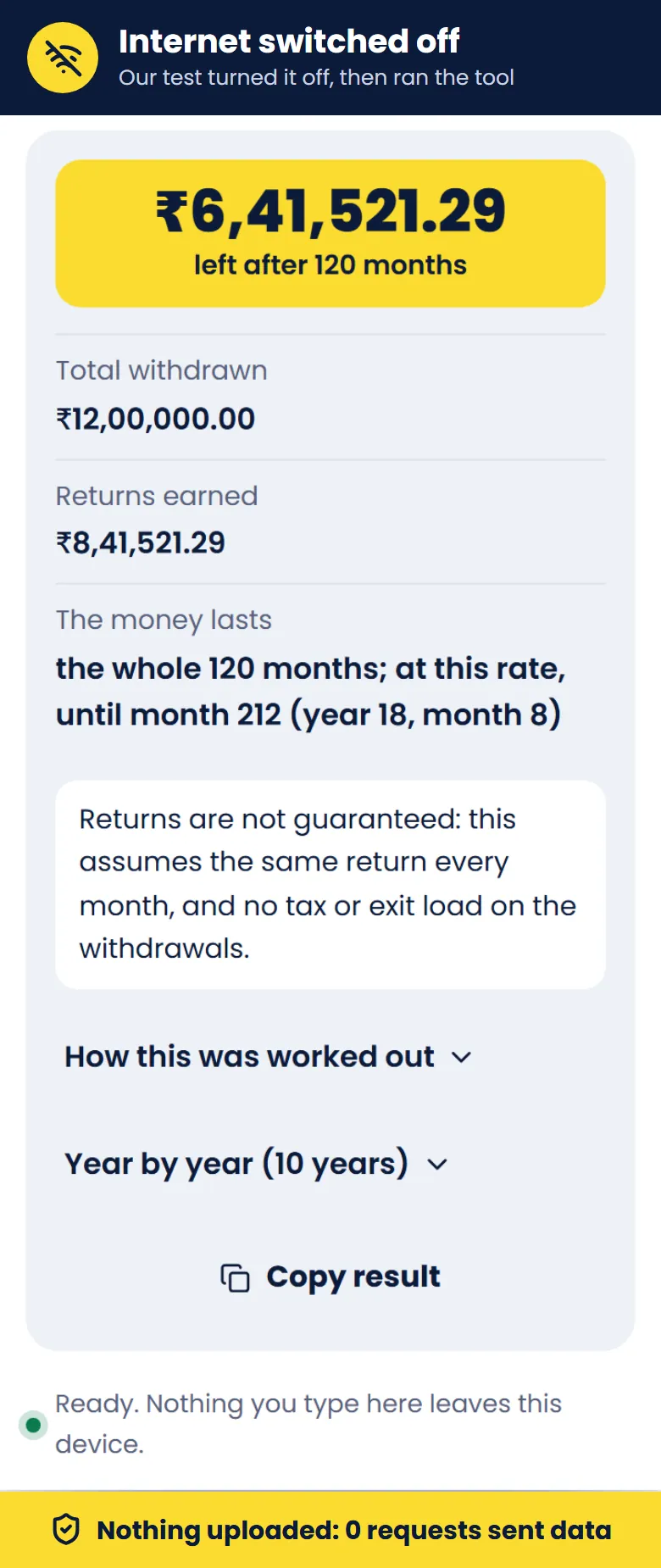
Try it yourself: press "Try an example" at the top of this page. It puts 10,00,000, 10,000, 10 and 10 in the boxes, and the money left after 120 months is ₹6,41,521.29, with ₹12,00,000.00 withdrawn and ₹8,41,521.29 earned. Then change the withdrawal to 15,000 and the return to 8: the money runs out in month 88.
The formula, by hand
Each month, the withdrawal comes out first and what is left earns a month's return: balance = (balance − W) × (1 + i), where W is the withdrawal and i the monthly rate. Repeat that for every month and it comes to one formula:
Left after n months = P × (1 + i)n − W × ((1 + i)n − 1) ÷ i × (1 + i)
The first part is what the whole amount P would grow to; the second is what the withdrawals would have grown to, the same sum a SIP calculator works out. For the example, P = ₹10,00,000, W = ₹10,000, i = 10 ÷ 12 ÷ 100 and n = 120: the first part is about ₹27,07,041.49, the second about ₹20,65,520.20, and what is left is ₹6,41,521.29, exactly as the page shows. Returns earned are what is left plus what was taken out, less what was put in: ₹6,41,521.29 + ₹12,00,000.00 − ₹10,00,000.00 = ₹8,41,521.29.
A spreadsheet gives the same with =FV(10%/12, 120, 10000, -1000000, 1): the last 1 says each withdrawal is at the start of its month.

When the money runs out
If the withdrawals are larger than the returns can carry, the balance falls a little faster every month, until one month's withdrawal can't be paid in full. That month pays all that is left, and the plan is over. The page then shows a second answer, the month the money runs out, and a note with the size of that last, smaller withdrawal.
Take ₹10,00,000 at 8% a year with ₹15,000 a month. The money lasts until month 88, year 8 and month 4: that month only ₹10,005.94 is left, and the total withdrawn comes to ₹13,15,005.94. At ₹10,000 a month and 10%, the same amount lasts the whole 10 years with ₹6,41,521.29 left, and at that rate it would last until month 212, in the eighteenth year.
With no return at all, the sum is plain division: ₹5,00,000 at ₹10,000 a month lasts exactly 50 months, and month 50 takes the last ₹10,000.
Returns that keep up
If a month's return on what is left after the withdrawal is at least the withdrawal, the balance never falls: the plan can run for ever at that rate, and the page says "the returns keep up". Take ₹10,00,000 at 8% with ₹5,000 a month: after 10 years ₹12,98,811.86 is left, more than was put in, because the first month already earns ₹6,633.33 on the ₹9,95,000 left after its withdrawal, more than the ₹5,000 taken out, and the return grows as the balance does.
A withdrawal the returns can carry keeps the amount whole for later; a larger one spends it down on purpose. Neither is right or wrong: it depends on how long the income must last and whether you want to leave the amount to someone. Try a few withdrawals to see where the line falls for your amount and your expected return.
The year-by-year table
Under the working, "Year by year" opens a table with, for each year, the amount withdrawn, the returns earned and the money left at the end. For the example, the first year withdraws ₹1,20,000.00 and earns ₹98,010.26, leaving ₹9,78,010.26; the tenth year withdraws the same and earns ₹66,115.29, leaving ₹6,41,521.29.
Each year's balance is the last one, less what was withdrawn, plus the returns, so every row adds up to the paisa. On a phone, each row shows as a small card. The returns fall a little each year when the withdrawals are larger than the returns, because there is a little less money left to earn them.
Planning with it
An SWP's income is only as steady as the return behind it. Equity funds rise and fall, so a plan that works at a steady 10% can run out sooner in years with poor returns, especially if they come early, when the most is withdrawn from a falling balance. Many people plan with a careful return, check every year, and keep a part of the money in safer investments for the next few years' withdrawals.
Prices also rise, so ₹10,000 a month buys less each year. The Inflation Calculator shows what a withdrawal will be worth in today's money. To build the amount in the first place, the SIP Calculator and the Goal SIP Calculator work out the monthly investment, and the Lumpsum Calculator what a single amount grows to.
Worked examples
All from ₹10,00,000 invested, at a steady 8% a year, over 10 years:
| Withdrawal a month | Left after 10 years | How long it lasts |
|---|---|---|
| ₹5,000 | ₹12,98,811.86 | For ever: the returns keep up |
| ₹6,000 | ₹11,14,646.18 | For ever: the returns keep up |
| ₹8,000 | ₹7,46,314.83 | Until month 265, in year 23 |
| ₹10,000 | ₹3,77,983.48 | Until month 164, in year 14 |
| ₹12,000 | ₹9,652.13 | Until month 121, in year 11 |
| ₹15,000 | ₹0.00 | Until month 88, in year 8 |
The return matters as much as the withdrawal. ₹10,000 a month from the same ₹10,00,000 over 20 years lasts until month 138 at 6% a year, month 164 at 8% and month 212 at 10%; at 12% it lasts the whole 20 years with ₹9,01,074.46 left, and at that rate until month 464. A difference of 2% in the return moves the end of the plan by years, which is why a careful return is the safer one to plan with.
Common mistakes
- Planning with the best year's return. A fund's average over many years is lower than its best year, and an SWP spends from the balance whatever the market does.
- Forgetting inflation. ₹10,000 a month is worth less each year. Plan the withdrawal you will need later, not only the one you need now.
- Ignoring tax and costs. The page takes off none, so what reaches your bank can be less than the withdrawal you type.
- Reading only the end figure. The year-by-year table shows how fast the balance falls; a plan that ends with something left after 10 years may still run out in year 14.
- Counting the withdrawals as returns. The money withdrawn is mostly your own money coming back; the returns earned are only the part above what you put in.
- Mixing yearly and monthly amounts. The withdrawal box is a month's amount; ₹1,20,000 a year is ₹10,000 a month.
Reading the answer
The large figure is the money left at the end of the time you chose. When the plan runs out sooner, a second large figure gives the month, such as "Month 88: the money runs out", and the money left is ₹0.00. Under them:
- Total withdrawn is every withdrawal added up, the smaller last one included when the money runs out.
- Returns earned is what is left plus what was withdrawn, less what you put in: the money the investment made along the way.
- The money lasts says whether the plan covers the whole time, and, if it does, how much longer it would go on at the same rate: "until month 212 (year 18, month 8)". When the returns are at least the withdrawal, it says "the returns keep up", and the plan could run for ever.
Copy result puts the plan and its outcome on one line, such as "₹10,000.00 a month from ₹10,00,000.00 at 10% a year for 120 months: ₹6,41,521.29 left, ₹12,00,000.00 withdrawn.", ready to paste into a note or a message. Change one box at a time and compare the lines to see what each change does.
Questions to ask before you start an SWP
- How long must the income last? Try the plan for that many years, and look at how long the money lasts at the same rate.
- What return can I count on? Try a careful figure as well as the one you hope for.
- Will I need more each year? Prices rise, so a plan that fits today's needs may fall short later.
- What does the fund charge, and what is taxed? Ask the fund house; the page takes neither off.
- Where does the money for the next few years sit? Many people keep it somewhere steadier than shares.
Private: your numbers stay on your device
What you type never leaves your device. The calculator runs inside your browser and has no upload step: it never sends your amounts, withdrawals, returns or years anywhere, and it doesn't save them, so closing the page forgets them. The page's Content Security Policy lets it contact only this site and Google's ad service, which pays for the site; our code never gives your numbers to the ad code. You can check it yourself in your browser's network panel (F12 on a computer): working out the answer adds no request that carries what you typed.
Read our privacy policy and how we prove your files are never uploaded.
Tips
- Plan with a careful return, lower than you hope for, and check the plan every year.
- Try the withdrawal the returns can carry: it keeps the amount whole.
- Look at the table, not only the end figure: it shows how fast the balance falls.
- Remember tax and costs: the calculator takes off neither.
- Copy the result to compare plans side by side.
Limits
- One steady return every month; real returns rise and fall.
- The same withdrawal every month; no yearly increase for inflation.
- No tax or exit load is taken off the withdrawals, and no fund units or NAV are shown.
- Withdrawals at the start of each month, the first at once; a real plan may start on a date you choose.
- Not advice. It works out the numbers; whether a plan suits you is your choice.
Terms explained
- SWP
- A systematic withdrawal plan: a fixed amount taken out of an investment at regular times.
- Corpus
- The amount of money invested, from which the withdrawals are paid.
- Return
- What the investment earns, written as a percentage a year.
- Exit load
- A charge some funds take when money is withdrawn early.
- NAV
- Net asset value: the price of one unit of a mutual fund.