What Dice Roller and Coin Flip does, and when you need it
Dice Roller and Coin Flip rolls dice with 4, 6, 8, 10, 12, 20 or 100 sides, up to 100 of them at once with their total, or tosses a coin up to 100 times and counts the heads and tails. Every result comes from your device's secure random source, in your browser, with your rolls never sent anywhere and no sign-up.
People use it when:
- A board game's dice are lost, mid-game of Ludo or Snakes and Ladders.
- Two captains need a toss before a gully cricket match, and nobody has a coin.
- A role-playing game calls for a d20, or several dice added together.
- A teacher wants a class to see probability at work with hundreds of rolls.
For numbers in any range, Random Number Generator draws them; for names, Random Name Picker.
How it works
Each die is a number from 1 to its number of sides, drawn with crypto.getRandomValues, the browser's secure random source, with every face exactly as likely as the others: the page throws away the rare random values that would favour some faces, rather than letting them tilt the odds. Each die is rolled on its own, so one die's result has no effect on another's. A coin is a die with two faces, heads and tails.
With more than one die, the page shows each result and the total; with more than one coin, how many heads and how many tails.
Real results from our tests
We ran the page's own random code (web/js/gen-core.js) in Node.js, which has the same crypto.getRandomValues as browsers, on a Windows 11 laptop on 31 October 2026.
| What we rolled | What came out | What it means |
|---|---|---|
| 600,000 rolls of a six-sided die | Each face 99,769 to 100,199 times | Within a fifth of a per cent of the 100,000 each that a fair die gives |
| The same, tested for evenness | A chi-square of 1.08 on 5 degrees of freedom | Comfortably what fair dice give |
| 1,000,000 coin tosses | 499,637 heads: 49.964% | As close to half as a million fair tosses usually come |
| 360,000 rolls of two dice | A total of 7 59,919 times | 1 in 6, as the 6 ways of making 7 out of 36 predict |
What the numbers mean: a fair die doesn't give exactly 100,000 of each face; it wobbles around that by a few hundred in 600,000 rolls, as ours did. A loaded one shows a face coming up more often every time you test it.
On a first visit the page downloads about 0.1 MB for the tool: the page, its styles, its scripts and the fonts, with Google's ad code not counted.
Step by step
- Choose Throw: Dice, or A coin.
- Choose How many, from 1 to 100.
- For dice, choose Sides on each die: 6 for a normal die, or 4, 8, 10, 12, 20 or 100.
- Press Roll. The results show in large figures, with the total for several dice, or the heads and tails for several coins. Press Roll again for the next turn.

Which dice for which game
| Die | Used for |
|---|---|
| 6 sides (d6) | Ludo, Snakes and Ladders, Monopoly and most board games; two for Monopoly |
| 4, 8, 10, 12 sides | Role-playing games such as Dungeons and Dragons, for damage and effects |
| 20 sides (d20) | The main roll in Dungeons and Dragons and similar games |
| 100 sides (d100) | Percentage rolls: 1 to 100 |
| A coin | Tosses, yes-or-no choices, who goes first |
Role-playing games write dice as 3d6, three six-sided dice added together, or 1d20, one twenty-sided die: set How many and Sides to match, and read the total.
Ludo and Snakes and Ladders
Both need one ordinary die: How many 1, Sides 6. Put the phone or laptop where every player can see it, and let each player press Roll on their own turn. The game's own rules still apply: in Ludo, a 6 usually lets a piece out and gives another turn, and many families have their own house rules. The page simply rolls a fair die; it doesn't know whose turn it is. For two players sharing one phone, a quick press each turn is faster than hunting for a lost die under the sofa.
Waiting for a six
Everyone at a Ludo board knows the feeling: three players have pieces out and one is still waiting for a six. Each roll gives a six 1 time in 6, whatever came before, so the wait is pure chance, and it can be long:
| Rolls so far | Chance of at least one six |
|---|---|
| 1 | 16.7% |
| 3 | 42.1% |
| 5 | 59.8% |
| 10 | 83.8% |
| 20 | 97.4% |
On average a six takes 6 rolls to arrive, yet about 1 player in 6 is still waiting after 10 rolls, and about 1 in 38 after 20. Nothing is wrong with the die when that happens; it is how a fair die behaves. That long wait is one reason so many families add house rules of their own, and the page leaves those to the players.
Dice games from India
Snakes and Ladders began in India as Moksha Patam, a game in which ladders stood for virtues and snakes for vices, long before it reached Britain and the rest of the world. Pachisi and its cousin Chaupar, the ancestors of Ludo, were played with cowrie shells instead of dice: the number of shells that landed with their opening upwards gave the move. A six-sided die does the same job for today's Ludo boards, and this page's die stands in when the board's own has rolled under a cupboard.
Role-playing games
- A d20 check: How many 1, Sides 20, and add your bonus to the result.
- Advantage or disadvantage: roll 2 dice of 20 sides and keep the higher or the lower.
- Damage such as 2d8: How many 2, Sides 8, and read the total.
- Ability scores, four dice keeping three: roll 4 dice of 6 sides and add the highest three.
The page shows every die, so dropping the lowest or keeping the highest is easy to do by eye.
Letting a die decide
Stuck between options? Number them and roll. Six restaurants, six chores or six films each get a face of a six-sided die; four options suit a d4, and twelve a d12. For any other number of choices, list them in Random Name Picker instead, and to split players into sides, use Random Team Generator. Agreeing beforehand to accept the roll is half the point: the die only settles it if nobody asks for best of three.
The same goes for who starts a board game: each player rolls one die and the highest goes first, and players who tie for the highest roll again between themselves until one wins.
A coin toss for cricket
A fair toss needs the call before the flip. With Throw set to A coin and How many 1:
- The visiting captain, or whoever the teams agree, calls heads or tails out loud.
- One press of Roll, with both captains watching the screen.
- The result decides it: the winner chooses to bat or bowl.
Pressing again after seeing the result is a re-toss, and both sides should agree to that first, just as with a real coin.
Two dice: totals and their chances
Two six-sided dice can land 36 ways, and the totals don't all have the same number of ways, so they aren't equally likely. 7 is the most common, 2 and 12 the rarest:
| Total | Ways out of 36 | Chance |
|---|---|---|
| 2 or 12 | 1 each | About 2.8% each |
| 3 or 11 | 2 each | About 5.6% each |
| 4 or 10 | 3 each | About 8.3% each |
| 5 or 9 | 4 each | About 11.1% each |
| 6 or 8 | 5 each | About 13.9% each |
| 7 | 6 | About 16.7% |
Our 360,000 rolls gave 7 59,919 times, against the 60,000 that 6 in 36 predicts. The page draws each die on its own, so the totals come out with exactly these chances, as real dice would.
A double, both dice showing the same face, can also happen 6 ways out of 36: 1 roll in 6. In Monopoly, three doubles in a row send a player to jail, which happens about once in 216 turns.
What total to expect
The average of one die is halfway between its lowest and highest faces: 3.5 for a six-sided die, 10.5 for a d20. Add more dice and the averages add up too, but the totals bunch closer and closer around the middle:
| Roll | Average | What to expect |
|---|---|---|
| 1 die of 6 sides | 3.5 | Every face 1 time in 6 |
| 3 dice of 6 sides | 10.5 | 10 and 11 most often, 27 ways each out of 216; 18 only 1 way |
| 2 dice of 20 sides, keep the higher | 13.8 | At least one 20 about 1 time in 10 |
| 2 dice of 20 sides, keep the lower | 7.2 | At least one 1 about 1 time in 10 |
| 4 dice of 6 sides, add the highest three | 12.2 | About 1.7 more than three dice alone |
| 100 dice of 6 sides | 350 | Between 317 and 383 about 95 times in 100 |
So a total far from the middle is a real surprise: 100 dice add up to less than 300 only about once in 660 tries. Teachers can use this the other way round, too: roll 100 dice a few times, and each total lands near 350, however different the dice themselves look.
Two famous dice questions
Probability as a subject began with dice. In 1654, a French gambler asked why two bets that seemed alike paid off differently, and the mathematicians Blaise Pascal and Pierre de Fermat worked it out in their letters:
- At least one six in four rolls of one die: the chance of no six is 5/6 four times over, about 48.2%, so at least one six comes up about 51.8% of the time. A small edge for whoever bets on the six.
- At least one double six in 24 rolls of two dice: no double six is 35/36 twenty-four times over, about 50.9%, so a double six comes only about 49.1% of the time. The edge has turned the other way.
Both are easy to try here: roll 4 dice and look for a six, many times over, and keep a tally.
Are real coins fair?
Nearly. Researchers who filmed and counted real tosses found that a flipped coin lands the same way up as it started slightly more often than not, about 51 times in 100, because of how a thumb sets it spinning. A coin that is spun on a table, rather than flipped, can lean further towards one side. A screen coin has neither problem: heads and tails are exactly even, as our million tosses showed.
Experiments in class
Probability is easier to believe once seen. Three quick experiments with a projector:
- Small and large numbers: toss 10 coins, then 100. Ten tosses often give 7 heads or 3; a hundred land much closer to 50. Write the results on the board and ask why.
- No memory: after three sixes in a row, ask the class whether a six is now less likely. Roll again many times to show it isn't.
- Totals: roll two dice 100 times, tally the totals, and compare the tally with the table above.
- Real or made up: ask half the class to toss 100 coins on screen and the other half to write down 100 tosses from imagination, then mix up the lists. Made-up lists rarely have six heads or six tails in a row; real ones have such a run about 4 times in 5, so the longest run usually gives the made-up lists away.
Many dice at once
Set How many up to 100: each die's result shows, up to 20 in large figures, with the total in a note, and the full list can be copied or downloaded as a text file. That covers games that roll fistfuls of dice, quick sums for a class, and tallies for an experiment. For coins, the note counts heads and tails.
Fair, and what fair doesn't mean
Fair means every face has the same chance on every roll, and no roll affects the next. It doesn't mean results look even in the short run: four rolls without a six, or two heads in a row, happen all the time. A six that hasn't come up for a while isn't due. Real dice can be slightly uneven from wear or poor making; a screen die can't wear, which is one reason game nights and online classes use them.
Streaks are normal too, and longer than most people guess. In 100 rolls of one die, the same face three times in a row turns up somewhere about 91 times in 100, and four in a row about 32 times in 100. In 100 coin tosses, a run of five heads or five tails is almost certain, about 97 times in 100, and a run of six happens about 4 times in 5. We worked these out exactly, rather than by rolling, so they are what any fair die or coin gives.
A worked example: the Sunday match
Two teams meet for a Sunday match in a colony ground, and the coin has gone missing. One captain opens the page on a phone, chooses A coin, and holds it so the other captain can see. The visiting captain calls tails, the home captain presses Roll once, and Tails shows in large letters. The visitors choose to bat. Nobody argues about how the coin was caught or whether it was a fair spin, because both captains watched the same screen.
Private: rolled on your device
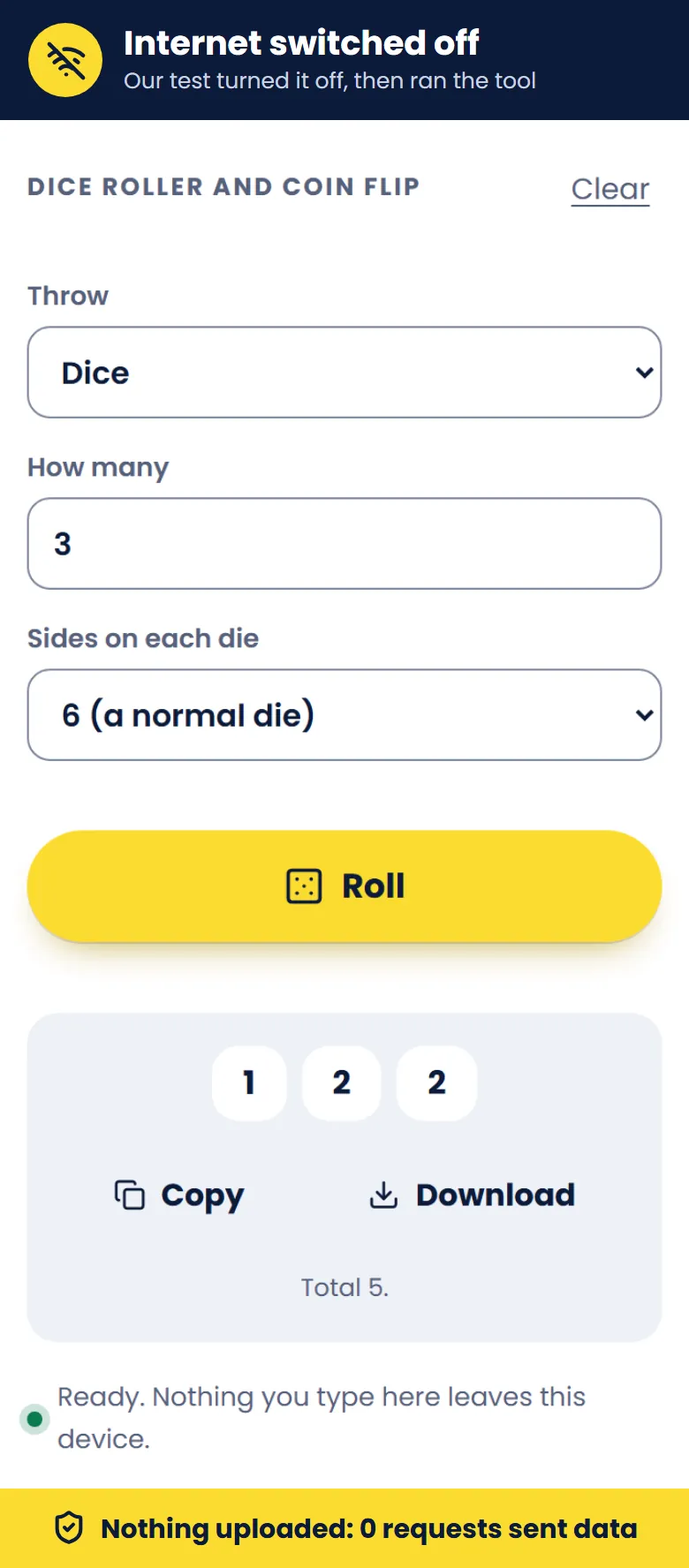
Every roll and toss happens inside your browser from your device's own secure random source; your rolls are never sent to us or kept, and once loaded the page works with the internet switched off. Google's ad code runs on the page too, but our code never gives it your results. How we prove it shows how anyone can check.
Problems and fixes
- The Sides list is gone
- Throw is set to A coin, which has no sides to choose. Set it back to Dice.
- The same number keeps coming up
- Streaks happen with fair dice: in 100 rolls, three of the same face in a row turn up about 91 times in 100. Over many rolls the counts even out, as our test shows.
- I need a die with 7 or 30 sides
- Use Random Number Generator from 1 to 7 or 30: it is the same as a die with that many sides.
Limits
- Dice of 4, 6, 8, 10, 12, 20 or 100 sides; others through Random Number Generator.
- Up to 100 dice or coins at a time.
- No game rules or turns: it rolls, and the players play.
- No record of past rolls: copy or download them if you need them.
Other ways
Search engines show a quick dice roller and coin flip for "roll a die" or "flip a coin". Real dice and coins are best when everyone is at one table. This page adds dice of every common size, up to 100 at once with their total, coin counts for experiments, and results you can copy.
Terms explained
- d6, d20
- A die with 6 or 20 sides; 3d6 means three six-sided dice added together.
- Fair die
- One whose faces are all equally likely.
- Independent
- Not affected by earlier results: the die has no memory.
- Chi-square test
- A standard test of whether counts are as even as chance allows.
- Average (expected value)
- What a roll gives on average over many rolls: 3.5 for a six-sided die, though no single roll can be 3.5.
- Streak or run
- The same result several times in a row; common with fair dice and coins.