What this page does, and when you need it
This page makes a PDF smaller until it is under 2 MB, and tells you plainly when it can't. It is our Resize PDF tool with the size already set to 2 MB, so there is nothing to choose: add your PDF and wait for the result. You get a new copy. Your original file is not changed.
You need it when a website refuses a file for being too big. Upload forms set their own limits, and 2 MB is one of them. The one we could check is Document Update on the myAadhaar portal, which asks for files of less than 2 MB (see Official limits). A phone photo of a paper, or a scan of a few pages, is often bigger than that.
It is not the same as our Compress PDF, which has three quality levels and lets the file end up at any size. Here you choose the size, and the page looks for the clearest copy that fits. For another size, or A4 pages, use Resize PDF. You can add several PDFs at once: each gets its own row, copy and Download button. A file you add usually ends in one of three ways:
- Already under 2 MB. Your file is left alone and there is nothing to download. Use your original.
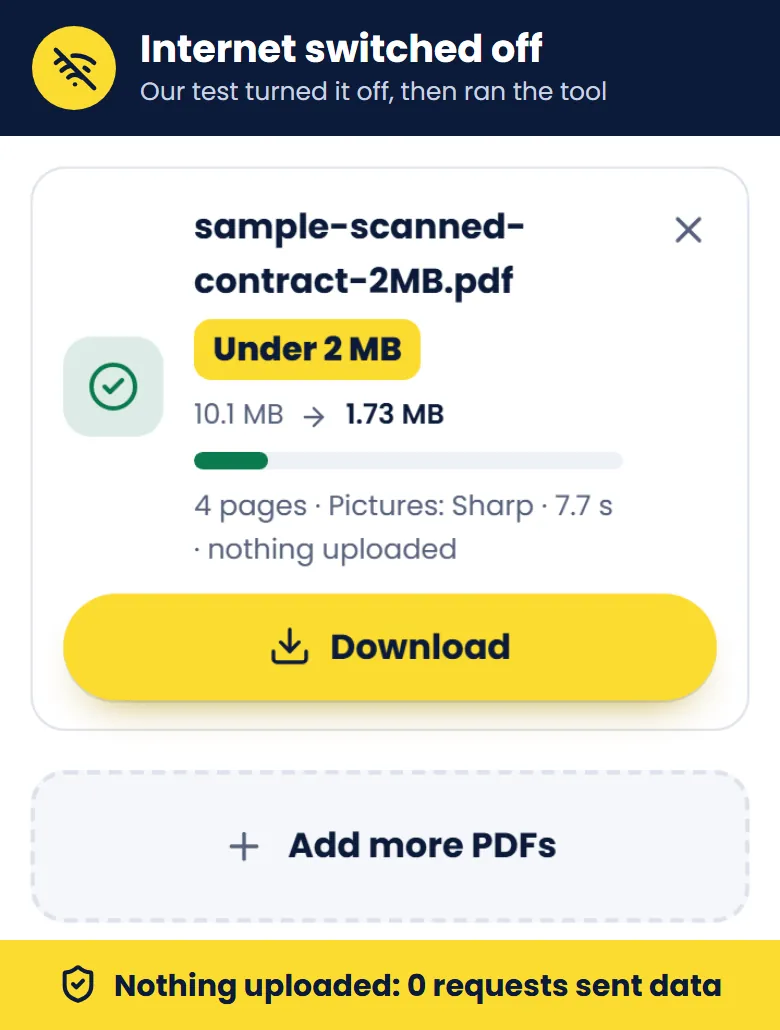
- Under 2 MB. Shown in green, with a Download button.
- Over 2 MB. The file could not get that small, and you get the smallest copy possible. It usually happens with typed PDFs, whose text and fonts can't shrink. See Long typed documents. A few other messages are in If something goes wrong.
What fits in 2 MB
Think of 2 MB as a budget that all the pages of your PDF share: 2,000 KB divided by the number of pages is the room each page gets. Every scan we tried is made of A4 pages scanned at 300 dpi (dots per inch). In the table, ppi means pixels per inch, the same idea: how many tiny dots of picture the file keeps for each inch of paper. More is sharper. The most this tool keeps is 220.
| File | Before | After | Pictures | Time |
|---|---|---|---|---|
| 1-page colour scan | 1.08 MB | Left alone | Not touched | No work |
| 2-page colour scan | 2.15 MB | 1,040 KB, under | Sharp, 220 ppi | 5.2 s |
| 4-page colour scan | 4.28 MB | 1,836 KB, under | Sharp, 208 ppi | 13.2 s |
| 6-page colour scan | 6.44 MB | 1,789 KB, under | Sharp, 168 ppi | 13.2 s |
| 4-page grayscale scan | 7.14 MB | 1,808 KB, under | Sharp, 208 ppi | 4.0 s |
| 20 different scanned pages | 21.4 MB | 1,998 KB, under | Readable, 99.8 ppi | 26.9 s |
| Phone-style photo of a letter, 1 page | 3.38 MB | 602 KB, under | Sharp, 220 ppi | 1.6 s |
Sizes in the table count 1,000 bytes to a KB, the same way the limit is counted, so 2 MB is 2,000 KB. Time runs from choosing the file to the result, in Chromium (the browser Chrome is built on) on a busy computer, so treat it as rough. Three things stand out:
- Up to six scanned pages stayed Sharp. The 2-page scan kept 220 ppi, and the 6-page scan, with room for about 330 KB a page, still kept 168.
- Files that needed squeezing landed just under the limit, between 1,789 KB and 1,998 KB. The 2-page scan and the photo fitted at the sharpest setting, so they stayed much smaller: more room would have bought nothing.
- Twenty different pages is where Readable begins. With about 100 KB a page, that set fitted at 99.8 ppi, just under the 100 where the word would change to Good.
Aadhaar document update: under 2 MB
When you update your Aadhaar details yourself on the myAadhaar portal, you upload a copy of a supporting document. On 2026-10-08 we read the upload guidelines of the myAadhaar portal. They say the document size should be less than 2 MB, and the file may be JPEG, PNG or PDF. The upload step shows only after you log in, which we did not do, so we read the guideline text built into the portal's web app. Rules change, so read the guidelines on your screen.
UIDAI, which runs Aadhaar, also publishes the Aadhaar Handbook for Residents. It says to upload a clear copy of the supporting document, and, if the document has many pages, to scan all the relevant pages and save them as a single PDF. The handbook does not mention the 2 MB limit. The portal does. So the job is: one PDF, all the pages, less than 2 MB.
- Make one file per paper. Photograph or scan each page flat, in good light, filling the frame. Several photos? Put them in one PDF with JPG to PDF, which places one picture on each page, in the order you choose. Several PDFs? Join them with Merge PDF.
- Shrink last. Bring the finished PDF under 2 MB on this page. Joining files can add their sizes together, so two files that are each just under 2 MB can make one that is far over.
- Check the result. It says Under 2 MB in green. For papers with small print, the word after Pictures should be Sharp or Good. Open the new file and look at your name, numbers and dates.
- Upload the new file, not the original.
Is your PDF already under 2 MB?
Check before you change anything. A file that is already small does not need this page, and the original is always the clearest copy. It also keeps a digital signature valid, if the PDF has one. The page checks for you: if the file is already under 2 MB, the row says so and there is no Download button. In our tests this happened to a 1-page colour scan of 1.08 MB, a 24-page typed PDF of 123.6 KB and a 120-page typed book of 540.5 KB. To see a file's size yourself:
- Android. Open the Files app, or your phone's own file manager, find the PDF and open its details or info.
- iPhone and iPad. In the Files app, press and hold the PDF and choose Get Info.
- Windows. Right-click the file, choose Properties and read the Size line.
Phones and computers count a little differently (see How 2 MB is counted). If your file shows a number near 2 MB, run it through the page: it takes seconds, and it says for certain.

Phone photos of documents
A photo taken with a phone camera is a big picture: 12 megapixels means 3000 × 4000 dots. For a test we made a photo like that of a printed letter lying on a table and placed it on one A4 page of a PDF. It is a phone-style photo made for testing, not taken on a real phone. The PDF was 3.38 MB. Under 2 MB it became 602,036 bytes (602 KB) and kept 220 ppi, the sharpest the tool makes, so the word was Sharp. It took 1.6 seconds on a computer-size screen and 1.2 seconds with the screen set to phone size. One photographed page is no trouble at 2 MB. Here is what helps with photos of papers:
- Several photos? Make one PDF first. JPG to PDF puts one picture on each page, in the order you choose, and JPG photos go in exactly as they are. Bring that PDF under 2 MB here, last.
- Fill the frame with the paper. A page photographed on a table carries the table, and the table costs bytes. In a smaller-size test we could still see the wood pattern around the paper in the result. Many phone scanner apps can crop to the page's edge.
- One photo, already under 2 MB? The portal's guidelines also list JPEG and PNG, so you may not need a PDF at all. This page works on PDFs only and does not shrink JPG pictures.
Big scans: from tens of MB to under 2 MB
Each A4 page scanned in colour at 300 dpi is a large picture, and a long set adds up to tens of MB. We tried two.
| File | Before | After | Pictures | Time | Memory |
|---|---|---|---|---|---|
| 20 different scanned pages | 21.4 MB | 1,998 KB, under | Readable, 99.8 ppi | 26.9 s | 93 MB |
| 42-page scan (four pictures repeated) | 48.3 MB | 1,835 KB, under | Sharp, 208 ppi | 95.0 s | 221 MB |
The 20-page scan is the honest test. Every page is different, as in a real set of papers. It went from 21.4 MB to just under the limit in 3 tries, about 27 seconds. It ended at 99.8 ppi, so the page said Readable, a hair under Good. The engine, the part that does the shrinking, reserved 93 MB of memory, and the browser tab peaked at 327 MB.
The 42-page scan needs a warning. Our test file holds only four different page pictures, repeated. Once shrunk, the copies are identical and the engine stores them once, so it fitted as easily as about four pages. Do not read it as "42 pages fit in 2 MB". We quote it only for time and memory, because every page still had to be read and shrunk. That took about 95 seconds in one run and 104 in another, and 144 in a later run while other programs shared the computer. The browser tab peaked at 453 to 461 MB in the first two runs.
To see what more room is worth, we put the same 20 different pages under three sizes:
| Under | Pictures | Room a page |
|---|---|---|
| 300 KB | Readable, 46.5 ppi | about 15 KB |
| 1 MB | Readable, 72.5 ppi | about 50 KB |
| 2 MB | Readable, 99.8 ppi | about 100 KB |
For a big scan, fewer pages are clearer and faster, so take out blank backs and cover sheets with Split PDF. Stay on this page until Download appears, because each try is a full pass over the file. A file of 2 GB or more is refused, with a message asking you to split it first, because the engine and its working copy of your file must fit in 4 GB of memory.

How pages look at 2 MB
The page tells you in one word how sharp the pictures stayed. The word comes from the ppi: 150 or more is Sharp, 100 or more is Good, 45 or more is Readable, and anything lower is Rough. We opened some results ourselves, page 1 next to the original at about 100% zoom on a computer screen. We did not open every 2 MB result by eye, so we can't describe those. These came from smaller limits, and show what the words mean:

| Result we looked at | What we saw |
|---|---|
| 1 page, under 50 KB, 72 ppi, Readable | The heading and every line of body text were readable, slightly soft. The colour photo kept its colours and shapes. |
| 6 pages, under 50 KB, 38 ppi, Rough | The heading was readable. Body text blurred into grey lines and could not be read. |
| 20 different pages, under 300 KB, 46.5 ppi, Readable | The blue signature was still clear. Body text was smudged and hard to read. |
| The same 20 pages, under 1 MB, 72.5 ppi, Readable | Body text was readable. |
At 2 MB every file got far more room than these. Six of the seven files that needed work kept 167.8 ppi or more, which is Sharp, and the 20-page set kept 99.8 ppi, more than the 1 MB copy whose body text was readable. So we expect 2 MB results to look closer to the original than any row above, but we can't promise it for your file. Look before you upload.
Readable covers 45 to 99 ppi: near the top a page looks close to the original, near the bottom small print struggles, so check roll numbers, dates and certificate numbers. If the row says Pictures unchanged, the pictures were left as they were, and a file without pictures shows no Pictures word at all. A script also checked every file we saved: not over the limit, the same pages and text, and opening cleanly in three PDF tools (pypdf, PDFium and qpdf).
Long typed documents
A typed PDF, made on a computer in Word or downloaded from a portal, is mostly text and fonts. Those are copied as they are, so the words stay sharp and searchable, which also means they can't shrink. Only the pictures inside it, such as a logo or a photo, are made smaller. At 2 MB this is rarely a problem, because typed pages are small. We tried two typed test files with no pictures:
| Typed PDF | Pages | Size | Result |
|---|---|---|---|
| Dense text, 2 embedded fonts | 24 | 123.6 KB | Already under, left alone |
| Tables and line drawings, 6 embedded fonts | 120 | 540.5 KB | Already under, left alone |
Typed books can be bigger. A long one with many fonts, tables and drawings may still say Over 2 MB, because only its pictures can shrink. None of our test files ended Over at 2 MB, so we have no 2 MB example to show. The guides on Resize PDF and the 100 KB page show measured typed PDFs that stopped at a smallest size. If a typed PDF says Over 2 MB, try these:
- Send only the pages the form needs. Take them out with Split PDF. Fewer pages means less text and fewer fonts.
- Turn a few pages into pictures. Save them as JPG pictures with PDF to JPG, put the JPGs back into a PDF with JPG to PDF, and shrink that PDF here. Pictures can be made smaller, but the words stop being text you can search or copy. It suits a few pages, not a long document.
How the page fits a file into 2 MB
Nobody can tell in advance how small a PDF will get, so the page tries, measures and adjusts, all inside your browser:
- First try. It makes the file with its Recommended setting and measures it.
- Find the edges. If that file fitted, it tries the gentlest setting, in case the sharpest pictures fit too, and if they do, that is your file. If the first file was too big, it tries the strongest setting. If even that is too big, you get that copy, marked Over.
- Close in. Now it has one result that fits and one that doesn't. It aims between them, guessing from their sizes where a result just under the limit should be, and repeats until one lands within 15% under 2 MB.
- Keep the best. It makes six tries at most, and you get the sharpest result that fits.
In our 2 MB tests it needed 2 or 3 tries: 2 for the 2-page scan and the photo, which came out at 220 ppi, and 3 for the others. The bar shows the try it is on. Only pictures are made smaller, by keeping fewer dots per inch, and copies of the same picture are stored once. Text, fonts and drawings are copied as they are. Before the Download button appears, the new file is checked.
How 2 MB is counted
There are two ways to count. In one, 1 KB is 1,000 bytes and 2 MB is 2,000,000 bytes. In the other, 1 KB is 1,024 bytes and 2 MB is 2,097,152 bytes. Websites use either. This page uses the stricter one: "under 2 MB" means at most 2,000,000 bytes. Such a file fits within 2 MB whichever way a website counts, so there is no need to aim for 1.5 MB to be safe. The largest result in our tests was 1,997,913 bytes, which is below both 2,000,000 and 2,097,152.
The sizes the page shows after a file are counted in 1,024-byte units, like most file apps. That 1,997,913-byte file shows as 1.91 MB on the page, and a 1,040,118-byte one as 1016 KB. Your phone or computer may show yet another number for the same file. Tables in this guide count in thousands, like the limit.
The page also lands close to the limit on purpose, within 15% under it. The four files in our main table that had to be squeezed came out between 1,789,277 and 1,997,913 bytes. A file already as sharp as the tool makes can stay far smaller, like our 602,036-byte photo.
Which forms ask for 2 MB, and where we checked
Limits change with every notice, so read the current one on the form itself. These are the ones we could check on 2026-10-08:
| Where | What it says | Link | Last checked |
|---|---|---|---|
| myAadhaar portal, Document Update, upload step | Guidelines for uploading documents: size less than 2 MB, formats JPEG, PNG and PDF. We read this in the portal's own page text. The step itself shows after login, which we did not do. | myaadhaar.uidai.gov.in | 2026-10-08 |
| Aadhaar Handbook for Residents, page 18 | Self-service update: upload a clear copy of the supporting document as PDF, PNG or JPEG, and save a many-page document as a single PDF. It states no size limit. The cover says March 2021. | UIDAI handbook (PDF) | 2026-10-08 |
| GST registration, rent or lease agreement | Third-party blog pages say about 2 MB. We did not verify this on an official page, so please do not rely on it. | No official link | Not verified |
Other portals and exam forms also set limits, and we list only what we verified. If your form says 2 MB, follow your form. Read its line closely: the type of file (a photo slot wants a JPG, a document slot a PDF), whether it says KB or MB, and whether one limit is shared by all your files.
On a phone
Yes, it works on phone screens. We tested in Chromium with the screen set to 390 × 844 pixels and touch turned on. That is a computer pretending to be a phone. We did not test real phones, Safari or Firefox, so we can't promise how fast it is or how much memory it needs there. At that size, the phone-style photo of 3.38 MB came out at 602 KB in about 1.2 seconds, and the browser tab used at most 223 MB. Some tips:
- Tap Choose PDF files and pick the PDF from your files or Downloads. The new copy saves like any other download.
- Stay on the page until Download appears. A long scan took a minute or more on our computer, and a phone may be slower.
If something goes wrong
- It says Over 2 MB. Usually the PDF is typed, so its text and fonts could not shrink. See Long typed documents.
- "This PDF can't get any smaller, so keep your original file." A new copy would not have been smaller than the one you added. Use your original.
- "This PDF is locked with a password." Remove the password first with Unlock PDF, which needs the password, then bring the unlocked copy under 2 MB.
- "This file can't be read as a PDF." It may be damaged, or may not be a PDF at all. If it does not open in your phone's or computer's PDF viewer either, scan or save it again.
- "This file needs more memory than your browser allows." Close other tabs, or use a computer with more memory.
- "This file had editing restrictions." The PDF had limits on editing. The new copy opens without them. Keep your original if the limits matter.
- The pages look soft. Start again from your first scan, because a copy shrunk earlier has already lost detail. Fewer pages means a sharper result.
- The portal still says the file is too big. Check that you picked the new file, whose name ends in -2MB.pdf, not the original. Then read the portal's message, which may be about something else, such as the type of file.
- "This tool couldn't start in this browser." Update your browser or try another one.
Your papers stay private
An Aadhaar proof, a PAN card or a bank page is about the most private paper you have. Many online PDF tools send your file to their own computers to work on it. This one doesn't. The tool has no upload step and never sends your files anywhere: a program running inside your browser, on your phone or computer, does the work, and the new file is saved straight back to your device. The only upload is the one you make yourself, to the portal.
The page also has a Content Security Policy, a rule the website gives your browser that limits which other sites the page may contact. There is no account, no sign-up and no watermark. If you like, you can open your browser's network panel while a file is being made and see that no file is sent. Our privacy policy has the details.
You can also test it: once this page has loaded, switch off Wi-Fi and mobile data, then make your copy. It should still work, because the work needs no network. An earlier offline check of this page's compressor engine worked with the network off; we did not repeat it for this page.
Other ways to get under 2 MB
This page is one way. Here are others, in general terms:
- Scan again at a lower setting, if your scanner or scanner app has one. Fewer dots means a smaller file, but you choose by guessing.
- Send fewer pages. Split PDF takes out only the pages you need.
- Use a program on your computer. Many PDF programs, and the Preview app on a Mac, can save a smaller copy. They usually ask you to pick a quality setting and check the size afterwards, while this page keeps trying until the size fits.
- Use an online PDF website. Many send your file to their own servers. For Aadhaar papers we would keep the file on your device.
- Pick another size here. If the form allows more, there are pages for 1 MB, 500 KB, 300 KB, 200 KB, 100 KB and 50 KB. With no limit at all, our PDF compressor lets you choose a quality level.
Limits
- Typed PDFs have a smallest size set by their text and fonts, so a long typed book can still end Over 2 MB.
- Many different scanned pages share one budget: 20 pages fitted, but only as Readable.
- Big scans take time and memory: our 48.3 MB test took between 95 and 144 seconds.
- PDFs that need a password to open can't be compressed as they are. Use Unlock PDF first.
- A digital signature in the PDF stops being valid when the file changes, and the row warns you. A signature scanned as part of the page is just a picture and stays.
- This page only makes PDFs smaller. It doesn't resize JPG photos, and it can't make a file bigger if a form sets a minimum size.
- We can't promise that a portal accepts the file. Rules change, so read the form's current notice. We tested in Chromium only, with phone screen sizes.